
Technical Growth Architect & Search Strategist
The Multi-Agent Workforce: Building Autonomous Agentic Workflows for SEO and GEO
An architectural blueprint for deploying autonomous multi-agent systems for technical SEO and GEO. Unify Claude Code, Codex, and Google Antigravity via MCP.
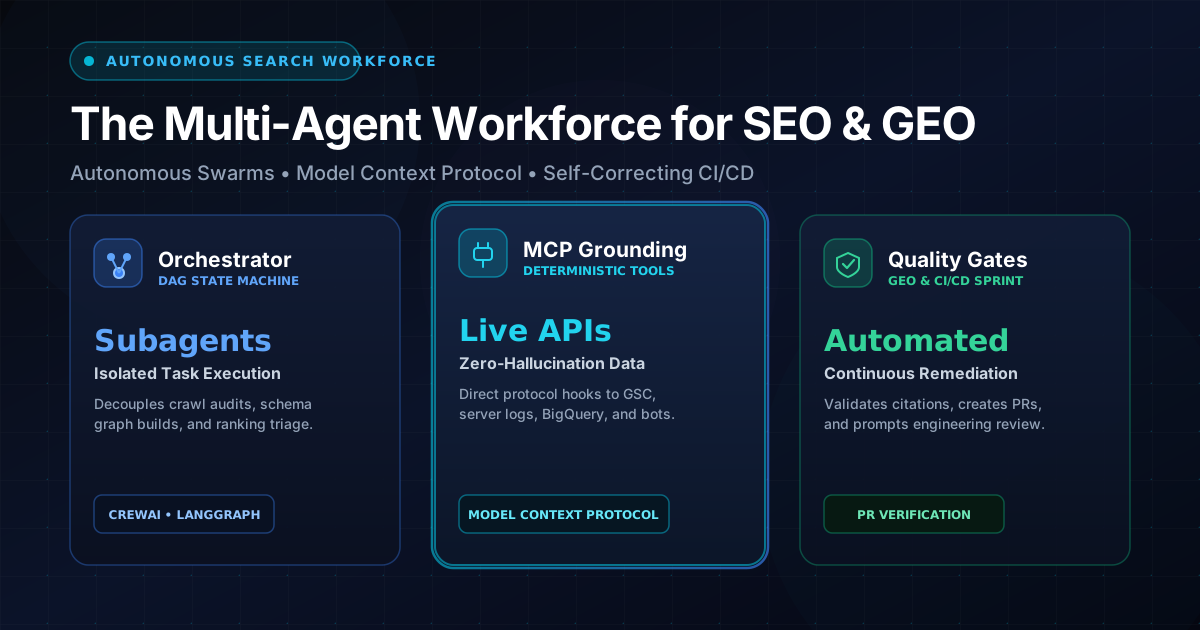
Table of Contents• Quick Navigation
10 Sections
Table of Contents• Quick Navigation
When enterprise search operations scale past tens of thousands of pages, manual workflows collapse under computational complexity.
Traditional search engine optimization has historically relied on human specialists manually auditing spreadsheets, compiling keyword lists, and filing static tickets that languish in engineering backlogs for quarters.
In the era of modern search engine algorithms and generative answer engines, this fragmented approach is obsolete. The emergence of Google AI Overviews, Perplexity AI, and ChatGPT Search has permanently altered how information is indexed, retrieved, and synthesized.
Having spent years operating at the intersection of conversion engineering and search architecture, including architecting the organic growth engine at FigPii, I have seen the same pattern repeat across enterprise stacks:
Search performance is not an episodic marketing campaign. It is an engineering discipline.
Treating SEO as a series of disconnected spreadsheet audits or isolated prompt experiments produces fragile gains that evaporate the moment search algorithms update or code ships to production.
To achieve sustainable organic growth and dominate generative answer engines, I built an autonomous multi-agent architecture unifying Claude Code, Codex, and Google Antigravity. By grounding autonomous agents in live search telemetry via the Model Context Protocol (MCP), I transformed reactive SEO tasks into an autonomous, 24/7 technical workforce.
This architectural blueprint details how to design, build, and deploy an enterprise multi-agent workforce for technical SEO and Generative Engine Optimization (GEO).
The Failure of Single-Prompt AI in Enterprise Search Operations
Single-prompt artificial intelligence fails in enterprise search operations for a simple engineering reason: standalone language models lack deterministic state, real-time telemetry, and feedback loops.
When an enterprise growth team prompts a standalone LLM like ChatGPT to execute a technical audit or generate organic content, the model operates in an architectural vacuum. Without direct integration into production infrastructure, it lacks three essential capabilities:
- Deterministic State Management: No persistent memory of crawl topologies, canonical hierarchies, or dependency graphs across multi-step tasks.
- Real-Time Ground Truth Telemetry: No connection to live HTTP response codes, Search Console APIs, or rendered DOM HTML payloads.
- Iterative Feedback Loops: No self-correcting validation gate to test code or schema changes against staging environments before execution.
Because traditional AI platforms operate as stateless probability engines, a monolithic prompt forces the model to solve dozens of cognitive tasks in a single pass.
In one unverified attempt, it must interpret intent, analyze competitors, select keywords, structure headings, draft prose, and format schema markup.
This architectural coupling causes four structural failure modes:
- Context Window Contamination: Monolithic prompts mix disparate instructions, leading to prompt drift where the model forgets core technical constraints set in the initial system message.
- Hallucinated Ground Truth: Isolated LLMs have no direct connection to any live data source. When prompted to analyze search trends or evaluate canonical integrity, traditional AI invents search volumes, fabricates backlink metrics, and assumes crawl accessibility without checking server status codes.
- Homogenized Output and AI Slop: Without granular data sources and iterative entity verification, single-prompt models default to generic linguistic patterns. While unvetted AI content floods the index with redundant noise, these low-information-density articles fail Google Helpful Content assessments and collapse in AI search visibility.
- Zero Production Integration: A block of text generated in a web interface provides zero utility for engineering teams. It does not inspect staging builds, cannot interact with GitHub pull requests, and fails to diagnose edge routing latency.
The core lesson from these failure modes is clear: you cannot automate enterprise search by treating an LLM as an all-knowing oracle in a browser tab.
When engineering high-scale data and content infrastructure, such as the digital analytics systems I developed for e-cens, the operational bottleneck was never text generation. It was always ground-truth verification against live servers.
If an automated workflow cannot inspect HTTP status codes, query Search Console telemetry, validate DOM hydration, and open pull requests, it is not an enterprise workflow; it is an interactive demo.
The Anatomy of a Multi-Agent SEO and GEO Architecture
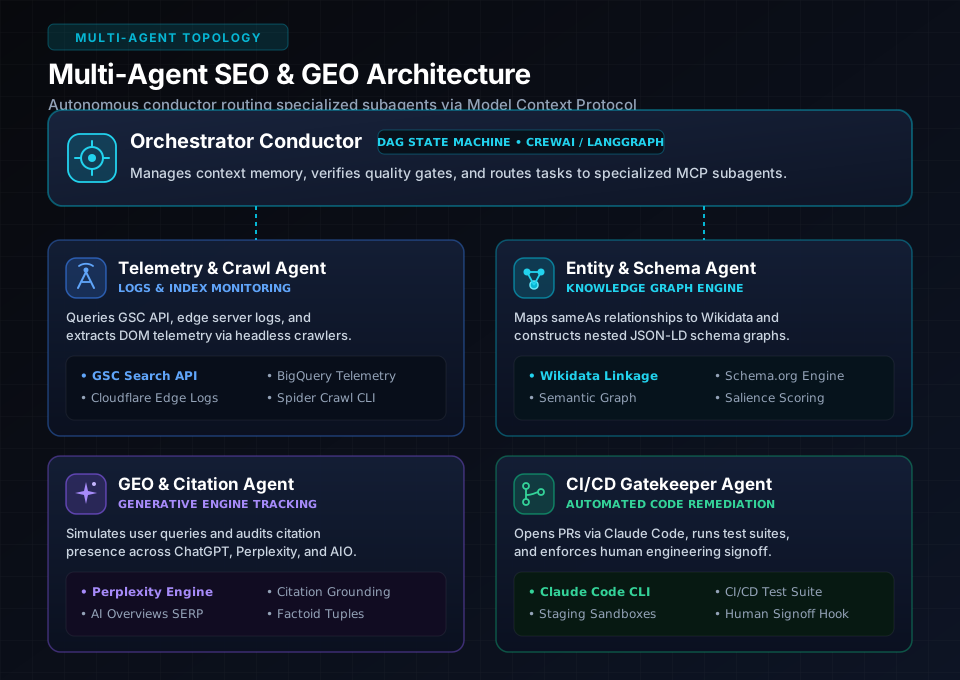
A production-grade multi-agent SEO and GEO architecture operates as a directed acyclic graph (DAG) of specialized autonomous agents coordinated by a primary conductor.
Instead of burdening a single model with end-to-end execution, the system delegates discovery, crawling, content optimization, schema validation, and citation tracking to distinct subagents equipped with isolated toolchains.
This decoupled topology guarantees three operational outcomes:
- Deterministic Output: Every subagent executes within a strictly validated JSON schema.
- Enforced Quality Gates: Code or content cannot advance without automated verification.
- Context Protection: Zero hallucinated recommendations reach production repositories or sitemaps.
In my multi-agent system architecture, aligned with Anthropic’s research on Building Effective Agents, I unify Claude Code, Codex, and Google Antigravity into a coordinated workforce. Understanding how these agents operate in production requires examining each specialized role within the agentic SEO workflow:
- Conductor Agent (Orchestrator): Manages the global state machine using CrewAI, delegating tasks across the dependency graph and enforcing execution timeouts.
- Telemetry Agent: Queries the Google Search Console API and CDN server access logs to identify crawl budget starvation, 4xx/5xx spikes, and rendering drift.
- Entity Agent: Reconciles topic entities against Wikidata to construct schema.org graphs that maximize semantic salience.
- GEO Agent: Simulates answer generation across Perplexity AI, ChatGPT Search, and Google AI Overviews to monitor brand citation frequency.
- Gatekeeper Agent: Employs Claude Code to submit verified code fixes directly as GitHub pull requests with automated regression test suites.
If it were me building this multi-agent workforce from scratch today, I would enforce one core architectural rule:
Never start by writing prompts for an LLM. Start by defining the deterministic schemas of your tools.
When I architect these swarms for production, I enforce total task isolation. An agent either reasons over telemetry or it handles code remediation; never both in a single session. Coupling those tasks causes context drift every single time.
Below is the asynchronous conductor pattern I personally run to route tasks across specialized subagents:
import asyncio
from typing import Dict, Any, List
from pydantic import BaseModel

class AgentTask(BaseModel):
    task_id: str
    assigned_agent: str
    payload: Dict[str, Any]

class MultiAgentSEOConductor:
    def __init__(self, mcp_client_hub):
        self.mcp_hub = mcp_client_hub

    async def execute_seo_pipeline(self, domain: str, urls: List[str]) -> Dict[str, Any]:
        telemetry = await self.dispatch("telemetry_agent", {"domain": domain, "urls": urls})
        if telemetry.get("has_blockers"):
            return {"status": "HALTED", "reason": "P0 Crawl Errors"}

        entity_res, geo_res = await asyncio.gather(
            self.dispatch("entity_agent", {"telemetry": telemetry}),
            self.dispatch("geo_agent", {"domain": domain, "queries": telemetry.get("queries")})
        )

        pr = await self.dispatch("gatekeeper_agent", {
            "telemetry": telemetry, "entities": entity_res, "geo": geo_res
        })
        return {"status": "SUCCESS", "pull_request": pr.get("url")}

    async def dispatch(self, agent_name: str, payload: Dict[str, Any]) -> Dict[str, Any]:
        handler = self.mcp_hub.get_agent_handler(agent_name)
        return await handler.run(payload)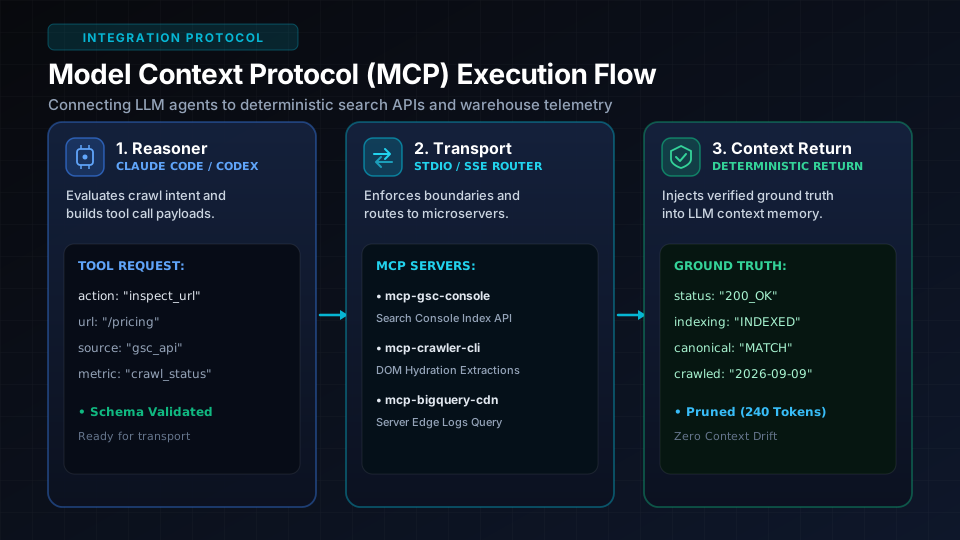
Tool Grounding and the Model Context Protocol (MCP) in Search Automation
The Model Context Protocol (MCP) establishes an open, client-server standard connecting autonomous AI agents directly to live search infrastructure and deterministic data sources.
By exposing tools through MCP servers, an SEO agent transitions from probabilistic guesswork to deterministic execution. Instead of hallucinating metrics, agents can:
- Query Search Console APIs: Retrieve verified indexing states, click-through rates, and query impressions.
- Inspect Server Access Logs: Audit raw CDN or BigQuery logs to detect Googlebot crawl budget waste.
- Execute Headless Browser Audits: Inspect client-side DOM rendering, hydration parity, and Core Web Vitals.
- Perform Database & Code Mutations: Update structured schema data or submit Git pull requests without human intervention.
Before MCP emerged as an open standard, connecting LLMs to external systems required brittle custom integrations, proprietary plugins, and hardcoded credentials. Engineers had to manually export CSVs, copy-paste numbers into prompt contexts, or build custom API wrappers prone to serialization errors.
The Model Context Protocol solves this architectural hurdle by establishing a universal, JSON-RPC transport layer between AI models and underlying infrastructure, developed as an open standard on the MCP GitHub Organization.
In an agentic SEO workflow, each specialized subagent acts as an MCP client, while search tools, crawlers, and data warehouses operate as MCP servers:
- Discovery and Introspection: At initialization, every agent introspects the MCP server to discover available tools, argument schemas, and security boundaries.
- Context Isolation: Telemetry data returned from an MCP server is structured and filtered before injection into the LLM context window, preventing token bloat.
- Execution Safety: Tools exposed via MCP enforce strict permission controls. A crawler MCP server allows read-only DOM extraction, while a GitHub MCP server enforces branch protection rules requiring human sign-off.
Here is how I personally handle MCP grounding in production:
Enforce a hard token ceiling on every single tool response.
The single most common failure mode I see engineering teams make when adopting MCP is dumping raw 50KB JSON payloads from APIs straight into an agent’s context window. That instantly pollutes working memory and burns token budgets on irrelevant metadata.
If it were me configuring your MCP transport layer, I would place a lightweight JSON schema filter on the server side. Strip the API return down to a clean, 200-token ground truth tuple before the model ever reads it.
The following JSON schema defines an enterprise MCP tool connecting an agent directly to the Google Search Console URL Inspection API:
{
  "name": "gsc_inspect_url",
  "description": "Deterministic tool that queries Google Search Console to verify indexation and canonical integrity.",
  "parameters": {
    "type": "object",
    "properties": {
      "site_url": { "type": "string", "description": "GSC property URI" },
      "inspection_url": { "type": "string", "description": "Absolute URL to inspect" }
    },
    "required": ["site_url", "inspection_url"]
  }
}
Architectural Comparison: Traditional Automation vs. Single-Prompt LLMs vs. Multi-Agent Systems
Evaluating search automation across traditional scripts, single-prompt LLMs, and multi-agent systems reveals stark differences in operational autonomy, fault tolerance, and contextual depth.
While traditional automation relies on brittle if-else logic and single prompts produce superficial hallucinations, an autonomous agentic workforce combines dynamic reasoning with deterministic tool execution.
This enables enterprise teams to automate multi-stage workflows with verifiable accuracy, automated error recovery, and continuous self-correction.
To clarify these architectural trade-offs for engineering leaders, the following matrix compares the three paradigms across operational dimensions:
| Architectural Capability | Traditional Script Automation (Python/Cron) | Single-Prompt LLMs (ChatGPT / Claude UI) | Multi-Agent Autonomous Workforce (Conductor + MCP) |
|---|---|---|---|
| Execution Model | Deterministic, rigid if-else logic; fails on unhandled edge cases | Monolithic, probabilistic single-pass generation | Directed Acyclic Graph (DAG) of specialized autonomous subagents |
| Ground Truth Telemetry | High accuracy via direct API, but zero reasoning or dynamic adaptation | Zero live grounding; high rate of hallucinated metrics and URLs | 100% grounded via Model Context Protocol (MCP) servers and live APIs |
| Context & State Management | Static database variables; no cognitive memory | Ephemeral, easily confused context window prone to prompt drift | Isolated subagent memory pools coordinated by a persistent Conductor |
| Fault Tolerance & Self-Healing | Halts execution upon encountering unhandled exceptions | Cannot self-evaluate; outputs plausible-sounding falsehoods | Continuous quality gates; agents iteratively critique and repair code |
| GEO & AI Citation Readiness | Incapable of evaluating semantic meaning or LLM answer synthesis | Superficial keyword stuffing; lacks knowledge graph entity mapping | Simulates RAG extraction across Perplexity AI, ChatGPT, and AI Overviews |
| Engineering Integration | Isolated scripts generating CSV exports for human review | Copy-pasting text from browser windows into content management systems | Direct Git automation; creates branches, runs test suites, submits PRs |
| Operational Scalability | High throughput for basic math, zero cognitive adaptability | Low throughput; requires continuous manual prompting and editing | Elastic parallel execution across thousands of enterprise URLs |
| Unit Economics | Fractions of a cent per run; zero cognitive synthesis | Inefficient; high token waste re-prompting failed outputs | Optimized via hierarchical model routing and prompt caching ($0.04/URL) |
Step-by-Step Blueprint: Building Your First Multi-Agent SEO Workforce
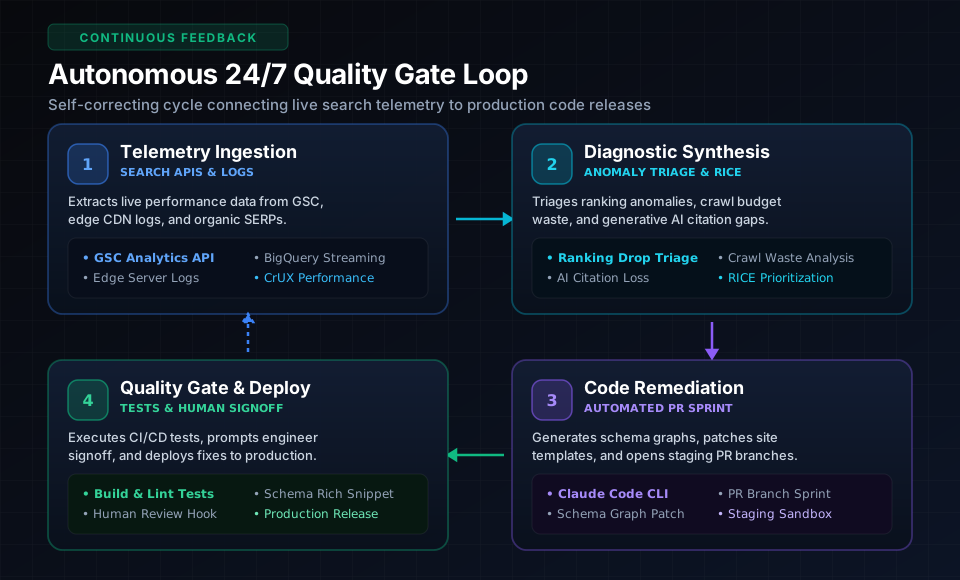
Building an enterprise multi-agent SEO workforce requires deploying a four-stage execution pipeline:
- Telemetry Ingestion: Continuous monitoring of live search telemetry and server access logs.
- Diagnostic Synthesis: Real-time anomaly triage, ranking decay analysis, and entity gap identification.
- Autonomous Remediation: Content optimization, internal link graph updates, and schema synthesis.
- Pull Request Automation: Staging validation, CI/CD linting, and GitHub pull request creation.
By binding individual agents to standardized Model Context Protocol servers and enforcing human-in-the-loop gates, teams automate continuous auditing without risking code integrity or crawl efficiency.
In my client work, the single biggest operational mistake is attempting to automate all four stages at once. If it were me rolling this out for an enterprise brand, this is my non-negotiable rule:
Spend the first two weeks exclusively on Stage 1 and Stage 2.
Run your Telemetry and Diagnostic agents in a read-only loop until you trust their signal 100%.
Only when their anomaly detection matches what your top technical SEO lead would find manually should you enable Stage 3 and Stage 4 to touch Git branches and submit pull requests.
Stage 1: Telemetry Ingestion and Crawl Log Monitoring
The workflow polls search infrastructure on automated cron schedules:
- Search Console Sync: The Telemetry Agent calls the GSC MCP server to pull indexing status, CTR regressions, and keyword impression trends.
- Access Log Ingestion: In parallel, it queries BigQuery server logs via Google Search Console bulk data exports to track Googlebot crawl concurrency, flagging non-canonical parameters that waste crawl budget.
Stage 2: Diagnostic Synthesis and Entity Gap Analysis
The Conductor dispatches the Diagnostic and Entity Agents for root-cause triage:
- Crawl Starvation Triage: The Diagnostic Agent isolates URLs suffering ranking decay caused by crawl bottlenecks or rendering failures.
- Entity Deficit Mapping: The Entity Agent scrapes top-ranking competitor pages, extracts core entity tuples, and compares them against Wikidata graphs to surface semantic gaps.
Stage 3: Autonomous Content Optimization and Schema Synthesis
Armed with verified entity deficits, the Content Optimization Agent drafts targeted fixes:
- Semantic Structure: Injects missing semantic entities directly into subheadings and definition blocks.
- Internal Link Topology: Dynamically recalibrates internal links between relevant topical cluster pages.
- Structured Schema Graph: Rebuilds nested JSON-LD schema graphs connecting
Organizationand Schema.org TechArticle entities with explicit Wikidata authority pointers (sameAs).
Stage 4: Pull Request Automation and Staging Verification
The Gatekeeper Agent defines strict remediation payload schemas using Pydantic and applies modifications to isolated Git feature branches:
- Automated Linting: Runs schema validation suites and executes Astro build tests to ensure zero hydration errors.
- Pull Request Dispatch: Submits an automated GitHub Pull Request complete with telemetry justifications and automated test logs:
import httpx
from pydantic import BaseModel

class SEORemediationPayload(BaseModel):
    url: str
    target_keyword: str
    missing_entities: list[str]

async def submit_seo_pull_request(payload: SEORemediationPayload, github_token: str, repo: str) -> str:
    branch = f"seo-patch/{payload.target_keyword.replace(' ', '-').lower()}"
    body = f"""
### Autonomous SEO Remediation: {payload.target_keyword}
- Target URL: {payload.url}
- Injected Entities: {', '.join(payload.missing_entities)}
- Automated Quality Gate: Schema Validated & Staging Build Passed
"""
    headers = {"Authorization": f"Bearer {github_token}", "Accept": "application/vnd.github.v3+json"}
    async with httpx.AsyncClient() as client:
        res = await client.post(
            f"https://api.github.com/repos/{repo}/pulls",
            headers=headers,
            json={"title": f"[SEO] Optimize {payload.target_keyword}", "head": branch, "base": "main", "body": body}
        )
        res.raise_for_status()
        return res.json().get("html_url")
Bridging Traditional Technical SEO and Generative Engine Optimization (GEO)
Bridging traditional technical SEO and Generative Engine Optimization (GEO) requires aligning crawler-accessible DOM architecture with semantic entity structures consumed by LLMs.
Traditional search engines rank URLs based on link equity, keyword targeting, and crawl efficiency. Generative engines like Perplexity AI, ChatGPT Search, and Google AI Overviews extract factual data tuples directly from authoritative entity nodes, as demonstrated in seminal research on Generative Engine Optimization (GEO).
An agentic SEO workflow optimizes simultaneously for both layers:
- Traditional SEO: Governs how search engine spiders discover, render, and index your digital footprint.
- Generative Engine Optimization (GEO): Governs how large language models parse, synthesize, and cite your factual authority when generating answers.
Traditional Crawl & Index Layer (Googlebot, Bingbot)
  ↳ Edge Caching, Server Log Telemetry, SSR DOM Hydration Parity
      ↳ Semantic Entity & Knowledge Graph Layer (Wikidata, Schema.org @graph)
          ↳ Generative Engine Optimization (ChatGPT Search, Perplexity AI, Google AI Overviews)
To optimize across both surfaces, I direct my multi-agent system to enforce three semantic standards:
- Direct Answer Formulation: Structure subheadings so that the opening 60 to 90 words directly answer the core technical query before expanding into contextual nuance.
- Factual Data Tuples: Present statistics, technical parameters, and benchmarks in clear markdown tables and bulleted lists that embedding models parse without semantic degradation.
- Nested Schema Graphs: Link corporate entities directly to verified Wikidata nodes using
sameAsarrays, anchoring domain credibility in authoritative knowledge bases.
If it were me auditing an enterprise brand for GEO readiness today, I would look beyond traditional keyword rankings entirely:
A high rank in Google organic search only confirms indexation. It does not tell you if Perplexity AI or ChatGPT considers your entity authoritative enough to cite in an answer.
My personal playbook for GEO auditing follows a 3-step test:
- Extract Core Queries: Pull the top 20 factual questions prospective customers ask during evaluation.
- Simulate RAG Extraction: Run automated multi-model prompts across Perplexity, Claude, and ChatGPT Search.
- Audit Citation Graphs: Verify whether your domain is cited as the primary factual authority, or if competitors own the citation layer.
If your brand is absent from that citation graph, you are effectively invisible to the next generation of search users.
If you are developing strategic roadmaps across these intersecting disciplines, inspect my dedicated service frameworks:
- For comprehensive AI answer-engine citation modeling and AI brand visibility, explore my Generative Engine Optimization (GEO) architecture.
- For high-scale platforms and catalog architectures facing crawl waste, faceted navigation traps, and hydration bottlenecks, inspect my Technical SEO consulting.
- For editorial systems that convert search visitors into qualified sales pipeline, explore my Content Engine.
- To discover how multi-agent automation integrates directly into editorial and publishing workflows, examine The 9-Stage Publishing Engine.
Engineering Economics: Token Budgets, Compute Costs, and ROI
The unit economics of multi-agent SEO systems depend on hierarchical model routing, prompt caching, and aggressive context pruning.
Deploying frontier reasoning models for low-complexity data parsing inflates token consumption without improving search outcomes. By routing routine data extraction to fast, lightweight models and reserving high-parameter models for synthesis and code review, I maintain enterprise operational compute costs below:
$0.04 per fully optimized URL
Operating an enterprise multi-agent workforce requires strict cost accounting. To prevent token budget exhaustion across millions of URLs, I enforce a three-tiered hierarchical model routing architecture:
[ Tier 1: Lightweight Classifiers & Regex Parsers ]
  ↳ Task: Log filtering, status code checks, schema validation
  ↳ Models: Claude 3.5 Haiku / GPT-4o-mini
  ↳ Cost: ~$0.0005 per URL

[ Tier 2: Mid-Tier Analytical & Extraction Agents ]
  ↳ Task: Entity recognition, GSC trend correlation, content drafting
  ↳ Models: Claude 3.5 Sonnet / GPT-4o
  ↳ Cost: ~$0.015 per URL

[ Tier 3: Frontier Reasoning & Code Gatekeepers ]
  ↳ Task: Architecture design, complex diff generation, PR review
  ↳ Models: Claude 3.5 Sonnet (extended thinking) / Claude Code
  ↳ Cost: ~$0.025 per URL
By combining hierarchical routing with Anthropic prompt caching and deterministic HTML pruning, compute costs remain negligible compared to agency retainers.
Automating updates across 10,000 URLs requires less than $400 in model API compute, completing in 48 hours what typically demands months of manual consultant labor.
If it were me presenting the business case for multi-agent SEO to a CFO or VP of Engineering, I would keep the comparison straightforward:
Compare token cost per remediated URL against traditional agency retainers.
When an enterprise pays an agency $15,000 a month to crawl pages and deliver static slide decks that languish in shared drives, that is pure operational drag.
My agentic system executes the audit, patches the schema, verifies the build, and opens the GitHub PR for $0.04 per URL in direct compute.
The 2026 Shift: From SEO Specialists to Multi-Agent Conductors
The role of the search professional in 2026 has transitioned permanently from manual spreadsheet manipulation to systems engineering and multi-agent orchestration.
SEO practitioners who spend hours manually mapping keywords or copy-pasting meta tags are being replaced by multi-agent conductors. These operators design prompt topologies, configure MCP toolchains, and enforce deterministic quality controls.
Orchestrating autonomous agents allows growth architects to direct search strategies across thousands of templates simultaneously, shifting organizational focus from repetitive labor to algorithmic governance.
The modern search landscape has outpaced manual human bandwidth:
- Search engines deploy daily machine learning updates.
- Generative answer engines dynamically synthesize search results in real time.
- Optimizing enterprise pages one by one in a spreadsheet is an exercise in futility.
The convergence of SEO and AI means the most effective search engineers today operate like software leads:
- From Manual Auditing to Pipeline Engineering: Practitioners build continuous observability pipelines that alert engineering teams to indexing regressions before rankings drop.
- From Keyword Lists to Entity Graph Modeling: Practitioners architect corporate knowledge graphs, map relationships to Wikidata, and optimize for AI entity salience.
- From Writing Meta Descriptions to Designing Agent Prompts: Practitioners craft system prompts, specify JSON schemas, and establish strict validation rules for autonomous content and code generation agents.
- From Agency Middlemen to CI/CD Gatekeepers: Growth architects work directly inside repository environments, reviewing automated pull requests and ensuring technical governance standards are maintained.
To succeed in this paradigm, organizations must stop viewing SEO as an isolated marketing tactic.
Deploying AI agents transforms search into a distributed systems engineering discipline. Those who build autonomous agentic architectures will capture compounding search authority, while those clinging to manual checklists will be rendered invisible by algorithmic evolution.
Transform your search operations into an autonomous multi-agent workforce.
Whether you need to automate large-scale technical SEO audits, deploy real-time telemetry pipelines via Model Context Protocol, or establish definitive citation dominance across Perplexity AI and ChatGPT Search, I design and deploy custom multi-agent architectures directly into your codebase.
Frequently Asked Questions: Multi-Agent SEO and GEO Systems
Understanding how multi-agent architectures transform enterprise search operations requires clarifying key technical distinctions.
The answers below address critical architectural questions regarding Model Context Protocol implementation, production deployment safety, AI citation tracking, and token economics for engineering leads.
What is the fundamental difference between traditional AI tools and an agentic SEO workflow?
Traditional AI tools rely on single-prompt, static generation where a human user prompts a model to write text or draft code without external verification.
In contrast, an agentic SEO workflow uses autonomous AI agents operating in coordinated loops with external tools via the Model Context Protocol (MCP). The agents query live Google Search Console APIs, audit server access logs in BigQuery, extract rendered DOM states, and iteratively critique and test their own output before submitting production pull requests.
This transforms probabilistic guesswork into deterministic, software-engineered search operations.
How does the Model Context Protocol (MCP) prevent AI agents from hallucinating SEO data?
The Model Context Protocol (MCP) enforces tool grounding by connecting AI agents to live, deterministic data sources through standardized client-server interfaces.
Rather than guessing whether a URL is indexed or predicting search traffic patterns, an agent invokes an MCP tool (such as querying Google Search Console or executing a headless crawl) that returns factual JSON telemetry. The agent reasoning loop is strictly bounded by this ground truth, eliminating hallucinated metrics and ensuring accurate optimization decisions.
Can autonomous AI agents safely deploy code and schema changes to production websites?
Autonomous agents should never push unverified changes directly to production main branches.
A resilient multi-agent architecture uses automated CI/CD quality gates where agents operate on isolated Git feature branches. The Gatekeeper Agent runs automated schema syntax validators, executes build tests, and verifies staging parity before opening a Pull Request.
A human engineering or search lead reviews the automated diff and approves the merge, guaranteeing that production code remains defect-free while eliminating 90% of manual preparation labor.
How do multi-agent systems optimize for AI Overviews and Generative Engine Optimization (GEO)?
Multi-agent systems optimize for GEO by analyzing how large language models parse, synthesize, and cite factual content during retrieval-augmented generation (RAG) queries.
The Entity Agent extracts core topic clusters and builds nested JSON-LD schema graphs linked to Wikidata. Simultaneously, the GEO Agent simulates queries across Perplexity AI, ChatGPT Search, and Google AI Overviews to monitor brand citation frequency, identify factual coverage gaps, and optimize content for direct answer synthesis.
What infrastructure and token budget is required to operate a multi-agent SEO workforce?
Operating a production multi-agent workforce requires an orchestration layer (such as CrewAI, LangGraph, or custom asynchronous Python routines), an MCP client hub, and API access to frontier LLM providers.
By enforcing hierarchical model routing (using lightweight models for data extraction and reserving frontier reasoning models for strategic synthesis and code review), enterprise platforms maintain operational compute costs under $0.04 per processed URL, delivering 10x to 50x cost efficiencies over traditional manual consulting agencies.
Conclusion: Deploying Autonomous Search Operations
Deploying an autonomous multi-agent search workforce is the definitive path for enterprises seeking resilient organic growth across traditional search and generative AI answer engines.
Moving beyond brittle scripts and manual consulting checklists requires three engineering pillars:
- Software-Driven Observability: Continuous ingestion of search telemetry and server access logs.
- Deterministic Tool Grounding: Direct infrastructure integration via the Model Context Protocol (MCP).
- Rigorous CI/CD Verification: Automated linting, build checks, and human-in-the-loop pull requests.
The transition from manual search tasks to autonomous multi-agent systems represents an architectural milestone in enterprise growth. By decoupling discovery, auditing, content optimization, and code delivery into specialized subagents, technical leaders eliminate operational bottlenecks and protect their digital assets from sudden algorithmic disruption.
Sustainable search dominance in 2026 requires treating search engine crawlers and generative answer engines as first-class infrastructure consumers. Integrating automated quality gates directly into deployment pipelines guarantees that every published URL satisfies strict indexation and entity salience standards before hitting production.
Whether scaling dynamic catalog templates, diagnosing edge crawl bottlenecks, or commanding AI citation visibility across ChatGPT and Perplexity, building an autonomous agentic workforce turns organic search into a continuous, compounding software advantage.

Eliminate structural crawl debt. Secure permanent search & AI visibility.
Whether managing multi-million-URL dynamic catalogs, migrating to a headless stack, or establishing citation dominance inside ChatGPT and Perplexity, I diagnose and unblock high-stakes technical bottlenecks directly with your engineering and growth leaders.
Direct practitioner engagement. Zero junior agency handoffs. You leave with prioritized engineering fixes.