
Technical Growth Architect & Search Strategist
Enterprise AI Crawler Governance: The Technical SEO Guide
Master AI crawler governance: configure robots.txt, protect origin compute, prevent GEO erasure, and audit your server logs with verified CIDR tools.
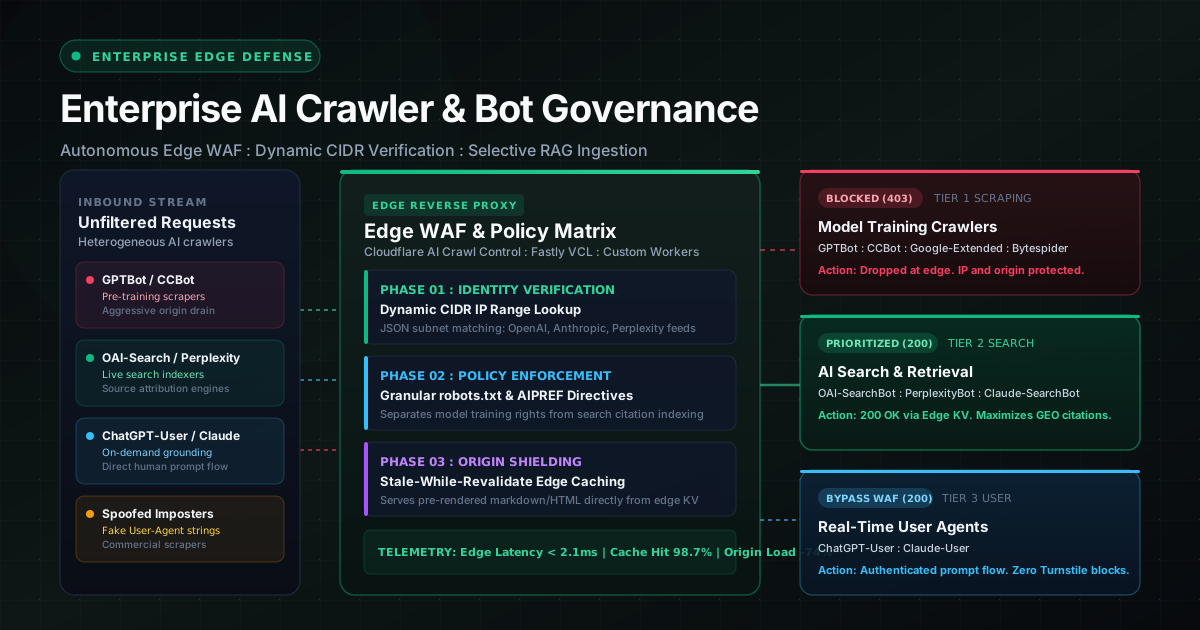
Table of Contents• Quick Navigation
6 Sections
Table of Contents• Quick Navigation
At 3:14 AM on a Tuesday, an unannounced crawl wave hit an enterprise directory client I was advising.
The monitoring dashboard flashed red. Origin CPU utilization spiked from 18% to 99%, PostgreSQL connection pools exhausted their max limits, and the edge CDN cache-hit ratio collapsed under 34%.
When I pulled the raw Nginx access logs, the culprit was not a distributed denial-of-service attack or an aggressive competitor. It was Bytespider and CCBot, running hundreds of concurrent threads across unindexed faceted filter combinations, extracting gigabytes of raw product metadata to feed model training pipelines.
For thirty years, webmasters and search engineers lived by a clean, unspoken contract: search engines crawled origin servers, consumed host bandwidth, and repaid publishers with qualified organic search impressions and referral clicks.
That contract is now broken.
Today, enterprise platforms face three distinct, competing classes of automated traffic: foundation model training spiders that harvest content for zero commercial return, generative search retrieval crawlers that feed real-time citations across ChatGPT Search and Perplexity, and user-triggered autonomous browser agents executing workflows on behalf of human users.
Treating all AI traffic as a monolithic block with a blunt Disallow: / in robots.txt or a blanket Cloudflare firewall rule is architectural suicide. Indiscriminate blocking triggers invisible GEO erasure, wiping your brand from generative answer engines while your competitors capture high-intent citations. Conversely, leaving your origin unshielded exposes your infrastructure to severe compute degradation.
This guide delivers the enterprise engineering blueprint for governing AI crawlers: configuring bulletproof robots.txt policies, enforcing multi-layer edge controls, auditing server logs, and maintaining visibility in the era of generative search.
User-agent: __usage_ai-training token to express a standardized training opt-out without maintaining dozens of vendor tokens.
The Broken Contract: Why Traditional Crawl Management Fails in 2026
Traditional crawl management operated under a predictable covenant: search engines consumed origin server resources, and webmasters received qualified organic traffic in return. In the agentic search era, this economic balance has completely broken down. Modern automated traffic is split between high-velocity foundation model training spiders that extract proprietary content for zero commercial return, and generative search crawlers that drive high-intent citations inside platforms like ChatGPT Search and Perplexity. Applying blunt robots.txt disallows or blanket firewall toggles either exposes origin databases to crushing compute spikes or triggers catastrophic invisible GEO erasure. When an enterprise platform blocks automated traffic indiscriminately, it vanishes from generative retrieval pipelines while competitors capture authoritative citations. Modern enterprise crawl governance requires a multi-layered infrastructure approach that isolates training scrapers, preserves search retrieval indexing, and accommodates user-triggered autonomous browser agents at the edge before requests consume costly origin compute.
When I audit crawl telemetry on high-scale client catalogs, the numbers tell an alarming story. In one recent audit for an enterprise directory, non-search automated spiders accounted for 48% of total HTTP requests and 62% of origin bandwidth consumption. Spiders like Bytespider, CCBot, and unauthorized scraping fleets hit dynamic faceted parameters, bypassing CDN cache layers and forcing the origin database to execute costly relational joins over and over again.
Yet the solution is never as simple as turning on an aggressive firewall block or writing a blanket disallow. The modern search landscape is split between two distinct forms of machine consumption:
- Extraction without Reciprocity: Large language model developers train frontier models on hundreds of millions of web pages. Once digested into billions of neural weights, your original content provides zero backlink equity, zero referral clicks, and zero attribution.
- Retrieval with Reciprocity: Generative search engines use Retrieval-Augmented Generation (RAG) to fulfill user queries in real time. Platforms like ChatGPT Search, Perplexity, and Google AI Overviews crawl your canonical content, extract passage-level answers, and display direct citation cards that direct qualified users to your product or domain.
If you treat both categories identically, you lose on both fronts. If you leave your infrastructure wide open, your engineering budget subsidizes model pre-training. If you lock down your site with blunt disallow rules, your brand experiences invisible GEO erasure. Your domain disappears from the exact answer engines modern decision-makers use to evaluate enterprise software, services, and products.
Sustainable crawl governance is an engineering discipline that balances infrastructure stability against generative discoverability.
The 3-Tier Taxonomy: Training Spiders, Search Bots, and Autonomous Agents
Governing automated visitors requires segmenting traffic into three distinct operational tiers based on technical intent and commercial reciprocity. Tier 1 comprises Foundation Model Training Crawlers such as GPTBot, ClaudeBot, and CCBot, which scrape bulk text for LLM pre-training, generate severe origin server loads, and provide zero referral attribution. Tier 2 consists of AI Search and Retrieval Crawlers, including OAI-SearchBot, Claude-SearchBot, and PerplexityBot, which index real-time web content to power citation cards inside generative search interfaces. Tier 3 encompasses User-Triggered Real-Time Fetchers like ChatGPT-User and autonomous browser agents executing workflows on behalf of active users. Treating these distinct tiers identically in server configuration produces catastrophic operational failures. Blocking Tier 2 causes immediate disappearance from conversational discovery, while permitting Tier 1 unthrottled drains database connections on faceted filters. Infrastructure architects must align access policies with the precise commercial role and technical behavior of each crawler family.
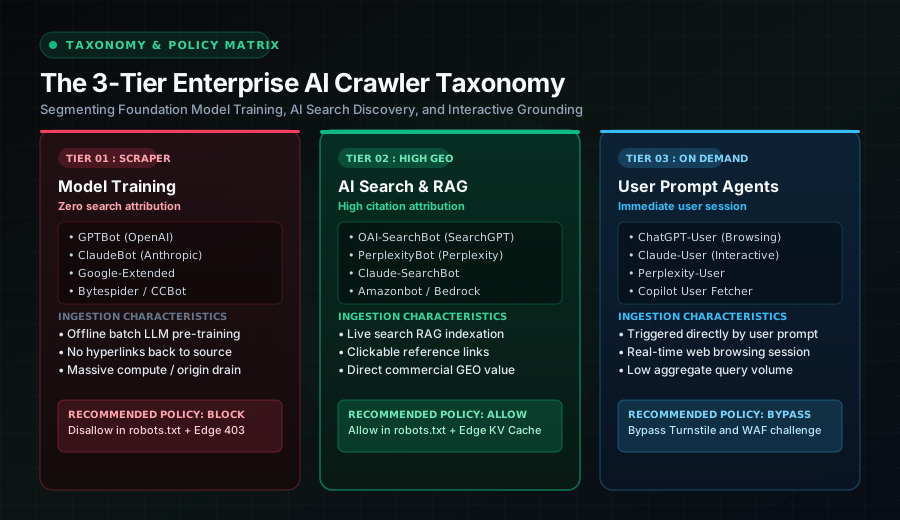
To build a resilient governance strategy, you must classify every automated visitor into one of three operational tiers.
Tier 1: Foundation Model Training Crawlers
Tier 1 crawlers are batch-scraping spiders operated by AI research labs. Their sole objective is to ingest massive quantities of raw text, code, and structured data to train the next generation of base foundation models.
- Primary Actors:
GPTBot(OpenAI),ClaudeBot(Anthropic),Google-Extended(Google/Gemini),Applebot-Extended(Apple Intelligence),CCBot(Common Crawl),Meta-ExternalAgent(Meta Llama), andBytespider(ByteDance). - Infrastructure Impact: Extremely aggressive. In high-scale catalogs, Tier 1 spiders crawl deep into paginated archives and filter combinations. They ignore caching conventions, trigger slow database queries, and drive up origin egress costs.
- Commercial Return: Zero. Content digested by Tier 1 bots is embedded into model parameters. It provides no backlinks, no click-through opportunities, and no referral attribution.
- Architectural Verdict: Block across proprietary assets, private databases, and monetized content. Unless an organization has negotiated a direct commercial licensing deal with an AI lab, allowing Tier 1 crawlers burns infrastructure capital without business return.
Tier 2: AI Search and Retrieval (RAG) Crawlers
Tier 2 crawlers are low-latency, real-time search indexing spiders. They operate identically to traditional search spiders, refreshing live indexes and vector databases that power generative search engines.
- Primary Actors:
OAI-SearchBot(OpenAI ChatGPT Search),Claude-SearchBot(Anthropic Claude Search),PerplexityBot(Perplexity AI),Bingbot(Microsoft Copilot / Bing), andGooglebot(Google Search and AI Overviews). - Infrastructure Impact: Moderate and predictable. These crawlers generally respect HTTP cache headers,
If-Modified-Sincevalidation, and sitemap XML lastmod declarations. - Commercial Return: High. These crawlers power Generative Engine Optimization (GEO). When a user asks ChatGPT Search or Perplexity for a software comparison, product recommendation, or technical analysis, Tier 2 bots fetch the data that generates the inline citation card.
- Architectural Verdict: Allow across all canonical, indexable content. Blocking Tier 2 crawlers produces immediate invisible GEO erasure, handing citations and brand authority directly to competitors.
Tier 3: User-Triggered Real-Time Fetchers and Autonomous Agents
Tier 3 crawlers are synchronous proxies. They fire on demand when an active human user prompts an AI interface to inspect, summarize, or interact with a specific web page.
- Primary Actors:
ChatGPT-User(OpenAI),Claude-User(Anthropic), andPerplexity-User(Perplexity), alongside headless browser automation agents (Playwright, Puppeteer, Browser-Use, MultiOn). - Infrastructure Impact: Low aggregate volume, but characterized by bursty concurrency spikes that frequently trip WAF rate-limiting heuristics.
- The Crucial Distinction: Tier 3 bots do not build indexes; they act as a direct proxy for a live human customer. When an engineer, prospect, or client pastes your URL into ChatGPT or Claude and asks for an evaluation, blocking Tier 3 bots returns an immediate error: “I cannot access this website because the site owner has blocked automated access.”
- Architectural Verdict: Allow across public marketing, blog, and documentation routes. Restrict them only on authenticated application areas, checkout funnels, and internal API routes.
| Bot Token | Operator | Primary Role | Bot Tier | Recommended Action | Verification Method | Last Verified |
|---|---|---|---|---|---|---|
| Googlebot | Search Indexing & AI Overviews | Tier 2 | ALLOW | FCrDNS (*.googlebot.com) |
October 2026 | |
| Bingbot | Microsoft | Bing Search & Copilot Citations | Tier 2 | ALLOW | FCrDNS (*.search.msn.com) |
October 2026 |
| OAI-SearchBot | OpenAI | ChatGPT Search RAG Indexation | Tier 2 | ALLOW | JSON CIDR (openai.com/searchbot.json) |
October 2026 |
| Claude-SearchBot | Anthropic | Claude Search RAG Indexation | Tier 2 | ALLOW | JSON CIDR (claude.com/crawling/bots.json) |
October 2026 |
| PerplexityBot | Perplexity | Generative Search Indexation | Tier 2 | ALLOW | JSON CIDR (perplexity.ai/perplexitybot.json) |
October 2026 |
| ChatGPT-User | OpenAI | User-Triggered On-Demand Fetch | Tier 3 | ALLOW (Public URLs) | JSON CIDR (openai.com/chatgpt-user.json) |
October 2026 |
| Claude-User | Anthropic | User-Triggered On-Demand Fetch | Tier 3 | ALLOW (Public URLs) | JSON CIDR (claude.com/crawling/bots.json) |
October 2026 |
| Perplexity-User | Perplexity | User-Triggered On-Demand Fetch | Tier 3 | ALLOW (Public URLs) | JSON CIDR (perplexity.ai/perplexity-user.json) |
October 2026 |
| GPTBot | OpenAI | LLM Foundation Model Training | Tier 1 | BLOCK (Proprietary Data) | JSON CIDR (openai.com/gptbot.json) |
October 2026 |
| ClaudeBot | Anthropic | LLM Foundation Model Training | Tier 1 | BLOCK (Proprietary Data) | JSON CIDR (claude.com/crawling/bots.json) |
October 2026 |
| Google-Extended | Gemini Model Training & APIs | Tier 1 | BLOCK (Optional Policy) | Virtual token (Evaluated by Googlebot) | October 2026 | |
| Applebot-Extended | Apple | Apple Intelligence Model Training | Tier 1 | BLOCK (Optional Policy) | FCrDNS (*.applebot.apple.com) / JSON |
October 2026 |
| Meta-ExternalAgent | Meta | Llama Model Training & Scrapes | Tier 1 | BLOCK | ASN / IP Blocks (Meta IP list) | October 2026 |
| CCBot | Common Crawl | Public Scraping Corpus | Tier 1 | BLOCK | ASN / rDNS (*.commoncrawl.org) |
October 2026 |
| Bytespider | ByteDance | Model Training & Aggregation | Tier 1 | BLOCK & WAF DROP | Aggressive IP filtering / ASN 138699 | October 2026 |
| Protocol Layer | Tier 1 (Training Spiders) | Tier 2 (AI Search Crawlers) | Tier 3 (User-Action Agents) | Rogue Scrapers | Last Verified |
|---|---|---|---|---|---|
| Respects robots.txt? | Yes (Ethical providers) | Yes | Variable (May claim proxy status) | No | October 2026 |
| Reverse DNS Available? | Apple only; Others use JSON | Google/Bing only; Others use JSON | Almost never (Cloud egress IPs) | Spoofed hostnames | October 2026 |
| Triggers WAF Rate Limits? | Extremely High (Spike crawls) | Moderate (Polite crawl rates) | High (Bursty concurrent requests) | Critical (High concurrency) | October 2026 |
| Yields Referral Traffic? | Zero | High (Direct inline links) | High (Individual user engagement) | Zero | October 2026 |
| Best Mitigation Point | Edge WAF 403 / robots.txt | robots.txt path permissions | WAF Bot Management rate-limit | WAF Fingerprint / IP Drop | October 2026 |
Protocol Realities: The Limits of RFC 9309 and the Emerging IETF Standard
The Robots Exclusion Protocol standardized under IETF RFC 9309 operates strictly as an advisory access signal rather than an authenticated security perimeter. While compliant corporate crawlers voluntarily respect robots.txt directives, rogue scrapers and aggressive data aggregators deliberately ignore them. Furthermore, RFC 9309 was engineered exclusively to regulate URL crawling permissions over HTTP, making it fundamentally incapable of expressing intellectual property licensing or post-crawl model training restrictions. To bridge this architectural gap, the IETF AI Preferences working group introduced the standardized __usage_ai-training token. This emerging specification establishes an interoperable, vendor-neutral mechanism inside robots.txt that enables web publishers to express a universal opt-out for foundation model training while keeping their content fully discoverable for search engine retrieval. Major technology providers have committed to honoring this directive, decoupling network retrieval from copyright permissions without requiring brittle, ever-expanding lists of proprietary bot tokens.
When developers first confront AI scraping, their default reaction is to append dozens of disallow lines to robots.txt. However, relying on robots.txt as an access control list reveals critical protocol limitations.
1. Advisory Signal vs. Access Enforcement
Under IETF RFC 9309, robots.txt is purely an advisory protocol. Ethical search engines and AI research laboratories choose to read and obey the file. Unethical scrapers, shadow data brokers, and black-hat aggregators completely ignore it.
In fact, placing sensitive URLs, administrative endpoints, or staging environments inside a Disallow: block broadcasts the existence of your private infrastructure to every malicious actor who fetches the file.
2. The Crawl vs. Index vs. Train Conundrum
RFC 9309 defines rules for fetching URLs over HTTP. It does not possess a native syntax for governing what happens to data after it has been fetched.
Historically, this limitation forced website owners into an unmaintainable maintenance race. Every time a new AI laboratory launched a crawler, site owners had to discover its user-agent token and append new directives to their robots.txt file:
# The old, brittle approach to crawler management:
User-agent: GPTBot
Disallow: /
User-agent: ClaudeBot
Disallow: /
User-agent: CCBot
Disallow: /
User-agent: Bytespider
Disallow: /
User-agent: Diffbot
Disallow: /
This vendor-by-vendor patching is fragile, prone to syntax errors, and constantly outdated.
3. The IETF AIPREF Standard: Unified Training Opt-Out
To resolve this fragmentation, the Internet Engineering Task Force established the IETF AI Preferences (AIPREF) Working Group.
Drawing from emerging drafts, AIPREF introduces a universal, cross-vendor directive: __usage_ai-training.
# The modern IETF AIPREF standard directive:
User-agent: __usage_ai-training
Disallow: /
This simple block decouples HTTP retrieval (crawling for search indexing) from data utilization (training AI models). When modern training pipelines ingest web archives, their data sanitization scripts check for the __usage_ai-training token. If present, the associated URLs are purged from the training corpus.
Meanwhile, traditional web crawlers that do not recognize the token simply skip the block under standard RFC 9309 fallback rules.
Edge-Layer Defense: Enforcing Bot Governance at Cloudflare, Fastly, and AWS
Permitting unvetted automated crawlers to hit origin application servers before rejecting them wastes valuable compute cycles, memory pools, and database connections. Enterprise bot governance must be enforced at the edge CDN layer using tools like Cloudflare AI Crawl Control, Fastly VCL edge dictionaries, or AWS WAF managed rules. By classifying incoming requests at the DNS and edge proxy boundary, infrastructure teams can drop aggressive model training scrapers with immediate HTTP 403 Forbidden responses before a single packet touches origin compute. This architecture simultaneously guarantees that verified AI search crawlers receive fast, cache-optimized responses, and prevents user-triggered autonomous agents from tripping blunt IP-wide rate limits. Furthermore, isolating edge policies prevents common engineering blunders like blocking Googlebot while attempting to restrict Google-Extended, which silently destroys organic search rankings and Google AI Overview citations across the entire domain.
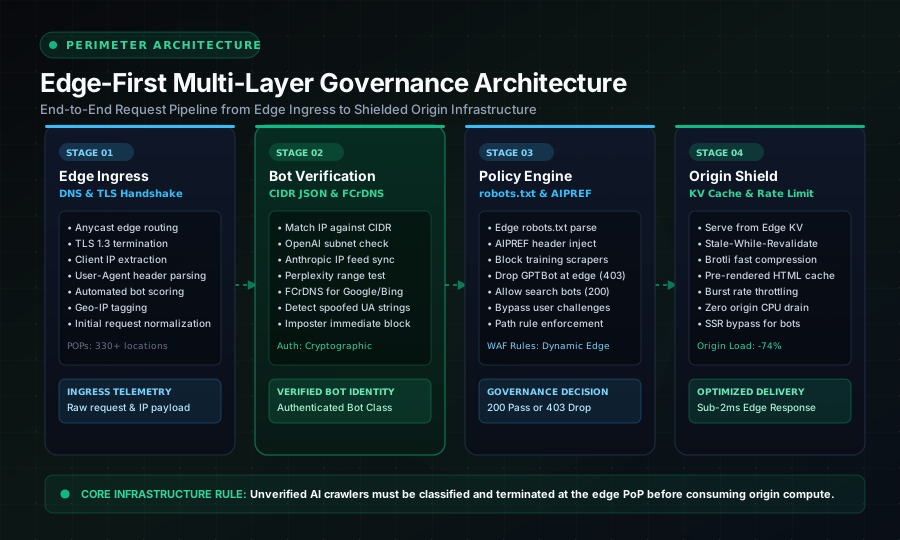
If you rely solely on application code or web server rewrites to block scrapers, you have already lost the infrastructure battle. By the time Nginx or Apache evaluates a request, your server has completed TLS negotiation, allocated memory, and opened a worker process. When an aggressive spider sends 250 requests per second, your origin crumbles regardless of whether your code returns HTTP 200 or HTTP 403.
True enterprise governance stops unwanted bots at the edge CDN.
Cloudflare AI Crawl Control
Cloudflare provides native bot classification through its AI Crawl Control tools. As documented in the Cloudflare AI Crawl Control documentation, incoming requests are categorized into distinct operational buckets:
- AI Search: Crawlers feeding conversational retrieval interfaces (e.g., OAI-SearchBot, PerplexityBot).
- AI Training: Crawlers harvesting data for foundation model training (e.g., GPTBot, ClaudeBot, Bytespider).
- AI Agent: Headless user-driven automation agents.
Rather than toggling a blunt site-wide switch, infrastructure teams can enforce targeted edge policies:
- Set AI Search to
Allow, ensuring full indexation and citation generation. - Set AI Training to
Block (403 Forbidden), dropping connections at Cloudflare’s nearest edge point of presence with zero origin server egress. - Set AI Agent to
Managed ChallengeorRate Limit, allowing human-driven tools while preventing headless scraping loops.
When an unauthorized crawler is dropped at the CDN edge, your origin servers incur zero CPU cycles, zero database queries, and zero bandwidth costs.
The Googlebot vs. Google-Extended Trap
One of the most dangerous mistakes I encounter during technical audits involves the relationship between Googlebot and Google-Extended.
As detailed in the Google Search Central Google-Extended Documentation, Google-Extended is not a standalone web crawler. There is no HTTP user-agent header that announces itself as Google-Extended, and there are no unique IP addresses associated with it.
Googlebot performs the crawl. Google’s downstream indexing systems then read your robots.txt file to determine if you have declared a policy for Google-Extended.
- What
User-agent: Google-Extended Disallow: /does: It instructs Google not to use your content to train Gemini base models or Vertex AI APIs. - What it does NOT do: It does not remove your content from Google Search, and it does not disqualify your content from appearing as a cited source in Google AI Overviews. Google AI Overviews pull directly from the standard Google Search index.
If an engineering team panics and blocks Googlebot under the false assumption that they are stopping AI training, they instantly de-index their website from both standard search results and AI Overviews simultaneously.
Is your infrastructure leaking crawl budget to unindexed faceted routes or rogue scrapers?
In my work scaling platforms like FigPii (+200% growth) and e-cens (4.3M+ impressions),
I routinely find millions of wasted server hits hidden in access logs.
Explore my Technical SEO Services (/services/seo) or review how I architect systems in the Execution Engine (/engine).
The Production Blueprint: Copy-Paste Configuration and Log Telemetry
Deploying resilient AI crawler governance requires combining a hardened, standards-compliant robots.txt manifest with automated server log verification tooling. Because major AI providers like OpenAI and Anthropic do not maintain reverse DNS hostname records, relying on traditional PTR lookups will produce constant false negatives and erroneously block legitimate search traffic. Instead, production systems must validate incoming client IP addresses against official, cryptographically signed JSON CIDR subnets published directly by each AI organization. Combining these automated CIDR matching routines with structured Nginx access log parsing scripts enables engineering teams to distinguish genuine search indexation traffic from spoofed User-Agent attacks and aggressive scrapers in real time. This dual-verification discipline provides the technical observability required to protect origin server stability, minimize egress bandwidth expenses, and verify that legitimate search retrieval spiders retain rapid, unhindered access to high-value commercial assets across all deployment environments.
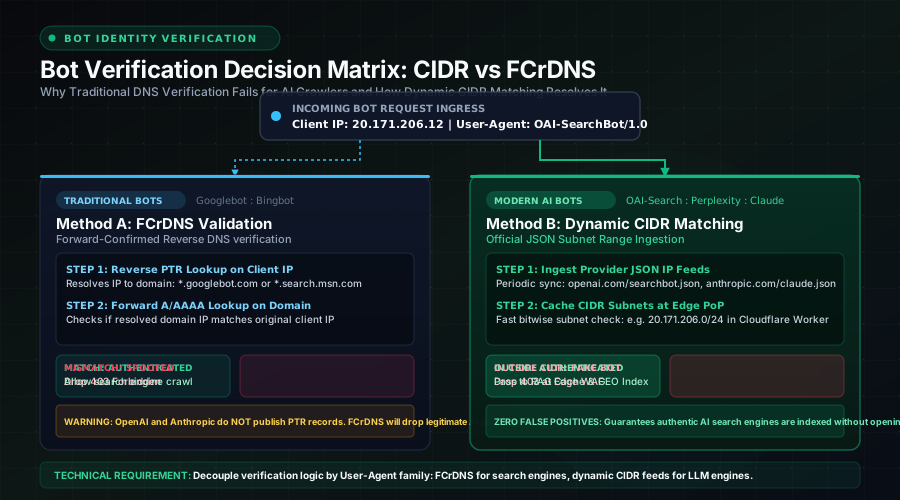
Below is the complete, production-tested implementation suite I deploy across high-scale architectures.
1. Enterprise Production robots.txt Blueprint
This configuration allows Tier 2 AI search crawlers, permits Tier 3 user agents across public content routes, enforces the IETF AIPREF universal training opt-out, and blocks Tier 1 foundation training spiders.
# ==============================================================================
# ENTERPRISE ROBOTS.TXT: AI BOT GOVERNANCE MATRIX
# Maintained by Mostafa Daoud (mostafadaoud.com)
# Compliance: RFC 9309 + IETF AIPREF Draft Standard
# ==============================================================================

# ------------------------------------------------------------------------------
# 1. CORE SEARCH ENGINES & AI SEARCH RETRIEVAL (TIER 2 - PERMITTED)
# Allows organic search discovery and Generative Engine Optimization (GEO).
# ------------------------------------------------------------------------------
User-agent: Googlebot
User-agent: Bingbot
User-agent: Slurp
User-agent: DuckDuckBot
User-agent: Baiduspider
User-agent: YandexBot
User-agent: OAI-SearchBot
User-agent: Claude-SearchBot
User-agent: PerplexityBot
Allow: /
Disallow: /admin/
Disallow: /api/
Disallow: /checkout/
Disallow: /search?
Disallow: /cdn-cgi/

# ------------------------------------------------------------------------------
# 2. USER-TRIGGERED AI AGENTS & BROWSING PROXIES (TIER 3 - SELECTIVE ACCESS)
# Allows on-demand user queries while shielding application routes.
# ------------------------------------------------------------------------------
User-agent: ChatGPT-User
User-agent: Claude-User
User-agent: Perplexity-User
Allow: /
Allow: /blog/
Allow: /projects/
Allow: /services/
Disallow: /admin/
Disallow: /api/
Disallow: /checkout/
Disallow: /cart/
Disallow: /private/

# ------------------------------------------------------------------------------
# 3. IETF AIPREF STANDARD POLICY TOKEN (CROSS-PLATFORM TRAINING OPT-OUT)
# Unified signal instructing participating AI models not to train on content.
# ------------------------------------------------------------------------------
User-agent: __usage_ai-training
Disallow: /

# ------------------------------------------------------------------------------
# 4. FOUNDATION MODEL TRAINING CRAWLERS (TIER 1 - STRICTLY BLOCKED)
# Prevents uncompensated content harvesting for LLM weight pre-training.
# ------------------------------------------------------------------------------
User-agent: GPTBot
User-agent: ClaudeBot
User-agent: Google-Extended
User-agent: Applebot-Extended
User-agent: CCBot
User-agent: Meta-ExternalAgent
User-agent: Meta-ExternalFetcher
User-agent: Bytespider
User-agent: Amazonbot
User-agent: Diffbot
User-agent: FacebookBot
User-agent: anthropic-ai
User-agent: cohere-ai
User-agent: OmiliBot
Disallow: /

# ------------------------------------------------------------------------------
# 5. GLOBAL FALLBACK DIRECTIVE
# Governs all other compliant user agents.
# ------------------------------------------------------------------------------
User-agent: *
Allow: /
Disallow: /admin/
Disallow: /api/
Disallow: /checkout/
Disallow: /search?
Disallow: /private/

# ------------------------------------------------------------------------------
# 6. SITEMAP DECLARATIONS
# ------------------------------------------------------------------------------
Sitemap: https://mostafadaoud.com/sitemap-index.xml
2. Linux Server Log Telemetry Protocol
To diagnose which AI crawlers are hitting your origin servers, use these bash commands on your combined access logs.
Filter and Rank AI Bot Traffic by Volume
# Extract and aggregate total request counts by AI bot User-Agent
grep -Ei "(GPTBot|OAI-SearchBot|ChatGPT-User|ClaudeBot|Claude-SearchBot|Claude-User|PerplexityBot|Bytespider|CCBot|Meta-ExternalAgent)" /var/log/nginx/access.log \
  | awk -F'"' '{print $6}' \
  | awk '{print $1}' \
  | sort \
  | uniq -c \
  | sort -rn
Identify Top URIs Hit by Scrapers
# Discover which URLs are being targeted by Bytespider or GPTBot
grep "Bytespider" /var/log/nginx/access.log \
  | awk '{print $7}' \
  | sort \
  | uniq -c \
  | sort -rn \
  | head -n 25
3. Bot Verification Engineering: FCrDNS vs. CIDR Matching
A major vulnerability in bot governance is User-Agent spoofing. Any malicious script can send User-Agent: Googlebot/2.1 or User-Agent: OAI-SearchBot/1.0. If your firewall trusts the header without verification, scrapers bypass all restrictions.
However, verification mechanics diverge completely between search engines and AI labs:
- Search Engines (Google, Microsoft, Apple): Verified using Forward-Confirmed Reverse DNS (FCrDNS). The server performs a reverse DNS PTR query to confirm the hostname resolves to an authorized domain (
*.googlebot.comor*.search.msn.com), followed by a forward A record query to verify the IP matches. - AI Providers (OpenAI, Anthropic, Perplexity): As specified in the OpenAI Crawlers & IP Ranges Documentation, OpenAI, Anthropic, and Perplexity do not support reverse DNS PTR records. Running FCrDNS checks against them will produce 100% false negatives. Instead, these providers publish dynamic, authoritative JSON files listing their CIDR subnets.
Below is the production Python script I use to validate visitor IPs against official JSON feeds:
#!/usr/bin/env python3
"""
Enterprise AI Bot CIDR Validator
Author: Mostafa Daoud (mostafadaoud.com)
Verifies incoming client IPs against official JSON feeds for OpenAI, Anthropic, and Perplexity.
"""

import ipaddress
import json
import sys
import urllib.request

ENDPOINTS = {
    "openai_search": "https://openai.com/searchbot.json",
    "openai_training": "https://openai.com/gptbot.json",
    "openai_user": "https://openai.com/chatgpt-user.json",
    "anthropic": "https://claude.com/crawling/bots.json",
    "perplexity": "https://www.perplexity.ai/perplexitybot.json",
}

def fetch_prefixes(url: str) -> list:
    req = urllib.request.Request(url, headers={"User-Agent": "Enterprise-Bot-Verifier/1.0"})
    try:
        with urllib.request.urlopen(req, timeout=5) as response:
            data = json.loads(response.read().decode("utf-8"))
            return data.get("prefixes", [])
    except Exception as e:
        print(f"Error fetching {url}: {e}", file=sys.stderr)
        return []

def verify_ip(ip_str: str, prefixes: list) -> bool:
    try:
        client_ip = ipaddress.ip_address(ip_str)
    except ValueError:
        return False

    for item in prefixes:
        cidr = item.get("ipv4Prefix") or item.get("ipv6Prefix") if isinstance(item, dict) else item
        if cidr:
            try:
                network = ipaddress.ip_network(cidr, strict=False)
                if client_ip in network:
                    return True
            except ValueError:
                continue
    return False

if __name__ == "__main__":
    if len(sys.argv) < 3:
        print("Usage: python verify_bot.py <provider_key> <ip_address>")
        print(f"Supported providers: {list(ENDPOINTS.keys())}")
        sys.exit(1)

    provider = sys.argv[1]
    test_ip = sys.argv[2]

    if provider not in ENDPOINTS:
        print(f"Unknown provider '{provider}'")
        sys.exit(1)

    prefixes = fetch_prefixes(ENDPOINTS[provider])
    if verify_ip(test_ip, prefixes):
        print(f"[VERIFIED] {test_ip} is an official {provider} endpoint.")
        sys.exit(0)
    else:
        print(f"[REJECTED] {test_ip} is NOT an official {provider} endpoint.")
        sys.exit(2)
Frequently Asked Questions About AI Crawler Governance
What is the technical difference between GPTBot and OAI-SearchBot?
GPTBot is OpenAIs foundation model training crawler, used to harvest bulk web content for pre-training future GPT models without providing search citations or referral traffic. In contrast, OAI-SearchBot is OpenAIs dedicated search crawler that indexes pages in real time for ChatGPT Search, providing direct inline citations and referral links to users.
Does blocking Google-Extended remove my website from Google AI Overviews?
No. Google-Extended is a robots.txt product token that controls whether your content is used to train Googles Gemini foundation models and Vertex AI APIs. Google AI Overviews pull directly from the standard Google Search index crawled by Googlebot. To appear in AI Overviews, Googlebot must remain allowed.
How do I verify if a request from GPTBot or ClaudeBot is genuine without reverse DNS?
OpenAI and Anthropic do not maintain reverse DNS (PTR) hostname patterns. To verify their crawlers, you must match the client IP address from your server access logs against the authoritative JSON CIDR lists published directly by OpenAI and Anthropic, rather than relying on hostname lookups.
What is the IETF __usage_ai-training token?
The __usage_ai-training token is a standardized directive developed by the IETF AI Preferences (AIPREF) working group. It establishes a vendor-neutral signal inside robots.txt that enables website operators to express a universal opt-out for AI model training while continuing to allow search engine indexation.
Why do user-triggered agents like ChatGPT-User trip WAF rate limits?
User-triggered agents fire synchronously when an active user prompts an AI application to visit or summarize a specific URL. Because multiple users may query the same domain simultaneously, these bots generate bursty concurrent requests from centralized cloud IP blocks that trip standard DDoS and WAF rate-limiting thresholds.
Protect your origin infrastructure. Win citations across AI search.
Whether your origin database is choking under unthrottled AI scraping spikes or you need to ensure your enterprise catalog earns primary citations in ChatGPT Search and Perplexity, I work directly with your engineering and SEO teams to build resilient governance systems.

Eliminate structural crawl debt. Secure permanent search & AI visibility.
Whether managing multi-million-URL dynamic catalogs, migrating to a headless stack, or establishing citation dominance inside ChatGPT and Perplexity, I diagnose and unblock high-stakes technical bottlenecks directly with your engineering and growth leaders.
Direct practitioner engagement. Zero junior agency handoffs. You leave with prioritized engineering fixes.