
Technical Growth Architect & Search Strategist
The Technical SEO Audit Blueprint for High-Scale Sites
An architectural blueprint for technical SEO audits on high-scale sites. Diagnose edge crawl bottlenecks, two-wave hydration drift, and prioritize technical debt.
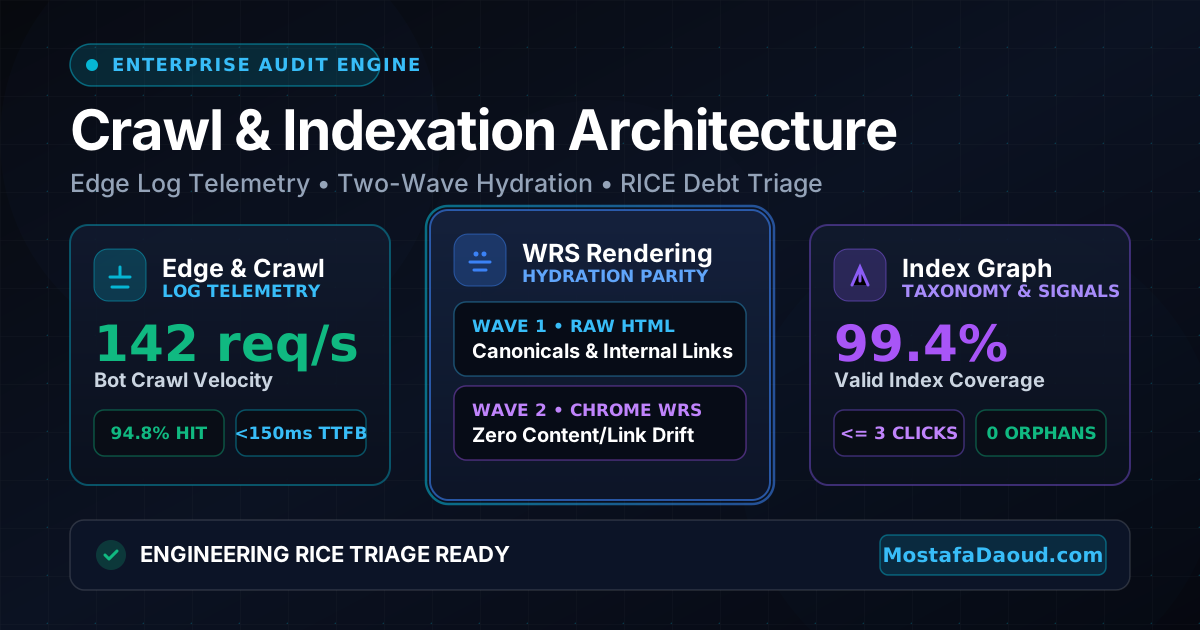
Table of Contents• Quick Navigation
10 Sections
Table of Contents• Quick Navigation
When a website grows past hundreds of thousands of URLs, SEO transforms into a distributed systems challenge. Basic marketing checklists fail to handle this underlying complexity.
At enterprise scale, minor technical defects never stay isolated. An unhandled query parameter or slow category query multiplies across dynamic templates. This creates millions of redundant URLs, wastes server resources, and strands high-value pages outside the index.
Scaling organic search at e-cens to 4.3M+ impressions and achieving a +200% growth trajectory at FigPii confirmed a fundamental reality: sustainable organic performance requires rigorous technical governance. A single routing defect or inconsistent canonical tag can erase months of content gains overnight.
Executing an enterprise technical SEO audit requires moving past generic automated crawlers. High-scale platforms demand an engineering-grade audit framework. It must evaluate crawl architecture, indexation controls, PageRank distribution, rendering performance, and entity mapping.
Navigating large-scale search performance requires treating search crawlers as core infrastructure. This blueprint provides the diagnostic methodology, tooling specifications, and engineering triage frameworks I use to systematically eliminate technical debt.
Why Standard Audits Fail on Enterprise Architectures
A standard audit designed for a 500-page brochure website cannot survive an enterprise architecture.
When an auditor runs a generic site audit tool against a multi-million-URL catalog without custom extraction rules, the crawler crashes or produces an unwieldy spreadsheet of irrelevant noise.
Enterprise platforms operate across complex stacks. They feature micro-frontends, single-page applications, multi-regional CDNs, and legacy database structures. In these environments, surface-level checks like searching for missing meta descriptions fail to uncover structural defects.
An enterprise technical audit focuses on systemic root causes. Rather than cataloging individual page errors, it evaluates template integrity, database routing patterns, cache invalidation protocols, and indexation governance.
Search engine crawlers operate under strict computational constraints. Google allocates crawl budget based on host load capacity and organic demand. When an enterprise site wastes 60% of its crawl budget on faceted filter permutations or redirect chains, primary product templates remain unindexed.
For high-scale platforms, technical health directly dictates commercial outcomes. Traditional agency audits fall short because they lack software engineering fluency. They cannot diagnose edge routing latency, headless render queues, or microservice cache invalidation.
A technical audit is not about generating an 80-page PDF of broken images. It is an architectural intervention that aligns engineering, product, and search infrastructure.
As outlined in my Execution Engine and my Technical SEO Services, sustainable search growth requires automated SEO guardrails in the CI/CD pipeline. Embedding search standards into deployment pipelines ensures that new software releases never compromise organic indexation.
Phase 1: Crawl Architecture, Telemetry, and Crawl Budget Optimization
Crawl efficiency is the foundational layer of technical search health. If search engine bots cannot discover and request your URLs efficiently, downstream indexation and ranking signals become irrelevant.
An enterprise audit begins by mapping crawl mechanics through custom extractions, log file analysis, and edge routing.
Custom Screaming Frog Extractions and Log File Analysis
Auditing millions of URLs requires configuring Screaming Frog SEO Spider with enterprise-grade settings. The default configuration exhausts local memory on large catalogs.
Auditors must switch storage mode to database storage on an NVMe drive, allocate at least 32 gigabytes of RAM, and define targeted URL exclusion patterns. Using custom regex and XPath extractions, capture template identifiers, client-side dataLayer variables, published release versions, and canonical tags directly within the crawl stream.
Server access logs provide the definitive ground truth for crawl budget utilization.
By importing CDN access logs into Google BigQuery or Snowflake, isolate bot user agents (Googlebot Desktop, Googlebot Smartphone, Bingbot) and correlate their behavior against site architecture.
During my log audits, I frequently uncover critical technical bottlenecks:
- 40% to 70% of Googlebot requests consumed by non-indexable tracking parameters.
- Unexpected spikes in 500-level errors during aggressive crawl cycles.
- Deep product detail pages receiving only one crawl visit per quarter while obsolete archives are fetched daily.
Extracting these insights allows technical teams to resolve crawl bottlenecks before they harm organic rankings.
Eliminating Faceted Navigation Traps and Crawl Loops
Faceted navigation is the single most destructive source of crawl budget waste on enterprise eCommerce and marketplace platforms.
A category page with six independent filter dimensions and five options each creates 15,625 possible URL permutations. Multiply that across thousands of categories, and an application exposes tens of millions of duplicate URLs to search engine bots.
To eliminate faceted navigation traps, enforce strict architectural rules:
- Canonicalization: Pointing facet variations to the root category is often insufficient to halt crawling. Search engines must still request the URL to discover its canonical tag.
- Robots.txt Disallows: Use wildcard path rules (such as Disallow: /*?sort= or Disallow: /?*filter_) to block search bots from requesting non-canonical filter parameters.
- Edge Link Obfuscation: Convert non-indexable filter toggles into dynamic controls using asynchronous fetch requests or pushState navigation without exposing raw href links in HTML.
- Selective Indexation: For high-volume filter combinations with verified search demand (such as mens black running shoes), generate dedicated canonical landing pages with unique content and sitemap inclusion.
Edge Caching and Server Response Optimization via Cloudflare
Crawler efficiency is heavily governed by server latency.
When Googlebot encounters slow origin servers, it throttles crawl concurrency to protect site infrastructure from overload. Conversely, reducing server response times from 700ms to sub-100ms allows search engines to crawl substantially more pages within the same time window.
Enterprise platforms must implement intelligent edge caching using CDN infrastructure like Cloudflare Workers or Fastly VCL.
Configure explicit cache-control response headers (public, max-age=3600, s-maxage=86400, stale-while-revalidate=604800) to serve HTML directly from edge points of presence (PoPs) closest to crawlers.
Edge workers can inspect request headers, verify bot authenticity through reverse DNS, and deliver pre-warmed cached static HTML instantly. Deploying these edge fixes protects origin capacity during peak crawling cycles.
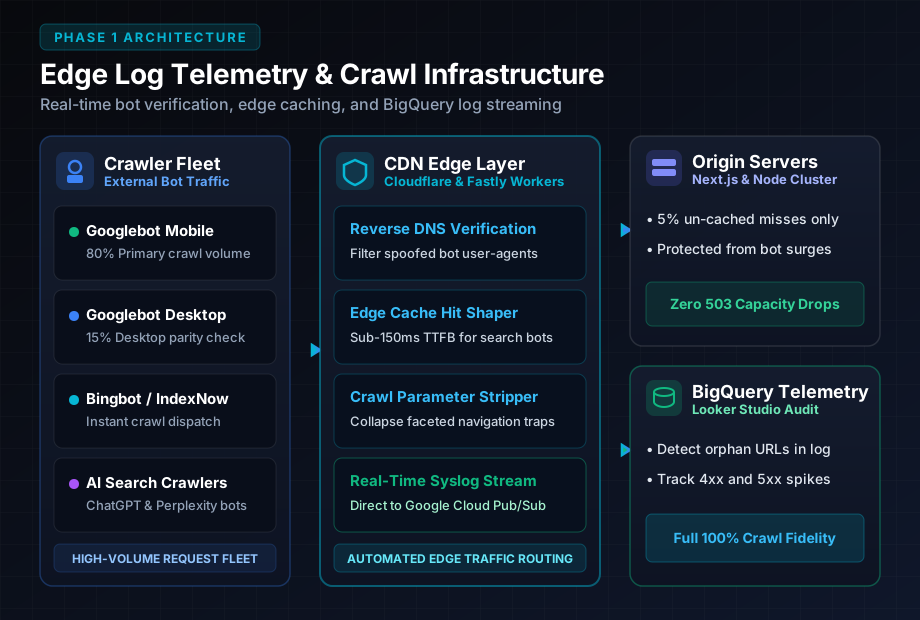
Diagnostic Reflection for Technical Leaders: How much of your monthly server bill and Googlebot crawl budget is consumed by non-canonical parameters, 5xx timeouts, or crawler loops? If your engineering team does not maintain real-time log ingestion to quantify crawl waste, high-converting templates are inevitably paying the price. Review my Technical SEO Services or inspect how I restructured search architecture to achieve a 200% organic growth trajectory in my FigPii Case Study.
Phase 2: Indexation Governance and Canonical Integrity
Discovering a page is merely the first step. Controlling whether search algorithms accept that page into their primary index determines organic reach.
On high-scale websites, indexation issues stem from rampant duplicate content, ambiguous canonical tags, and unmonitored parameter sprawl.
Resolving Parameter-Induced Duplicate Content
URL query parameters introduced by marketing analytics, session tracking, and sorting algorithms create massive duplicate content footprints.
URLs such as /catalog/shoes?session_id=98341&sort=asc present the exact same inventory as the clean root category /catalog/shoes/.
When an enterprise site serves near-identical content across multiple URL variants, search engines must guess which version to index. This splits link equity and dilutes keyword relevance.
The audit must establish strict parameter hygiene:
- Consolidate tracking parameters using Google Search Console and edge redirect rules.
- Ensure marketing parameters (such as
utm_source,utm_medium, andgclid) are stripped or canonicalized before search engines index them. - Enforce lowercase URLs and trailing slash uniformity across application routers to eliminate case-sensitive duplicate entries.
Canonical Tag Hygiene and Cross-Domain Signals
The canonical tag is one of the most misunderstood mechanisms in modern technical SEO. A canonical tag is a recommendation, not an absolute directive.
If external links, internal links, XML sitemaps, or redirect signals contradict the canonical tag, Google will ignore the tag and select its own canonical URL.
A rigorous technical audit checklist verifies canonical integrity across five criteria:
- Absolute URLs: Every canonical tag must specify absolute protocol and domain (
https://example.com/page/) rather than relative paths. - Self-Referencing Parity: Primary indexable pages must feature a self-referencing canonical tag matching their exact published URL structure.
- Singularity: Page templates, CMS plugins, and edge scripts must never output multiple conflicting canonical tags within the HTML head.
- Cross-Domain Attribution: When syndicating content across partner domains, implement cross-domain canonicals to attribute original authorship to the primary source.
- HTTP Header Canonicals: For non-HTML digital assets like PDF whitepapers, output canonical tags via HTTP response headers (
Link: <https://example.com/whitepaper/>; rel="canonical").
Diagnosing Google Search Console Index Coverage Gaps
Google Search Console provides crucial diagnostic telemetry for enterprise site health.
When auditing the Page Indexing report across an enterprise site, segment URLs by template type to uncover index exclusion root causes:
- Discovered - currently not indexed: Google knows the URL exists but has not allocated resources to crawl it. At enterprise scale, this signals crawl budget exhaustion, weak internal link topology, or poor site-wide technical health.
- Crawled - currently not indexed: Google crawled the URL, evaluated the content, and actively decided not to index it. This indicates thin content, low content quality, or automated template duplication. For enterprise publishers, pairing this diagnostic with an editorial content quality audit is critical to eliminating programmatic low-value pages.
- XML Sitemap Alignment: Sitemaps must contain only 200 OK canonical URLs. Exclude redirects, 404s, blocked paths, and parameterized URLs. Split sitemaps into modular files under 50,000 URLs organized by template, referenced through a central sitemap index.
Phase 3: Internal Link Topology and PageRank Distribution
Internal PageRank remains the primary currency of organic authority distribution.
On massive websites, internal link architecture determines how efficiently link equity flows from high-authority landing pages down into deep category spokes and long-tail product detail pages.
Hub-and-Spoke Architecture and Click-Depth Compression
Click depth describes the number of links required to reach a specific page from the root domain.
In enterprise architectures, deep hierarchies often bury high-converting product pages at depths of 6 to 10 clicks from the homepage. Pages buried at extreme depths receive negligible internal PageRank. This leads to infrequent crawling and suppressed search engine visibility.
Enterprise site architecture must enforce a compressed hub-and-spoke model, ensuring at least 95% of target indexable pages reside within four clicks of the homepage:
- Category Hubs: Main category pages act as authoritative hubs, passing equity downward to subcategory spokes and lateral siblings.
- Faceted Clusters: Programmatic subcategory pages must feature contextual cross-links to related brands and complementary collections.
- Breadcrumb Integration: Implement valid BreadcrumbList structured data across all subpages to reinforce taxonomy and clear crawl paths.
- Navigational Discipline: Avoid monolithic megamenus containing thousands of links. Excessive sitewide links dilute PageRank value passed through each individual hyperlink.
Executing this topology reinforces scalable architecture that distributes authority evenly across millions of URLs.
Algorithmic Orphan Page Detection and Recovery
An orphan page is any URL that exists on a web server but possesses no incoming internal links from the rest of the website.
Orphan pages cannot be discovered through standard internal site crawls, yet they consume crawl budget or linger in search engine indexes via legacy sitemaps or external backlinks.
To detect orphan pages systematically, the audit team must execute a three-way data join across distinct data sources:
- Screaming Frog Crawl Data: All internal URLs discovered by following crawlable HTML links.
- XML Sitemap Ingestion: All URLs declared in published sitemaps.
- Server Access Logs: All URLs receiving visits from search engine crawlers or users in the past 90 days.
Any URL present in access logs or XML sitemaps that does not exist in the crawl graph is an orphan.
Once identified, evaluate orphaned URLs:
- If they represent valuable existing content, integrate them programmatically into category navigation, related article widgets, or automated tag archives.
- If they represent obsolete legacy pages, decommission them with a clean 301 redirect or 410 Gone status code.
Auditing legacy directories ensures internal authority is not wasted on abandoned URLs, eliminating systemic routing defects across the catalog.
Phase 4: Rendering Performance and Core Web Vitals at Enterprise Scale
Modern enterprise websites increasingly rely on complex JavaScript frameworks such as React, Next.js, Angular, and Vue.
While these frameworks enable rich web applications, they introduce severe rendering bottlenecks, indexing delays, and performance penalties if not engineered correctly.
Evaluating SSR, SSG, and Hydration Bottlenecks
Search engines process JavaScript through a two-wave indexing architecture.
In the first wave, Googlebot inspects raw server-rendered HTML. In the second wave, the page enters a rendering queue where Googles Web Rendering Service (WRS) executes JavaScript and evaluates the Document Object Model (DOM).
Depending on Googles rendering resource availability, the second wave can lag behind initial discovery by days or even weeks.
For high-scale platforms with frequently changing inventory, relying on pure Client-Side Rendering (CSR) is unacceptable. The audit must evaluate the rendering pipeline:
- Server-Side Rendering (SSR) and Static Site Generation (SSG): Ensure critical text content, internal links, canonical tags, and structured data are fully rendered into the initial static HTML payload delivered by the server. Search engines must not rely on client-side JavaScript execution to uncover basic navigational links.
- Hydration Cost: After the initial HTML renders, heavy JavaScript bundles execute to attach client-side event listeners (hydration). Inefficient hydration locks the browser main thread, causing significant input delays and degrading user experience.
- Dynamic Rendering: While dynamic rendering was historically common, Google has officially deprecated it in favor of unified SSR or hybrid static delivery per the Google Search Central JavaScript SEO documentation.
Addressing these technical aspects early guarantees that search engine bots immediately process your full contextual hierarchy without waiting on rendering queues.
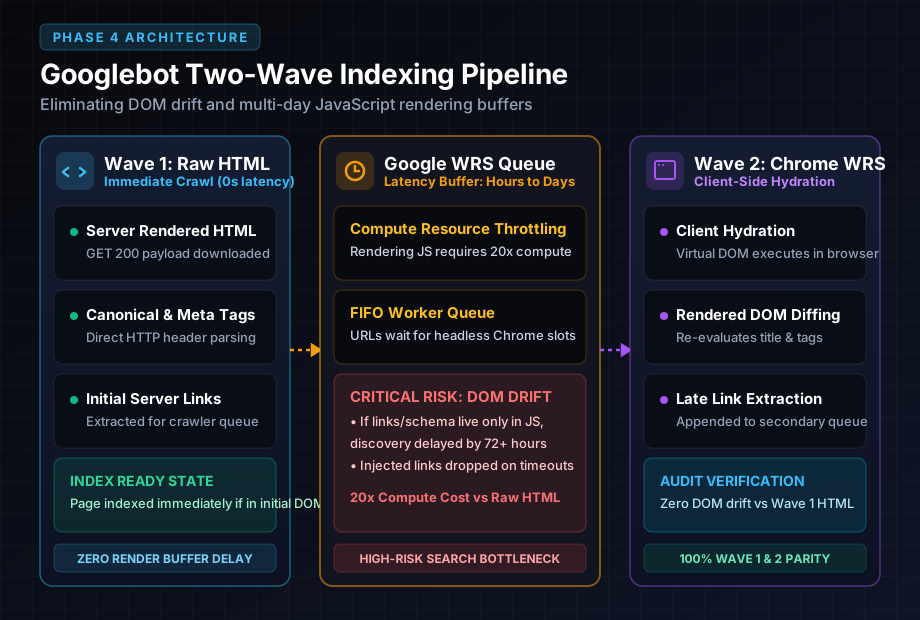
Architecture Check: Does your product catalog rely on client-side hydration to inject critical breadcrumbs, related product links, or canonical URLs? When rendering queues delay execution by 48 to 72 hours, search bots make indexing decisions on an incomplete initial DOM. Explore my engineering frameworks in my Execution Engine or read how I approach modern software architecture on my About page.
Field Metrics Optimization: INP, LCP, and CLS Across Enterprise Templates
Core Web Vitals represent official Google ranking signals directly tied to user experience. At enterprise scale, performance optimization cannot happen on an individual page basis; it must be addressed systematically at the template level.
The technical audit must assess real-user field data from the Chrome User Experience Report (CrUX) and lab data across three primary metrics:
- Interaction to Next Paint (INP): Measures responsiveness to user interactions. High INP is typically driven by long JavaScript execution tasks (>50ms) during hydration. Remediate INP by breaking monolithic JavaScript bundles into asynchronous chunks, debouncing heavy event handlers, and deferring non-critical third-party scripts via Google Tag Manager or web workers.
- Largest Contentful Paint (LCP): Measures perceived loading speed. The largest visual element on the screen must render within 2.5 seconds. Optimize LCP by preloading the hero image (
<link rel="preload" as="image" href="...">), serving modern WebP or AVIF image formats, using responsive srcset attributes, and hosting static assets on a high-speed CDN. - Cumulative Layout Shift (CLS): Measures visual stability during page load. Sudden layout shifts trigger search ranking penalties. Enforce explicit width and height dimensions on all image and video tags. Reserve fixed aspect-ratio CSS placeholders for dynamic ad slots. Never insert client-side promotional banners above the fold without reserved containers.
Optimizing template-level rendering and Core Web Vitals directly protects organic visibility across competitive product categories.
Phase 5: Structured Data and Knowledge Graph Entity Alignment
Search engines and modern generative answer engines no longer parse the web as simple text strings. They parse the web as entities and conceptual relationships within a global knowledge graph.
An enterprise technical audit must verify that structured data accurately translates domain expertise into machine-readable format.
Validating Nested JSON-LD Schemas
Enterprise structured data should be implemented using nested JSON-LD in a centralized @graph structure rather than disconnected, fragmented schema blocks scattered across the template. Standalone schema snippets prevent search engines from resolving the relationships between the publisher, the author, the webpage, and the subject matter.
A unified enterprise schema implementation links entities together hierarchically:
- Organization: Declares corporate name, logo, official URL, and verified corporate affiliations.
- WebSite: Establishes the authoritative search portal, associated SearchAction sitelinks search box query targets, and domain identity.
- WebPage or ItemPage: Describes the specific page container, date published, date modified, and primary topic.
- Product, Article, or Service: Defines the primary subject entity, including SKU, pricing, author, ratings, and canonical identifiers.
All schemas must be rigorously validated using the Schema.org validator and Google Search Central Rich Results Test to eliminate syntax errors, missing mandatory fields, and deprecation warnings.
{
  "@context": "https://schema.org",
  "@graph": [
    {
      "@type": "Organization",
      "@id": "https://mostafadaoud.com/#organization",
      "name": "Mostafa Daoud",
      "url": "https://mostafadaoud.com",
      "sameAs": [
        "https://www.linkedin.com/in/mostafa-daoud/",
        "https://github.com/MostaDaoud"
      ]
    },
    {
      "@type": "WebSite",
      "@id": "https://mostafadaoud.com/#website",
      "url": "https://mostafadaoud.com",
      "name": "Mostafa Daoud",
      "publisher": {
        "@id": "https://mostafadaoud.com/#organization"
      }
    },
    {
      "@type": "TechArticle",
      "@id": "https://mostafadaoud.com/blog/enterprise-technical-seo-audit-checklist#article",
      "isPartOf": {
        "@id": "https://mostafadaoud.com/#website"
      },
      "headline": "The Enterprise Technical SEO Audit Blueprint for High-Scale Sites",
      "description": "An architectural blueprint for enterprise technical SEO audits. Diagnose edge crawl bottlenecks, two-wave hydration drift, and prioritize technical debt.",
      "author": {
        "@id": "https://mostafadaoud.com/#organization"
      }
    }
  ]
}
Aligning Corporate Entities with Wikidata and Google Knowledge Graph
To build sustainable organic visibility and maximize inclusion within AI citation engines like Perplexity, ChatGPT Search, and Google AI Overviews, enterprise platforms must establish unambiguous entity identity.
Incorporate sameAs schema arrays within corporate Organization and Person entities. These properties link your digital presence directly to canonical knowledge repositories:
- Wikidata URIs
- Wikipedia entries
- Crunchbase company profiles
- Verified LinkedIn and social media profiles
- Industry accreditation registries
Entity clarity ensures that search engines connect your content directly to authoritative topical nodes, elevating domain trust across competitive search verticals. To inspect how I architect entity graphs for generative visibility, explore my GEO Services or review my technical background on my About page.
The Enterprise Technical SEO Audit Checklist
Operationalizing an enterprise audit requires a systematic framework that tracks each technical subsystem, assigns clear ownership, and establishes remediation priority.
The following checklist outlines the primary checkpoints, detection tools, and corrective engineering actions I enforce across high-scale platforms:
| Category | Check & Signal | Priority | Primary Tool | Corrective Action |
|---|---|---|---|---|
| Crawl Architecture | Robots.txt Blocking | P0 (Critical) | Screaming Frog, GSC | Remove disallows on critical CSS, JS, and indexable template paths. Declare sitemap index. |
| Crawl Architecture | Faceted Navigation Traps | P0 (Critical) | Log Analysis, Screaming Frog | Disallow parameter combinations in robots.txt. Convert filter toggles to pushState controls. |
| Crawl Architecture | Server Log Distribution | P1 (High) | Google BigQuery, Snowflake | Prune non-performing legacy URLs consuming Googlebot crawl requests on 4xx/5xx status codes. |
| Crawl Architecture | Edge Response Latency | P1 (High) | Cloudflare, Fastly | Implement CDN HTML edge caching with stale-while-revalidate to keep bot TTFB under 150ms. |
| Indexation | Canonical Tag Parity | P0 (Critical) | Screaming Frog, Sitebulb | Enforce absolute self-referencing canonicals on indexable pages. Remove duplicate tags in DOM. |
| Indexation | Parameter Sprawl | P1 (High) | GSC Inspection, Botify | Strip marketing parameters at CDN edge. Standardize lowercase URLs and trailing slashes. |
| Indexation | Search Console Coverage | P1 (High) | Google Search Console API | Triage Crawled - currently not indexed URLs. Consolidate thin content and prune low-value pages. |
| Indexation | XML Sitemap Hygiene | P2 (Medium) | Screaming Frog, GSC | Exclude non-200, redirected, or noindexed URLs. Split sitemaps into modular 50k-URL chunks. |
| Site Architecture | Click Depth Compression | P1 (High) | Screaming Frog, OnCrawl | Compress crawl depth so 95% of target indexable URLs reside within 3 to 4 clicks of homepage. |
| Site Architecture | Orphan Page Recovery | P1 (High) | BigQuery, Screaming Frog | Reconcile log hits, sitemaps, and crawls. Re-link orphan pages via dynamic taxonomy modules. |
| Rendering & CWV | SSR HTML Parity | P0 (Critical) | Chrome DevTools, Rendertron | Ensure critical text, links, and metadata exist in raw HTML payload before client-side hydration. |
| Rendering & CWV | Interaction to Next Paint | P1 (High) | CrUX BigQuery, PageSpeed | Defer non-critical JS, break long tasks (>50ms), and optimize hydration on interactive templates. |
| Rendering & CWV | Largest Contentful Paint | P1 (High) | PageSpeed Insights | Preload hero images, implement modern WebP/AVIF formats, and inline critical above-fold CSS. |
| Structured Data | Nested JSON-LD Schemas | P2 (Medium) | Schema Validator, Rich Test | Implement unified @graph schemas connecting Organization, WebSite, and ItemPage entities cleanly. |
| International | Hreflang Tag Reciprocity | P1 (High) | Screaming Frog, Sitebulb | Validate reciprocal hreflang links across all regional language variants with self-references. |
Using this structured checklist allows cross-functional teams to maintain site health and prevent regressions.
Triaging Technical Debt: Transforming Audit Insights into Engineering Sprints
The most common failure mode of an enterprise technical audit is the audit that ends as an 80-page static document.
When an external agency or consulting team delivers hundreds of unprioritized recommendations, internal software engineering teams experience paralysis. Engineers have competing product priorities, feature roadmaps, and infrastructure sprints.
To turn audit findings into production fixes, SEO leaders must act as technical product managers.
The RICE Prioritization Framework for SEO Remediation
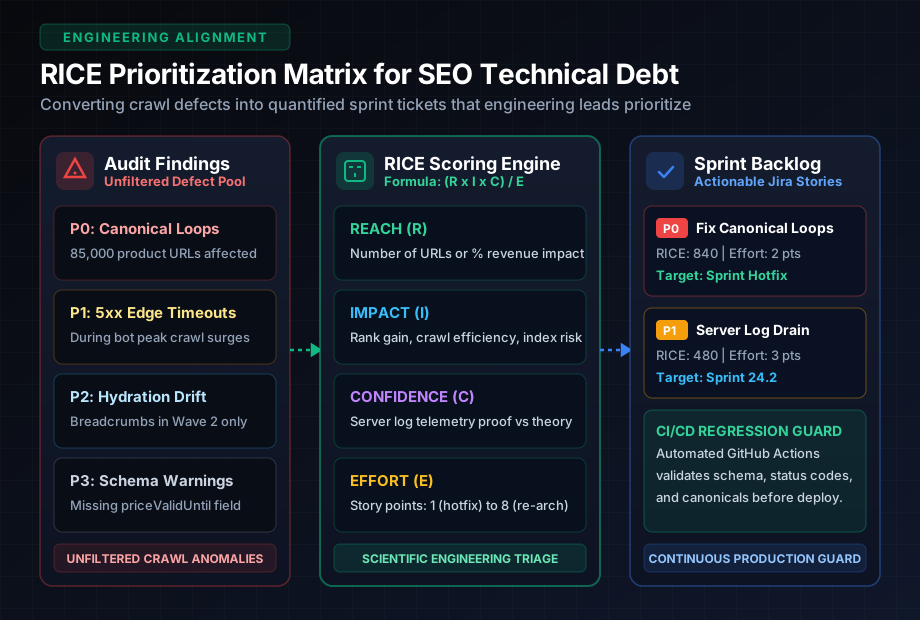
Technical SEO teams must apply rigorous prioritization frameworks like RICE (Reach, Impact, Confidence, Effort) to rank technical fixes based on measurable business value:
- Reach: The total volume of URLs or organic traffic share affected by the issue (such as a fix altering the global product template reaching 100% of product URLs).
- Impact: The estimated lift in crawl efficiency, indexation, or rankings (Minimal = 0.5x, Medium = 1x, High = 2x, Transformative = 3x).
- Confidence: The statistical certainty of the outcome based on log data, staging tests, or historical benchmarks (scored from 50% to 100%).
- Effort: The engineering person-weeks required to scope, develop, test, and deploy the fix.
The RICE score formula is calculated as: (Reach x Impact x Confidence) / Effort.
Prioritizing technical fixes through this formula prevents engineering teams from spending three sprints fixing low-impact image alt attributes while multi-million-URL canonical loops continue wasting crawl budget.
This systematic triage ensures that engineering capacity is focused on architectural improvements that directly unlock crawl efficiency, accelerate indexation velocity, and drive measurable organic revenue.
Writing Technical User Stories for Engineering Teams
Audit recommendations must be translated into standardized engineering user stories within Jira, Linear, or Azure DevOps.
A well-crafted technical SEO ticket includes precise context, reproduction steps, acceptance criteria, and QA verification methods:
Title: [SEO] Enforce Absolute Canonical Self-Reference on Product Detail Templates

User Story:
As a search engine bot, I need the product template to output a single, absolute, self-referencing canonical URL so that URL query parameters do not create duplicate index entries.

Technical Context:
Product detail pages currently output relative canonical links (e.g., <link rel="canonical" href="/products/item-123/">). When marketing campaigns append tracking parameters (?utm_source=adwords), search engines fail to normalize the canonical target, causing 420,000 duplicate URLs in Google Search Console.

Acceptance Criteria:
1. Every product detail page must render exactly one <link rel="canonical"> tag inside the <head> element.
2. The canonical href must be an absolute URL using the production HTTPS protocol and domain: https://example.com/products/item-123.
3. All query parameters, session IDs, and trailing sorting flags must be stripped from the canonical href.
4. If a product page is reached via an internal redirect or alternate path, the canonical must strictly match the primary database route.

QA & Verification Steps:
- Inspect rendered DOM in staging using curl -I -L.
- Verify canonical header and HTML tag using Screaming Frog staging crawl.
- Confirm zero duplicate canonical tags in browser console.
Translating audit findings into explicit tickets bridges the gap between marketing goals and engineering execution.
Frequently Asked Questions: Enterprise Technical Audits
What makes an enterprise technical SEO audit different from a standard audit?
An enterprise technical SEO audit differs fundamentally in scale, complexity, and methodology.
While a standard audit evaluates isolated pages on a small website for basic on-page elements, an enterprise audit evaluates programmatic template systems across millions of URLs.
Enterprise audits focus on server log analysis, faceted navigation crawl traps, micro-frontend rendering pipelines, edge CDN caching, and database routing logic. Furthermore, enterprise audits require integrating with corporate engineering workflows and CI/CD deployment pipelines.
Enterprise auditing focuses on systemic architectural health rather than cosmetic page tweaks.
Can AI tools like ChatGPT or LLMs automate an enterprise technical SEO audit?
Large Language Models and AI tools cannot automate an enterprise technical SEO audit end-to-end.
AI models excel at modular tasks like generating regex or drafting JSON-LD schema. However, they cannot access server infrastructure, run high-volume site crawls, or make complex architectural trade-offs.
An enterprise audit requires human architectural judgment to analyze log data, evaluate engineering feasibility, and balance commercial priorities against search crawler constraints. Effective technical diagnosis combines automated data ingestion with seasoned engineering oversight.
What is the best technical SEO audit tool stack for high-scale platforms?
High-scale platforms require a specialized audit tool stack designed for big-data processing:
- Desktop & Cloud Crawlers: Screaming Frog SEO Spider configured with database storage mode, Botify, or OnCrawl for multi-million-URL crawling.
- Log Analysis & Data Warehousing: Google BigQuery, Snowflake, or the ELK Stack (Elasticsearch, Logstash, Kibana) for processing gigabytes of raw web server access logs.
- Edge Infrastructure: Cloudflare Workers or Fastly VCL for edge-layer caching, bot detection, and header manipulation.
- Search Analytics & Telemetry: Google Search Console API integrated with Looker Studio or BigQuery for granular indexation monitoring.
- Real User Monitoring: Chrome UX Report (CrUX) BigQuery datasets and Google PageSpeed Insights API for continuous Core Web Vitals tracking.
Configuring this telemetry pipeline enables teams to detect technical regressions before they trigger search visibility drops.
How should enterprise teams prioritize technical debt and remediation?
Enterprise teams should prioritize technical debt using a structured triage hierarchy:
- P0 (Critical): Crawl and indexing blockers that prevent search engines from discovering or indexing primary revenue-driving URLs (such as accidental robots.txt disallows, sitewide noindex tags, or server crash loops).
- P1 (High): Structural efficiency defects that deplete crawl budget or dilute equity (such as faceted navigation crawl traps, canonical loops, and deep click depth).
- P2 (Medium): Performance and rendering degradation affecting Core Web Vitals (such as excessive hydration times, high INP, and layout shifts across primary templates).
- P3 (Low): Minor microdata refinements, image optimization, and static template polish.
By applying this discipline, organizations resolve structural crawl defects while maintaining feature delivery velocity.
Conclusion: Building Continuous SEO Observability
An enterprise technical SEO audit is not a one-time project; it is an ongoing operational discipline.
Enterprise engineering teams often deploy dozens of code releases weekly. In that environment, a single software update can introduce silent regressions that compromise indexation across millions of pages. Relying on an annual static PDF leaves platforms vulnerable to sudden organic traffic drops.
Building long-term organic visibility requires shifting from reactive quarterly reviews to continuous, automated SEO observability.
Engineering teams should integrate automated regression testing within the CI/CD pipeline to validate canonical tags, status codes, and robots directives before code reaches production. Furthermore, technical leaders should align remediation with engineering sprint cycles, ensuring that infrastructure reliability directly accelerates organic acquisition.
Embed technical search standards directly into sprint cycles. This eliminates silent debt, maximizes crawler efficiency, and builds a resilient organic growth engine across traditional search and AI answer engines.
Stop letting silent technical debt deplete your organic search pipeline.
If your platform struggles with crawl traps, indexation drops, or two-wave JavaScript rendering bottlenecks, let me inspect the underlying architecture. I evaluate server access logs, edge caching rules, and rendering pipelines live on a 30-minute diagnostic session.

Eliminate structural crawl debt. Secure permanent search & AI visibility.
Whether managing multi-million-URL dynamic catalogs, migrating to a headless stack, or establishing citation dominance inside ChatGPT and Perplexity, I diagnose and unblock high-stakes technical bottlenecks directly with your engineering and growth leaders.
Direct practitioner engagement. Zero junior agency handoffs. You leave with prioritized engineering fixes.