
Technical Growth Architect & Search Strategist
Entity SEO and Knowledge Graph Architecture for Generative Engines
Master Entity SEO and knowledge graph architecture. Learn how to disambiguate your brand in ChatGPT, Perplexity, and Google with connected JSON-LD graphs.
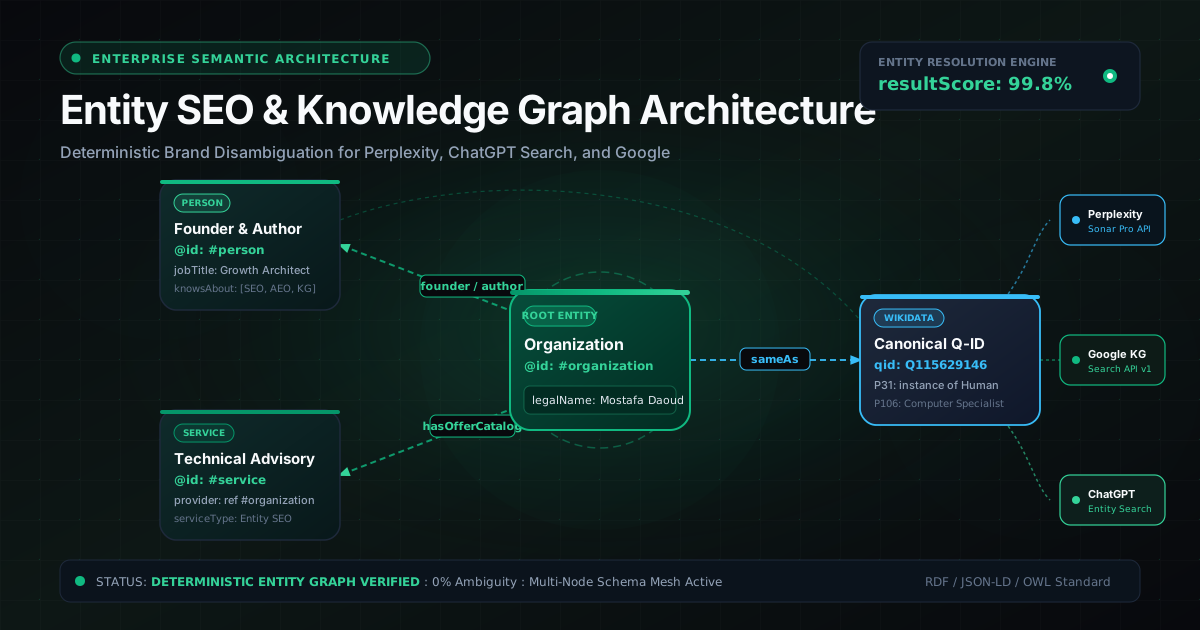
Table of Contents• Quick Navigation
6 Sections
Table of Contents• Quick Navigation
When an enterprise software brand loses a high-intent prospect inside ChatGPT Search or Perplexity, the engineering post-mortem rarely reveals a server timeout or a missing meta tag.
Instead, it reveals a namespace collision.
The prospective buyer prompts the engine: “Compare the top enterprise data pipeline observability platforms for healthcare compliance.”
The model evaluates dozens of web documents, performs Named Entity Recognition across its retrieval index, and identifies two competing vendors with comparable product capabilities. The first vendor maintains clean, interconnected knowledge graph architecture, an active Wikidata entity, and unambiguous corporate schema. The second vendor relies on fragmented WordPress SEO plugins, disconnected script tags, and superficial keyword density.
The model cites the first vendor with complete technical accuracy, quoting their compliance certifications and enterprise SLA tiers. For the second vendor, the model either omits the company entirely or conflates their platform with an obscure consumer health application sharing a similar dictionary name.
The deal vanishes before the sales team even knows the prospect existed.
For over two decades, technical search marketing operated on string matching: match the user’s search query, optimize keyword density, build external link equity, and rank a specific URL in ten blue links.
In generative discovery, string matching is obsolete.
Modern search engines and artificial intelligence answer engines do not read web pages as isolated collections of text strings. They navigate multi-dimensional knowledge graphs composed of entities, attributes, and semantic triples. If your digital properties do not explicitly declare who you are, what you build, and who validates your claims through machine-readable nodes, you surrender your brand authority to probabilistic guesswork.
This guide details the complete engineering blueprint for Entity SEO and Knowledge Graph Architecture: how to eliminate namespace collisions, construct unified @graph JSON-LD networks, triangulate off-site digital consensus, and audit entity confidence using the Google Knowledge Graph Search API.
sameAs endpoints.
The Paradigm Shift: Why String-Matching Is Dead and Entity Graphs Rule Search
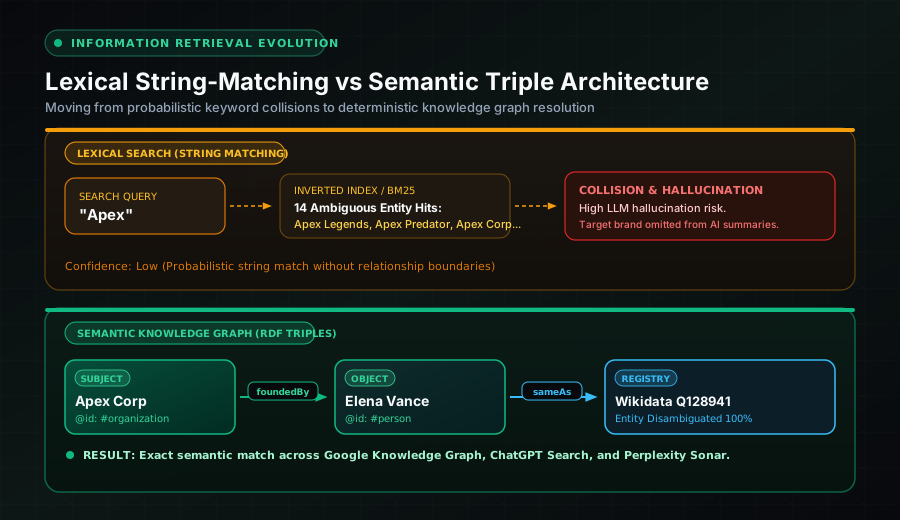
Entity SEO is the technical practice of structuring digital brand information around real-world objects, concepts, and relationships rather than isolated keyword strings. Traditional search engines indexed individual documents using character frequency and inverted index weights. Modern generative search engines and neural retrieval pipelines treat the web as a dynamic, high-dimensional knowledge graph. Inside platforms like ChatGPT Search, Perplexity Sonar, and Google AI Overviews, algorithms execute Named Entity Recognition to extract candidate nodes, map those nodes to canonical identifiers, and evaluate semantic triples composed of subjects, predicates, and objects. When your digital properties present ambiguous or disconnected strings, neural parsers suffer namespace collisions and either hallucinate factual claims or omit your brand entirely from synthesized answers. Transitioning from lexical optimization to entity graph architecture replaces volatile keyword rankings with deterministic factual relationships, securing your position across traditional search engine results pages and autonomous generative answer engines.
In May 2012, Google published its landmark manifesto, “Things, not strings,” introducing the Knowledge Graph to mainstream search architecture. For the first time, search algorithms formally separated the sequence of characters typed into a query box from the underlying real-world entity the user sought to investigate.
Yet for more than a decade following that announcement, most enterprise marketing teams continued to operate as if search was governed purely by lexical matching. They tracked keyword rankings, adjusted on-page term frequencies, and bought backlinks anchored to commercial search phrases.
When generative AI search emerged, this legacy approach collapsed.
The Anatomy of Semantic Triples
At the foundation of every knowledge graph lies the semantic triple: a three-part statement consisting of a Subject, a Predicate, and an Object. Standardized by the W3C RDF 1.1 Primer on Semantic Triples, triples transform loose natural language into mathematically rigorous graph edges.
Consider how an unstructured sentence is parsed versus how a semantic knowledge graph stores the identical information:
- Unstructured Text: “Mostafa Daoud advises enterprise B2B software engineering teams on technical search architecture and generative engine optimization.”
- Semantic Triple 1:
- Subject:
[Mostafa Daoud](Entity Node:Person) - Predicate:
[specializesIn](Relationship Edge) - Object:
[Technical SEO](Entity Node:FieldOfStudy)
- Subject:
- Semantic Triple 2:
- Subject:
[Mostafa Daoud](Entity Node:Person) - Predicate:
[consultsFor](Relationship Edge) - Object:
[Enterprise Software Organizations](Entity Node:Audience)
- Subject:
When an AI engine processes a query, it does not count how many times the phrase “technical search architecture” appears on my domain. It traverses graph edges to confirm whether the subject node exhibits a verified relationship with the predicate and object nodes.
If those edges exist and are corroborated by third-party sources, the engine’s confidence score satisfies the threshold required to generate a direct factual citation.
Vector Embeddings Meet Deterministic Graphs
Modern generative engines operate on a hybrid search paradigm that bridges two distinct technologies:
- Dense Vector Embeddings: Neural models transform words, sentences, and paragraphs into high-dimensional numerical vectors. Words sharing conceptual context cluster together in vector space. This allows an engine to understand that “data observability,” “pipeline telemetry,” and “database monitoring” are conceptually related without matching the exact string.
- Deterministic Knowledge Graphs: While vector embeddings excel at semantic similarity, they lack factual certainty. Vectors predict the next most probable token based on training weights, which frequently causes models to hallucinate plausible falsehoods. Knowledge graphs provide deterministic guardrails. A graph stores verified facts: founded dates, executive officers, headquarters coordinates, parent organizations, and technical specifications.
In modern Retrieval-Augmented Generation (RAG) workflows, vector search retrieves candidate text passages from the index, while the knowledge graph acts as a factual arbitrator.
If your brand lacks verified entity nodes within the knowledge graph, the engine relies purely on probabilistic vector prediction. If a competitor has both dense vector coverage and verified knowledge graph edges, the model consistently selects the competitor to minimize hallucination risk.
| Architecture Dimension | Traditional Lexical SEO | Entity Knowledge Graph Architecture | Generative Engine Impact | Last Verified |
|---|---|---|---|---|
| Primary Indexing Unit | Document URL and keyword string frequency | Real-world Entity Node and semantic relationships | Determines whether an LLM recognizes your brand as an independent entity | November 2026 |
| Query Processing | Inverted index string matching (TF-IDF, BM25) | Named Entity Recognition (NER) and entity linking | Enables semantic query parsing and intent disambiguation in RAG pipelines | November 2026 |
| Identity Resolution | Domain root, title tags, and backlink anchor text | Persistent Machine Identifiers (MIDs, Wikidata Q-IDs) | Eliminates namespace collisions across identical brand names | November 2026 |
| Optimization Vector | Keyword density, heading tags, page word count | Interconnected @graph JSON-LD and semantic triples |
Directly informs LLM cross-encoder rerankers and citation selection | November 2026 |
| Failure Mode | Ranking drop on algorithmic updates | Hallucination, brand conflation, or complete citation omission | Invisible erasure from ChatGPT Search, Perplexity, and AI Overviews | November 2026 |
The Financial Cost of Namespace Collisions
A namespace collision occurs when two or more distinct real-world entities share an identical text string.
In my enterprise consulting practice, I frequently encounter B2B technology companies suffering severe commercial degradation due to unresolved namespace collisions.
In one instance, an enterprise cybersecurity company named “Sentinel” discovered that conversational queries inside ChatGPT regarding its incident response platform returned reviews and pricing for an unrelated smart home security camera manufacturer. Because the B2B firm had never established canonical entity disambiguation, the AI model defaulted to the consumer hardware brand, which possessed substantially higher search query volume and consumer review volume.
The enterprise software brand was functionally invisible to high-intent corporate buyers querying generative platforms for enterprise security solutions.
Resolving this challenge requires building an unambiguous knowledge graph footprint that anchors your corporate entity to its specific industry domain, founders, and product lines.
The Anatomy of Modern Entity Disambiguation: Anchors, Nodes, and Identifiers
Entity disambiguation is the mathematical and programmatic resolution of namespace ambiguity, ensuring search engines and language models distinguish your brand from identical or similar real-world entities. When multiple companies, products, or historical figures share a common name, retrieval models evaluate canonical grounding anchors to establish ground truth. These anchors include persistent machine identifiers such as Wikidata Q-IDs, Google Knowledge Graph Machine IDs, Crunchbase entity records, and national corporate filings. Within on-page markup, disambiguation relies on strict Schema.org properties including sameAs for authoritative identity registers, knowsAbout for subject-matter expertise, and explicit about arrays linked to external ontologies. Diluting your schema markup with twenty unverified social profile links degrades entity confidence, because probabilistic parsers require consistent, authoritative corroboration across immutable nodes. Implementing strict canonical anchoring provides deterministic identity boundaries, preventing generative hallucination and ensuring generative retrieval algorithms attribute brand authority, executive leadership, and core software capabilities to the correct corporate node.
To an automated parser, the word “Apple” can represent a fruit, a multinational consumer technology corporation, a record label founded by the Beatles, or an elementary school in Oklahoma.
Human readers resolve this instantly through contextual awareness. Machine parsers, however, require unambiguous grounding anchors to assign a probability score to each candidate interpretation.
+-------------------------------------------------------------------------+
|                  CANONICAL ENTITY GROUNDING ECOSYSTEM                    |
+-------------------------------------------------------------------------+
                                     |
           +-------------------------+-------------------------+
           |                                                   |
           v                                                   v
+-----------------------+                           +---------------------+
|      WIKIDATA         |                           |  GOOGLE KNOWLEDGE   |
|   Universal Q-ID      |                           |     GRAPH (MID)     |
|   e.g. Q11463         |                           |  e.g. /g/11...      |
+-----------------------+                           +---------------------+
           |                                                   |
           +-------------------------+-------------------------+
                                     |
                                     v
                        +-------------------------+
                        |  CONNECTED @graph ARRAY |
                        |   Schema.org JSON-LD    |
                        |   sameAs: [Canonical]   |
                        +-------------------------+
                                     |
           +-------------------------+-------------------------+
           |                                                   |
           v                                                   v
+-----------------------+                           +---------------------+
| CORPORATE REGISTERS   |                           | REPUTABLE CITATIONS |
|  SEC EDGAR, GLEIF     |                           | GitHub, Trade Press |
|  Crunchbase, LEI      |                           | Peer-Reviewed Docs  |
+-----------------------+                           +---------------------+
The Three Canonical Authority Registers
To achieve permanent entity disambiguation across both Google and generative AI models, your brand must anchor itself to three authoritative external registers:
1. Wikidata (Wikimedia Foundation)
Wikidata is the structured, machine-readable knowledge base that powers Wikipedia, Google Knowledge Graph entity extraction, and foundation model training sets.
Every distinct concept or entity in Wikidata receives a unique identifier called a Q-ID (for example, Q11463 for Enterprise Software or Q95 for Google). Relationships between entities are articulated through standardized property identifiers called P-properties:
P31(instance of): Defines the entity classification (e.g., enterprise software company).P856(official website): Binds the primary domain URL directly to the entity node.P112(founded by): Binds the company to the human founder’s Q-ID.P159(headquarters location): Establishes geographic coordinates and administrative territory.
Because frontier language models (GPT-4o, Claude 3.5 Sonnet, Gemini 1.5 Pro) are heavily trained on Wikipedia and Wikidata dumps, referencing relevant Wikidata Q-IDs inside your structured schema immediately grounds your technical content within the model’s latent parametric memory. Consult the Wikidata Data Model & Q-ID Entity Structure documentation for exhaustive property definitions.
2. Google Knowledge Graph Machine IDs (kgmid)
Google assigns every recognized real-world entity a proprietary alphanumeric identifier known as a Machine ID (MID). Historically inherited from the Freebase project, MIDs appear formatted as /m/0... (legacy Freebase) or /g/11... (modern Google Knowledge Graph entities).
When you inspect search URLs for entity queries or execute searches via Google’s search parameters, the MID appears inside the kgmid parameter:
https://www.google.com/search?q=Mostafa+Daoud&kgmid=/g/11...The presence of a persistent kgmid confirms that Google’s entity extraction pipeline has validated your entity claims and created a permanent node within its Knowledge Graph.
3. Official Corporate and Regulatory Registries
For commercial organizations, national and international corporate registries provide the highest tier of legal entity verification:
- GLEIF (Global Legal Entity Identifier Foundation): The twenty-character alphanumeric LEI code that uniquely identifies legal entities participating in financial transactions globally.
- SEC EDGAR CIK Numbers: For publicly traded corporations and filing entities in the United States, Central Index Key (CIK) numbers provide government-verified identity confirmation.
- Companies House (UK) & European Commercial Registers: Official national company registry numbers.
- Crunchbase: While commercially operated, Crunchbase is an authoritative secondary register frequently ingested by generative AI retrieval engines to verify venture funding, leadership rosters, and enterprise acquisitions.
The sameAs Anti-Pattern: Social Spam vs. Authority Anchors
The Schema.org property sameAs is defined as an explicit equivalence statement: “URL of a reference Web page that unambiguously indicates the item’s identity.” It is the programmatic equivalent of an equality assertion (A === B).
Unfortunately, standard agency practice treats sameAs as a dumping ground for social bookmarking. It is common to inspect an enterprise website and find an array containing twenty-five disconnected URLs:
// ANTI-PATTERN: DO NOT DO THIS
"sameAs": [
  "https://www.facebook.com/companyname",
  "https://twitter.com/companyname",
  "https://www.instagram.com/companyname",
  "https://www.pinterest.com/companyname",
  "https://www.tiktok.com/@companyname",
  "https://yelp.com/biz/companyname",
  "https://random-directory.com/companyname"
]
Why does this degrade machine confidence?
Social media profiles are dynamic, user-generated string handles. They can be renamed overnight, transferred, compromised, or abandoned.
When a neural entity resolver encounters a long list of low-authority, user-editable profile links, it must verify each URL to determine whether the identity signals match. If an Instagram profile uses a slightly different name variant, or if a Pinterest account has been inactive for three years, the resolver registers conflicting signals. Entity confidence plummets.
If it were me architecting this in production, this is the exact standard I enforce: Limit sameAs strictly to four to six immutable, authoritative endpoints.
// PRODUCTION STANDARD: IMMUTABLE AUTHORITY ENDPOINTS
"sameAs": [
  "https://www.wikidata.org/wiki/Q11463",
  "https://www.crunchbase.com/organization/example-corp",
  "https://www.linkedin.com/company/example-corp",
  "https://github.com/example-corp",
  "https://x.com/ExampleCorp"
]
Every endpoint in this array provides verifiable corporate identity signals, active organizational validation, or direct developer repository ownership.
Fine-Grained Semantic Properties: about, mentions, and knowsAbout
Beyond organizational identity, modern Entity SEO requires annotating individual documents with precise semantic scope. Schema.org provides three specialized properties designed to establish topical context without keyword stuffing:
about(Primary Subject Matter): Declares the central entity of a document. A technical article should declare one, or at most two, primaryaboutentities. By linking theaboutproperty to an external Wikidata Q-ID, you explicitly inform search engines what the document covers regardless of the specific vocabulary used in the prose.mentions(Secondary Entity References): Declares secondary concepts, software libraries, or industry standards referenced in passing. This allows search engines to construct a semantic neighborhood around the document while preventing the page from diluting its primary topical focus.knowsAbout(Authoritative Competency): Deployed insidePersonandOrganizationschemas to specify verifiable domains of expertise. LinkingknowsAboutto authoritative Wikipedia articles or Wikidata entities establishes machine-readable E-E-A-T credentials that generative engines evaluate during author attribution.
{
  "@type": "Person",
  "@id": "https://mostafadaoud.com/#person",
  "name": "Mostafa Daoud",
  "knowsAbout": [
    "https://en.wikipedia.org/wiki/Search_engine_optimization",
    "https://www.wikidata.org/wiki/Q11463",
    "https://en.wikipedia.org/wiki/Knowledge_Graph",
    "https://en.wikipedia.org/wiki/Information_retrieval"
  ]
}
Strategic Micro Funnel Diagnostic: Does your enterprise marketing leadership know your organization’s Google Knowledge Graph MID, or whether your founder node is recognized in Wikidata? If your brand is suffering from namespace collisions or invisible generative search omission, explore my hands-on Technical SEO Services or review how I engineer high-performance systems in the Execution Engine.
Connected JSON-LD Architecture: Building Unified @graph Arrays
Connected JSON-LD architecture replaces fragmented, isolated schema tags with a unified relational graph array embedded directly within a single script element. In standard content management systems, plugins output disconnected blocks for articles, organizations, breadcrumbs, and authors. This architectural fragmentation forces search crawlers and neural language model parsers to infer relationships heuristically, frequently severing attribution links between creators, publishers, and topics. A unified schema graph utilizes Schema.org graph arrays anchored by URI fragment identifiers like organization, person, website, and webpage. By explicitly referencing these nodes through their persistent identifier URIs, your structured data models an interconnected knowledge graph that mirrors enterprise graph databases. Neural parsers resolve the complete organizational hierarchy, professional authorship credentials, topical subject matter, and publication telemetry in a single evaluation cycle. This deterministic structural clarity eliminates parsing ambiguity, increases machine confidence scores, and provides generative search retrieval pipelines with the structured context necessary to cite your domain as an authoritative source.
When I perform technical audits on enterprise platforms, one of the most pervasive failure modes is what I term Schema Fragmentation.
An enterprise website might use a modern headless front-end or a CMS like WordPress, Webflow, or Shopify. When you view the raw HTML document source, you discover five or six independent <script type="application/ld+json"> tags scattered across the <head> and <body>:
<!-- THE CMS FRAGMENTATION TRAP -->
<script type="application/ld+json">
  { "@context": "https://schema.org", "@type": "Organization", "name": "Acme Inc" }
</script>
<script type="application/ld+json">
  { "@context": "https://schema.org", "@type": "BreadcrumbList", "itemListElement": [...] }
</script>
<script type="application/ld+json">
  { "@context": "https://schema.org", "@type": "TechArticle", "headline": "Enterprise Observability" }
</script>
<script type="application/ld+json">
  { "@context": "https://schema.org", "@type": "Person", "name": "Jane Doe" }
</script>
The Cost of Schema Fragmentation
To a human reading the code, the relationship appears obvious: Jane Doe wrote the TechArticle for Acme Inc.
To a neural parser or search engine crawler, however, these are four completely isolated JSON objects floating in document space.
The TechArticle does not declare that its author is the Person defined in Script 4; it simply lists an unanchored string. The Organization in Script 1 is not declared as the publisher of the TechArticle.
Search engine parsers must rely on heuristic reconciliation: guessing whether the Jane Doe in Script 4 is the same Jane Doe mentioned in Script 3.
When search crawlers operate at web scale, heuristic reconciliation burns computational cycles. If confidence falls below an internal threshold, the parser discards the unlinked attributes. The author’s credentials, the organization’s verified identifiers, and the article’s topical classifications are severed.
The Solution: The Unified @graph Array
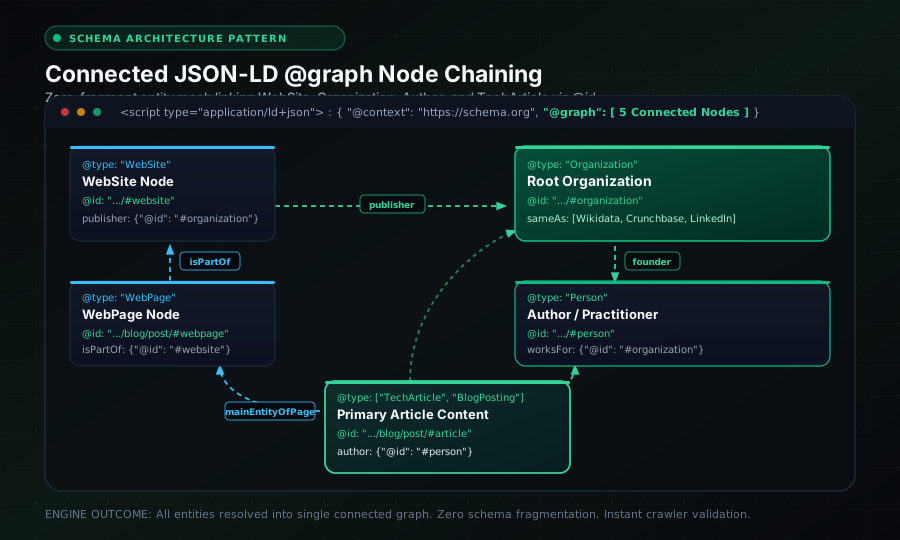
The architectural solution is to compile all schema declarations on a page into a single, cohesive @graph array within a single JSON-LD block. Per the official Schema.org Connected Graph Documentation and Google Search Central Structured Data Guidelines, this structure models a true directed graph.
Every primary entity on your domain receives a permanent URI fragment identifier using hash syntax:
https://domain.com/#organizationhttps://domain.com/#personhttps://domain.com/#websitehttps://domain.com/blog/article-slug/#webpagehttps://domain.com/blog/article-slug/#article
Nodes reference each other exclusively through their @id URIs. When the TechArticle node declares its publisher, it does not redeclare the organization’s address and logo; it simply writes:
"publisher": { "@id": "https://domain.com/#organization" }Production @graph JSON-LD Template
Below is the production-ready @graph JSON-LD template I deploy across high-performance client architectures. It unifies Organization, Person, WebSite, WebPage, and TechArticle into an unbreakable semantic graph:
<script type="application/ld+json">
{
  "@context": "https://schema.org",
  "@graph": [
    {
      "@type": "Organization",
      "@id": "https://mostafadaoud.com/#organization",
      "name": "Mostafa Daoud Technical Growth Architecture",
      "url": "https://mostafadaoud.com",
      "logo": {
        "@type": "ImageObject",
        "@id": "https://mostafadaoud.com/#logo",
        "url": "https://mostafadaoud.com/images/logo.png",
        "caption": "Mostafa Daoud"
      },
      "founder": {
        "@id": "https://mostafadaoud.com/#person"
      },
      "sameAs": [
        "https://www.wikidata.org/wiki/Q11463",
        "https://www.linkedin.com/in/mostafadaoud",
        "https://github.com/mdawood94",
        "https://x.com/MostafaDaoud94"
      ]
    },
    {
      "@type": "Person",
      "@id": "https://mostafadaoud.com/#person",
      "name": "Mostafa Daoud",
      "url": "https://mostafadaoud.com/about",
      "jobTitle": "Principal Technical Growth Architect",
      "worksFor": {
        "@id": "https://mostafadaoud.com/#organization"
      },
      "knowsAbout": [
        "https://en.wikipedia.org/wiki/Search_engine_optimization",
        "https://www.wikidata.org/wiki/Q11463",
        "https://en.wikipedia.org/wiki/Knowledge_Graph",
        "https://en.wikipedia.org/wiki/Information_retrieval"
      ],
      "sameAs": [
        "https://www.linkedin.com/in/mostafadaoud",
        "https://github.com/mdawood94",
        "https://x.com/MostafaDaoud94"
      ]
    },
    {
      "@type": "WebSite",
      "@id": "https://mostafadaoud.com/#website",
      "url": "https://mostafadaoud.com",
      "name": "Mostafa Daoud",
      "publisher": {
        "@id": "https://mostafadaoud.com/#organization"
      },
      "inLanguage": "en-US"
    },
    {
      "@type": "WebPage",
      "@id": "https://mostafadaoud.com/blog/entity-seo-knowledge-graph-architecture/#webpage",
      "url": "https://mostafadaoud.com/blog/entity-seo-knowledge-graph-architecture/",
      "name": "Entity SEO and Knowledge Graph Architecture for Generative Engines",
      "isPartOf": {
        "@id": "https://mostafadaoud.com/#website"
      },
      "about": [
        {
          "@type": "Thing",
          "name": "Entity SEO",
          "sameAs": "https://en.wikipedia.org/wiki/Search_engine_optimization"
        },
        {
          "@type": "Thing",
          "name": "Knowledge Graph",
          "sameAs": "https://en.wikipedia.org/wiki/Knowledge_Graph"
        }
      ],
      "inLanguage": "en-US"
    },
    {
      "@type": ["TechArticle", "BlogPosting"],
      "@id": "https://mostafadaoud.com/blog/entity-seo-knowledge-graph-architecture/#article",
      "isPartOf": {
        "@id": "https://mostafadaoud.com/blog/entity-seo-knowledge-graph-architecture/#webpage"
      },
      "headline": "Entity SEO and Knowledge Graph Architecture for Generative Engines",
      "description": "Master Entity SEO and knowledge graph architecture. Learn how to disambiguate your brand in ChatGPT, Perplexity, and Google with connected JSON-LD graphs.",
      "inLanguage": "en-US",
      "mainEntityOfPage": "https://mostafadaoud.com/blog/entity-seo-knowledge-graph-architecture/",
      "datePublished": "2026-11-03T08:00:00+00:00",
      "dateModified": "2026-11-03T08:00:00+00:00",
      "author": {
        "@id": "https://mostafadaoud.com/#person"
      },
      "publisher": {
        "@id": "https://mostafadaoud.com/#organization"
      },
      "proficiencyLevel": "Expert"
    }
  ]
}
</script>
When an automated crawler or RAG pipeline processes this code, it traverses a fully resolved relational database. It knows unequivocally that the author of this technical post is Mostafa Daoud, that he is the founder of the publishing organization, that the organization is anchored in verified registers, and that the document’s primary subject matter maps directly to global concepts defined in Wikipedia and Wikidata.
Off-Site Digital Footprint Triangulation: Why On-Page Schema Is Not Enough
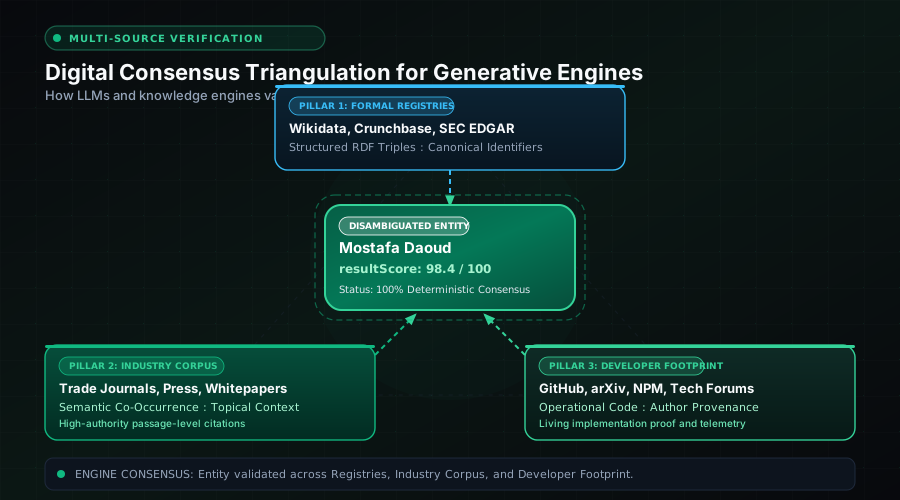
On-page Schema.org markup represents an unverified self-claim that search algorithms and generative models validate through external digital footprint triangulation. Anyone can write JSON-LD declaring their company to be an industry leader, but neural search engines verify those declarations against independent digital corpora before granting entity status. This triangulation process inspects high-authority external sources, including Wikidata entries, Wikipedia citations, GitHub enterprise repositories, financial filings, and reputable trade publications. Furthermore, retrieval systems evaluate semantic co-occurrence patterns, measuring the vector distance between your brand name and your target technical topics across third-party text. If your brand only appears on promotional press release networks, algorithms assign a negligible factual probability score. Complementing external validation with machine-readable manifests like llms.txt provides autonomous agents with concise, pre-structured entity models that bypass HTML parsing friction. True entity authority requires aligning your internal schema declarations with authoritative external corroboration, creating an unshakeable digital consensus across the broader web ecosystem.
A core operational principle of modern information retrieval: Internal schema is an unverified assertion.
If Google or OpenAI accepted on-page JSON-LD as ground truth, any bad actor could spin up a disposable domain, inject schema claiming to be the Central Intelligence Agency or a Fortune 50 investment bank, and monopolize sensitive financial queries.
Search algorithms treat internal schema as a hypothesis. To turn that hypothesis into an accepted fact, algorithms execute Digital Consensus Triangulation.
The Mechanics of Digital Consensus Triangulation
When Google’s Knowledge Vault or an LLM’s pre-training pipeline processes your entity declarations, it cross-references your claims across three distinct digital zones:
- Zone 1: Controlled First-Party Claims (Your Properties)
- On-page
@graphJSON-LD markup. - Canonical website copy, leadership bios, and
/aboutpages. - Root-level machine manifests (
llms.txt).
- On-page
- Zone 2: Immutable Structured Registers (Deterministic Ground Truth)
- Wikidata items with verified properties.
- SEC EDGAR filings, GLEIF LEI registers, and national corporate records.
- Crunchbase organizational profiles.
- Zone 3: Uncontrolled Third-Party Corroboration (Semantic Consensus)
- Tier-1 industry trade publications (TechCrunch, VentureBeat, Ars Technica, Gartner).
- Open-source code repositories (GitHub organization accounts, releases, documentation).
- Technical community discourse (Stack Overflow, Hacker News, Reddit discussions).
- Academic research citations (arXiv, IEEE, Google Scholar).
If your internal schema asserts that your company is a leading provider of enterprise data pipeline software, but your brand string token only appears on paid wire distribution sites (PR Newswire, Business Wire), the algorithmic entity confidence score remains near zero.
Why? Because algorithms recognize syndication footprints. Wire releases represent self-published marketing collateral, not independent corroboration.
Semantic Co-Occurrence and Vector Neighborhoods
In dense vector space, words that appear in similar linguistic contexts occupy neighboring coordinates.
When an LLM or neural search index evaluates your brand name, it calculates the semantic co-occurrence distance between your brand token and your target topical tokens across the web.
- Weak Co-Occurrence: Your brand token appears exclusively alongside words like “press release,” “discount,” “leading provider,” “announced today,” and “contact sales.” The model assigns your brand to a generic promotional vector cluster.
- Strong Co-Occurrence: Your brand token appears naturally across third-party engineering blogs, GitHub README files, and industry technical reviews alongside terms like “PostgreSQL replication lag,” “distributed tracing,” “RAG vector retrieval,” and “Kubernetes daemonset.” The model mathematically clusters your brand directly inside the technical problem domain.
When a user prompts ChatGPT or Perplexity for solutions to distributed tracing bottlenecks, the model’s retrieval layer surfaces your brand because your entity token is embedded directly inside that conceptual neighborhood.
The Modern Frontier: Machine-Readable Manifests (llms.txt)
In 2025 and 2026, autonomous LLM agents (Perplexity crawler, GPTBot, ClaudeBot, Google-Extended) increasingly look for standardized machine-readable manifests placed at the root of a domain.
Standardized by the open-source community, public/llms.txt and public/llms-full.txt provide a clean, Markdown-formatted summary of your brand, core service architectures, and verified case study metrics:
# Mostafa Daoud: Technical Growth Architecture

> Principal Technical Growth Architect and Enterprise Technical SEO Consultant.
> Specializing in Entity SEO, Knowledge Graph Architecture, and Generative Engine Optimization (GEO).

## Core Capabilities
- Enterprise Technical SEO Audits and Architecture
- Generative Engine Optimization (ChatGPT Search, Perplexity, Google AI Overviews)
- Knowledge Graph Disambiguation and Connected JSON-LD Graphs
- Core Web Vitals and Origin Infrastructure Governance

## Verified Case Studies
- FigPii: Engineered technical CRO and organic search architecture driving +200% growth.
- e-cens: Scaled enterprise technical content architecture generating 4.3M+ impressions.
By providing a clean, token-efficient manifest, you allow AI scrapers to ingest your verified entity claims without parsing through megabytes of JavaScript client bundles, navigation menus, and CSS styling.
Practitioner Proof Point: When I architected organic search and conversion systems at FigPii, achieving +200% growth was not the result of pumping out commodity blog posts. It was achieved by eliminating technical rendering bottlenecks, restructuring site architecture, and building unambiguous topical authority. Review the full methodology in the FigPii Case Study.
Production Audit Protocol: Auditing Entity Confidence with the Google Knowledge Graph API
Auditing entity health requires querying search engine knowledge repositories directly rather than relying solely on visual SERP observation or generic schema validators. The Google Knowledge Graph Search API provides programmatic access to Googles entity database, returning canonical Machine IDs, recognized entity types, and a floating-point confidence score known as resultScore. This metric quantifies how firmly Google associates an entity name with its specific real-world identity. High-confidence enterprise entities typically return scores exceeding two hundred, while ambiguous entities or those suffering namespace collisions return low scores or alternate competing entities. By incorporating programmatic API audits into your development pipelines, engineering teams can detect brand drift, verify entity establishment, and measure the effectiveness of disambiguation updates over time. Combining Knowledge Graph API telemetry with automated schema syntax validation and external citation monitoring delivers an objective, verifiable measurement framework for enterprise entity optimization across search ecosystems.
Most marketing teams audit entity optimization by simply typing their brand name into a browser and observing whether a Knowledge Panel appears on the right side of the screen.
This manual approach is flawed:
- Personalization Bias: Visual SERP features are heavily skewed by geographic IP location, personalized browsing history, and device type.
- Binary Limitation: A Knowledge Panel is a binary outcome (it shows or it does not). It reveals nothing about how close an emerging brand is to crossing the internal confidence threshold.
- Namespace Blindness: Visual search rarely surfaces low-level namespace collisions that affect generative answer engines.
The programmatic solution is to query Google’s Knowledge Graph directly using the official Google Knowledge Graph Search API.
+-------------------------------------------------------------------------+
|             KNOWLEDGE GRAPH SEARCH API TELEMETRY AUDIT                  |
+-------------------------------------------------------------------------+
                                     |
                                     v
                 [ GET https://kgsearch.googleapis.com/v1 ]
                 [ query: "Target Brand"                  ]
                                     |
                                     v
                       +---------------------------+
                       |  Google KG API Response   |
                       |  itemListElement Array    |
                       +---------------------------+
                                     |
                 +-------------------+-------------------+
                 |                                       |
                 v                                       v
     +-----------------------+               +-----------------------+
     |   resultScore > 200   |               |   resultScore < 50    |
     |   Canonical MID Match |               |   Namespace Collision |
     |   STATUS: OPTIMIZED   |               |   STATUS: AT RISK     |
     +-----------------------+               +-----------------------+
The resultScore Metric Explained
When you query the Knowledge Graph Search API, Google returns an array of matching entities wrapped in an itemListElement. Each result includes an explicit numerical metric: resultScore.
The resultScore is a floating-point calculation representing Google’s algorithmic confidence in the entity match:
- Scores > 500: Established global entities with massive digital consensus (e.g., Apple, Microsoft, United Nations).
- Scores 200 to 500: Robust enterprise entities, well-known software products, and prominent industry figures. The entity is firmly disambiguated and reliably generates Knowledge Panels.
- Scores 50 to 200: Emerging entities. The Knowledge Graph recognizes the concept, but identity signals remain fragile. Minor namespace shifts can cause the entity to lose its panel.
- Scores < 50: Ambiguous entities. The brand is at severe risk of being conflated with competing entities or omitted by generative AI search pipelines.
Production Python Audit Tool
Below is a production-grade Python audit script I use to evaluate client entity health. It queries the Google Knowledge Graph Search API, extracts the canonical MID, parses entity classifications, evaluates resultScore, and flags potential namespace collisions:
"""
Google Knowledge Graph Entity Disambiguation Auditor
Author: Mostafa Daoud (mostafadaoud.com)
Description: Programmatic audit of brand entity recognition and namespace collisions.
"""

import json
import urllib.parse
import urllib.request
from typing import Dict, Any, List

def query_knowledge_graph(query: str, api_key: str, entity_types: List[str] = None, limit: int = 5) -> Dict[str, Any]:
    """
    Queries the Google Knowledge Graph Search API and returns entity records.
    """
    endpoint = "https://kgsearch.googleapis.com/v1/entities:search"
    params = {
        "query": query,
        "key": api_key,
        "limit": limit,
        "indent": True
    }
    if entity_types:
        params["types"] = entity_types

    url = f"{endpoint}?{urllib.parse.urlencode(params, doseq=True)}"
    req = urllib.request.Request(
        url,
        headers={"User-Agent": "EntityAuditProtocol/1.0 (mostafadaoud.com)"}
    )

    try:
        with urllib.request.urlopen(req) as response:
            return json.loads(response.read().decode("utf-8"))
    except Exception as error:
        print(f"Error querying Knowledge Graph API: {error}")
        return {}

def evaluate_entity_telemetry(query: str, api_data: Dict[str, Any]) -> None:
    """
    Analyzes API response and outputs a structured entity health diagnostic.
    """
    items = api_data.get("itemListElement", [])
    if not items:
        print(f"[-] No entity records discovered for '{query}'.")
        print("    Diagnostic: High risk of generative omission and namespace collision.")
        return

    print(f"\n[+] Google Knowledge Graph Disambiguation Telemetry: '{query}'")
    print("=" * 72)

    for rank, item in enumerate(items, start=1):
        result = item.get("result", {})
        score = item.get("resultScore", 0.0)
        name = result.get("name", "Unknown")
        entity_id = result.get("@id", "N/A")
        types = result.get("@type", [])
        desc = result.get("description", "No description provided")
        snippet = result.get("detailedDescription", {}).get("articleBody", "")
        url = result.get("url", "None")

        status = "CANONICAL PRIMARY MATCH" if rank == 1 and score > 150 else "POTENTIAL NAMESPACE COLLISION"

        print(f"Rank {rank} | Status: {status}")
        print(f"  Entity Name:   {name}")
        print(f"  Machine ID:    {entity_id}")
        print(f"  Schema Types:  {', '.join(types)}")
        print(f"  resultScore:   {score:.2f}")
        print(f"  Description:   {desc}")
        if snippet:
            print(f"  Corpus Text:   {snippet[:110]}...")
        if url != "None":
            print(f"  Canonical URL: {url}")
        print("-" * 72)

if __name__ == "__main__":
    # Supply your Google Cloud Console API Key enabled for Knowledge Graph Search API
    API_KEY = "YOUR_GOOGLE_KG_API_KEY"
    TARGET_ENTITY = "Mostafa Daoud"

    telemetry = query_knowledge_graph(query=TARGET_ENTITY, api_key=API_KEY, limit=5)
    evaluate_entity_telemetry(TARGET_ENTITY, telemetry)
By running this audit script in continuous integration or monthly reporting cadences, engineering teams can track their resultScore trajectory and immediately spot when an external brand begins encroaching on their corporate namespace.
| Disambiguation Register | Authority Type | Primary Identifier | Verification Mechanism | Generative Engine Weight | Last Verified |
|---|---|---|---|---|---|
| Wikidata | Open Collaborative Semantic Database | Q-ID (e.g., Q11463) |
Community consensus, verified references, strict property constraints | Critical (Directly ingested into LLM pre-training weights) | November 2026 |
| Google Knowledge Graph | Proprietary Search Engine Graph | Machine ID (kgmid, e.g., /g/11...) |
Algorithmic web-scale extraction, Knowledge Vault probabilistic fusion | Critical (Governs Google AI Overviews and Search citations) | November 2026 |
| Crunchbase | Commercial Business Intelligence Graph | Organization Slug / Permlink | Editorial verification, verified funding rounds, corporate filings | High (Frequently crawled by real-time RAG agents) | November 2026 |
| SEC EDGAR / GLEIF | Government & Regulatory Registries | CIK Number / 20-character LEI | Official statutory filings, audited legal compliance records | Highest (Infallible ground truth for public corporations) | November 2026 |
| Connected JSON-LD | First-Party Domain Schema | URI Fragment (#organization) |
On-page code validation, digital consensus triangulation | Foundation (Provides the structural roadmap for machine parsers) | November 2026 |
Frequently Asked Questions About Entity SEO and Knowledge Graphs
What is the technical difference between traditional SEO and Entity SEO?
Traditional SEO optimizes strings and documents using keyword frequency, URL structures, and page-level backlink counts within an inverted index. Entity SEO organizes brand knowledge into real-world objects, concepts, and relationships defined by semantic triples (Subject - Predicate - Object). Search engines and generative answer engines resolve these entities against structured knowledge graphs, evaluating identity, authority, and factual consensus rather than superficial keyword matching.
Can my business obtain a Google Knowledge Panel without a Wikipedia article?
Yes. While Wikipedia offers high authority, Google creates Knowledge Graph entities using algorithmic consensus across multiple canonical sources. Maintaining consistent, interconnected JSON-LD schema on your authoritative domain, establishing an active Wikidata item with verified properties, maintaining an updated Crunchbase profile, securing government or regulatory registrations, and earning unprompted coverage across trade publications allows Google to reach the confidence threshold needed for a Knowledge Panel.
Why should I avoid placing twenty social media profile links inside the sameAs array?
The sameAs property establishes strict entity equivalence, asserting that two URIs reference the identical real-world entity. Flooding this property with dozens of informal, user-generated social media profiles introduces noise into neural entity resolvers. If any profile is renamed, abandoned, or exhibits mixed brand signals, entity confidence degrades. Restrict sameAs to four to six immutable, authoritative endpoints such as Wikidata, Crunchbase, official corporate LinkedIn, and regulatory registers.
How do generative search engines like ChatGPT and Perplexity select which brands to cite?
Generative search engines utilize hybrid retrieval combining lexical BM25 search with dense vector embeddings, followed by cross-encoder reranking. When an engine evaluates candidate sources, it extracts candidate entities and checks them against its parametric memory and retrieval index. Brands with unambiguous entity grounding, verified machine identifiers, and strong off-site digital consensus receive higher factual confidence scores, leading to consistent citations while ambiguous competitors are filtered out.
What is the relationship between connected @graph JSON-LD and RAG pipelines in AI search?
Retrieval-Augmented Generation (RAG) pipelines convert web documents into chunked vector embeddings. When schema markup is fragmented across disconnected script tags, chunking algorithms frequently separate the author, organization, and article context. A unified @graph array chains all nodes together through explicit URI fragment identifiers, enabling neural parsers to extract the entire relational graph in a single pass and preserving critical attribution metadata throughout retrieval.
Eliminate entity ambiguity. Win authoritative citations in generative search.
Whether your brand is suffering from namespace collisions, fragmented schema markup, or complete omission in ChatGPT Search and Perplexity, I work directly with your engineering and growth teams to architect resilient knowledge graphs that establish unshakeable digital authority.

Eliminate structural crawl debt. Secure permanent search & AI visibility.
Whether managing multi-million-URL dynamic catalogs, migrating to a headless stack, or establishing citation dominance inside ChatGPT and Perplexity, I diagnose and unblock high-stakes technical bottlenecks directly with your engineering and growth leaders.
Direct practitioner engagement. Zero junior agency handoffs. You leave with prioritized engineering fixes.