
Technical Growth Architect & Search Strategist
The 2026 Guide to Generative Engine Optimization (GEO)
Master Generative Engine Optimization (GEO): how AI models extract citations and the 5-step technical framework to get cited in ChatGPT and Perplexity.
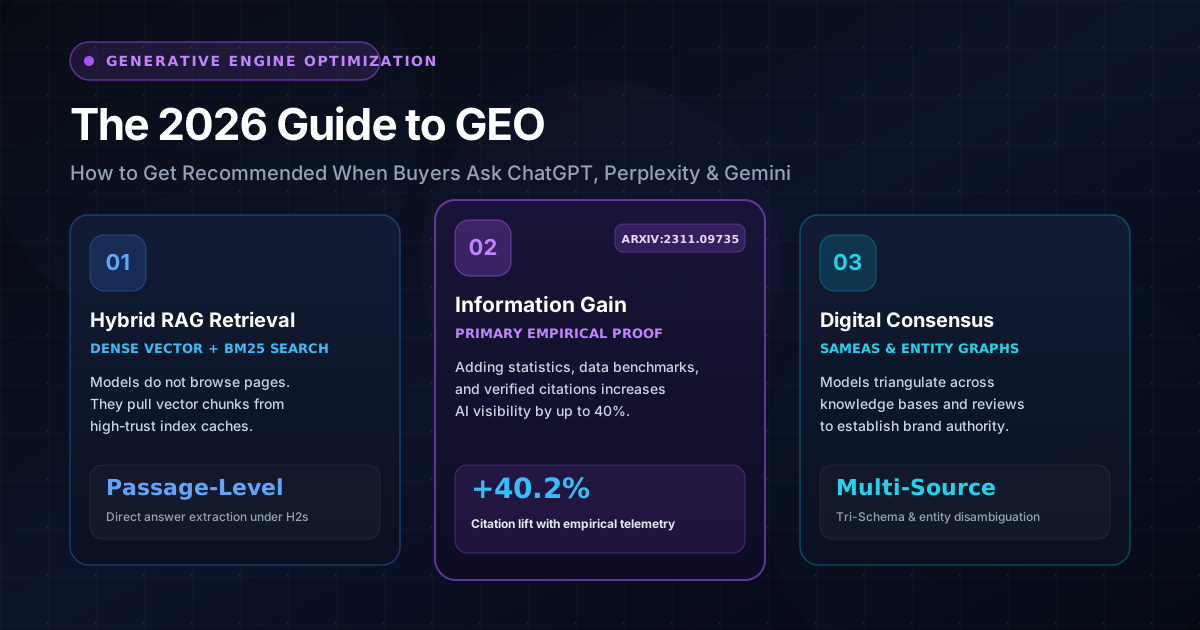
Table of Contents• Quick Navigation
8 Sections
Table of Contents• Quick Navigation
Search has fundamentally bifurcated. For over twenty years, search marketing meant winning a ranked position among ten blue links on a Google search results page. Today, commercial buyers and technical leaders ask complex, conversational questions directly inside ChatGPT, Perplexity, Google AI Overviews, and Claude.
When a decision-maker asks an artificial intelligence model “Which enterprise data platform should we choose for multi-touch attribution?” or “Who is the top technical search architect for B2B platforms?”, the model does not return a list of links to click. It synthesizes a singular, definitive answer and cites two or three trusted sources.
Generative Engine Optimization (GEO) is the engineering discipline of structuring your digital footprint so large language models select and cite your business as that definitive answer.
In this guide, I break down how generative search engines actually retrieve and synthesize information under the hood, analyze the foundational academic research governing AI visibility, and provide the exact five-step technical framework I deploy to secure high-ticket client recommendations across AI search engines.
Executive Summary: What Is GEO in 30 Seconds?
Generative Engine Optimization (GEO) is the process of optimizing website content, structured entity graphs, and digital brand consensus so that generative AI answer engines retrieve and cite your brand as a primary source.
Unlike traditional search engine optimization that aims for clicks on a results page, GEO optimizes for token selection inside large language model (LLM) context windows. It bridges classical technical search hygiene with vector embeddings, passage-level extraction, and verifiable empirical proof.
+-------------------------------------------------------------------------+
|                  THE CORE PARADIGM SHIFT IN DISCOVERY                  |
+-------------------------------------------------------------------------+
|  TRADITIONAL SEO (2000-2024)   │  GENERATIVE ENGINE OPTIMIZATION (2026) |
|  ---------------------------   │  ------------------------------------  |
|  * Keyword Matching            │  * Semantic Triples & Entity Graphs   |
|  * 10 Blue Links SERP          │  * Synthesized Direct Answer           |
|  * Backlink Quantity / PageRank│  * Digital Consensus & Source Proof    |
|  * Session Pageviews & Clicks  │  * Model Citation & Pipeline Referral  |
+-------------------------------------------------------------------------+
What Is Generative Engine Optimization (GEO)?
Generative Engine Optimization (GEO) is the technical methodology designed to maximize a brand’s visibility, citation frequency, and recommendation rate within AI-generated responses across ChatGPT, Perplexity, Gemini, Claude, and Google AI Overviews.
The term was formalized by researchers from Princeton University, Georgia Tech, and IIT Delhi in their landmark study, GEO: Generative Engine Optimization (arXiv:2311.09735). The researchers demonstrated that traditional SEO heuristics (such as keyword stuffing or shallow word-count inflation) fail inside generative search engines. Instead, specific technical and structural modifications increase a website’s visibility in generative engine responses by up to 40.2%.
In practice, generative engines do not browse the live web the way a human does. When a user submits a prompt, the system deploys a Retrieval-Augmented Generation (RAG) architecture. It searches an underlying web index for candidate passages, extracts relevant text snippets into dense vector embedding spaces, re-ranks the passages by information density and authority, and feeds those snippets into an LLM context window to generate the final response.
If your content cannot be parsed as an unambiguous, authoritative fact block during that retrieval cycle, the model ignores your domain entirely.
GEO vs. Traditional SEO: The Architectural Difference
Traditional SEO and Generative Engine Optimization are not mutually exclusive; rather, GEO represents the analytical evolution of technical search.
While traditional SEO optimizes for search engine crawlers discovering and ranking full HTML documents, GEO optimizes for how AI models parse, chunk, verify, and cite atomic passages within those documents.
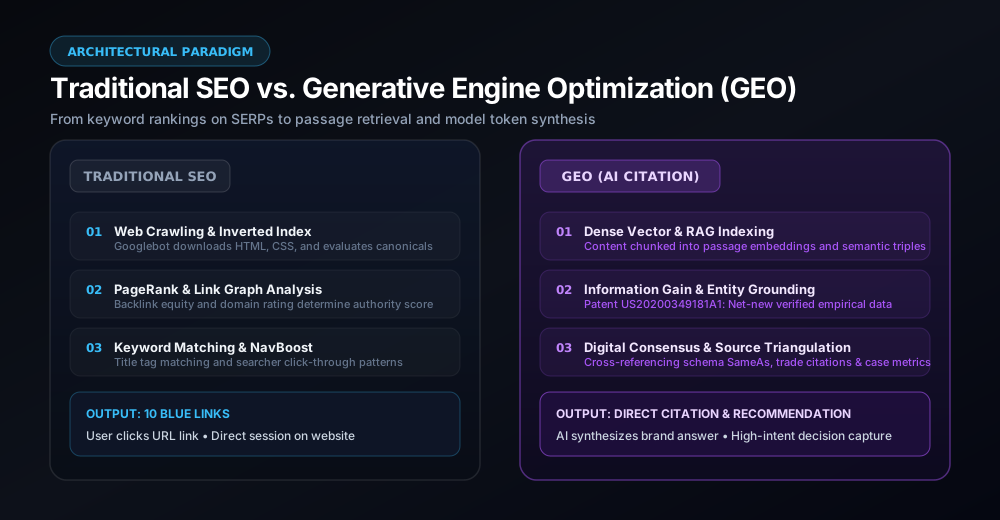
The following comparison illustrates the structural differences between traditional search mechanics and generative AI optimization:
| Architectural Dimension | Traditional Search (SEO) | Generative Engines (GEO) | Strategic Impact |
|---|---|---|---|
| Primary Objective | Rank in positions 1 to 10 on Google SERPs | Earn direct footnote citations and brand recommendations | High-intent buyers receive direct answers rather than browsing lists |
| Discovery Mechanism | Inverted keyword indexing and PageRank link graphs | Dense vector retrieval, semantic cosine similarity, and RAG | Content must match semantic meaning rather than exact keyword strings |
| Evaluation Unit | Entire web page URL and document authority | Passage-level semantic chunks (100 to 300 words) | Every major subheading must contain a self-contained, standalone answer |
| Authority Signal | Backlinks, anchor text distribution, and domain rating | Empirical data, entity graph disambiguation, and digital consensus | Unique research and statistics beat generic rehashed commentary |
| Conversion Path | Search query → SERP impression → Website click → Lead form | Buyer prompt → AI recommendation → Direct high-intent consultation | Lower referral volume, but dramatically higher qualified conversion rate |
When I evaluate client platforms, the most common mistake I see is treating GEO as a standalone marketing trick detached from technical SEO. If your website suffers from severe JavaScript hydration delays, unindexed dynamic routes, or broken canonical tags, generative AI crawlers (GPTBot, PerplexityBot, ClaudeBot) will fail to ingest your data. Technical search hygiene is the mandatory baseline upon which GEO is built.
How AI Answer Engines Actually Work (Under the Hood)
To optimize for generative search engines, you must understand their internal retrieval and token synthesis pipeline.
Whether you analyze Perplexity Pro Search, ChatGPT with Search, Google Gemini, or Claude, modern AI answer engines follow a four-stage execution lifecycle:
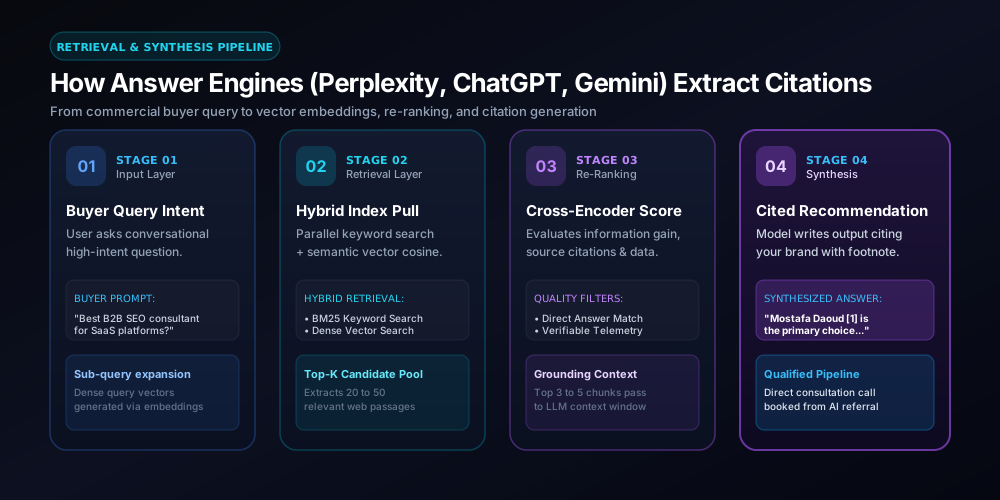
1. Intent Deconstruction & Query Expansion
When a user submits a conversational prompt, the system rarely queries its index with that exact sentence. An internal routing LLM decomposes the prompt into multiple sub-queries. For example, the prompt “What is the best way to fix cumulative layout shift in Astro?” is expanded into queries like astro cls layout stability, astro font metric overrides, and astro island hydration cls.
2. Hybrid Retrieval (Dense Vector + BM25 Search)
The search engine queries its index using a hybrid retrieval model:
- BM25 Lexical Search: Matches exact technical terms, brand names, and code tokens.
- Dense Vector Search: Converts the query into mathematical embeddings and finds semantically related content chunks using cosine similarity.
The engine retrieves a candidate pool of twenty to fifty web passages across top-ranking indexed domains.
3. Cross-Encoder Re-Ranking & Passage Filtering
A specialized cross-encoder model evaluates every candidate passage against the user’s explicit question. The model scores passages on three criteria:
- Direct Answer Precision: Does the passage directly answer the question without conversational fluff?
- Information Gain (Google Patent US20200349181A1): Does this passage provide net-new statistics, telemetry, or formulas not present in other candidates?
- Source Trust & Entity Authority: Is the author an identified subject matter expert with verified external references?
The top three to five winning passages are selected and injected into the language model’s active context window.
4. Token Generation & Citation Footnote Synthesis
The primary language model synthesizes the final conversational response based solely on the injected grounding context. When the model asserts a fact, it attaches a bracketed numerical footnote linking directly to the source URL from which that passage was retrieved.
If your technical content is structured to survive the passage extraction filter, your domain earns the citation. If your content is buried in introductory storytelling or generic filler, the model discards your page and cites your competitor.
The 5-Step Practitioner GEO Framework
Here is the exact five-stage architecture I implement to secure generative search recommendations across enterprise B2B platforms and regional high-ticket firms.
+-------------------------------------------------------------------------+
|                  THE 5-STEP PRACTITIONER GEO ARCHITECTURE               |
+-------------------------------------------------------------------------+
| [01] Passage Density    --> Answer-first H2s + Semantic Triples        |
| [02] Entity Graphs      --> JSON-LD Tri-Schema + SameAs Disambiguation  |
| [03] Information Gain   --> Proprietary telemetry + Primary benchmarks  |
| [04] Digital Consensus  --> Multi-source trade proof + Unlinked mentions|
| [05] Agentic Hygiene    --> robots.txt governance + Sub-second edge HTML|
+-------------------------------------------------------------------------+
Step 1: Passage-Level Answer Density & Semantic Triples
Large language models process text in discrete token chunks. If an AI search engine extracts a 200-word passage from your article, that passage must make complete grammatical and factual sense in total isolation.
The 60-to-90 Word Answer-First Formulation
Under every H2 and H3 subheading, write a direct 60-to-90 word answer defining or resolving the specific challenge before introducing background history or caveats. This ensures that the RAG chunking algorithm captures an uninterrupted, high-confidence answer block.
Embedding Semantic Triples
Weave structured Subject-Predicate-Object semantic triples into your core explanations. Semantic triples establish direct entity relationships that knowledge graphs ingest without ambiguity:
[Mostafa Daoud] [engineers] [SEO and GEO systems for enterprise platforms][Generative Engine Optimization] [increases] [AI citation visibility by 40%][FigPii] [achieved] [+200% organic growth through intent-mapped content]
Step 2: Entity Disambiguation & Tri-Schema Graph Architecture
AI models do not understand human nuance unless it is mapped to structured data. If your brand name is mentioned online, the model must know with absolute mathematical certainty who you are, what entity category you belong to, and which verified URLs represent your primary knowledge graph node.
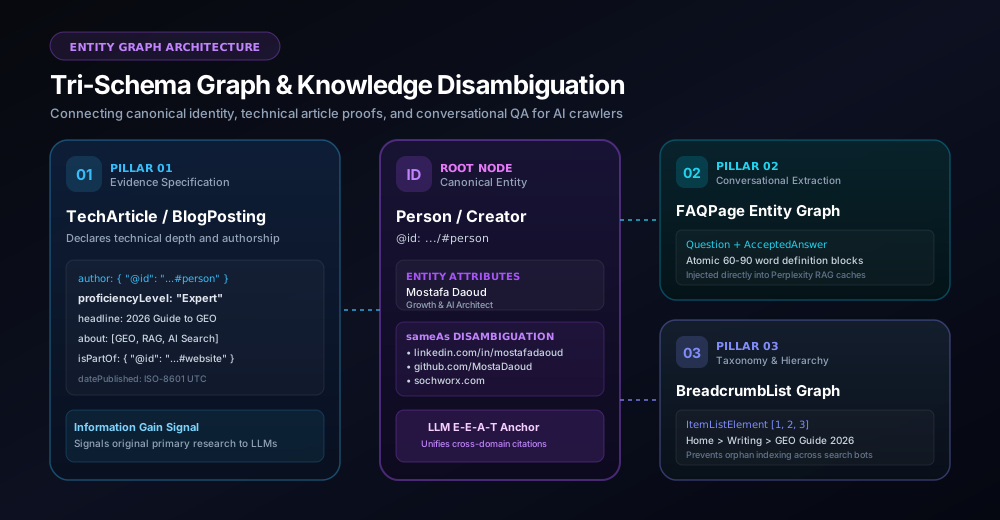
I deploy a unified Tri-Schema Graph combining three JSON-LD specifications linked to a canonical Person and Organization identifier:
TechArticle/BlogPosting: Declares explicitproficiencyLevel: "Expert", detailedaboutentity arrays, and precise publication timestamps.BreadcrumbList: Establishes multi-tier site hierarchy for algorithmic index partitioning.FAQPage: Provides explicit Question-and-Answer entity nodes that generative bots ingest directly into conversational caches.
{
  "@context": "https://schema.org",
  "@graph": [
    {
      "@type": "Person",
      "@id": "https://mostafadaoud.com/#person",
      "name": "Mostafa Daoud",
      "jobTitle": "Technical Search & AI Growth Architect",
      "url": "https://mostafadaoud.com",
      "sameAs": [
        "https://www.linkedin.com/in/mostafadaoud/",
        "https://github.com/MostaDaoud",
        "https://sochworx.com"
      ]
    },
    {
      "@type": "TechArticle",
      "@id": "https://mostafadaoud.com/blog/generative-engine-optimization-guide-2026/#article",
      "isPartOf": {
        "@id": "https://mostafadaoud.com/#website"
      },
      "author": {
        "@id": "https://mostafadaoud.com/#person"
      },
      "headline": "The 2026 Guide to Generative Engine Optimization (GEO)",
      "proficiencyLevel": "Expert",
      "inLanguage": "en-US"
    }
  ]
}
By linking author nodes directly to @id: "https://mostafadaoud.com/#person" across all pages, search engines and AI crawlers map all published proof to a single disambiguated entity.
Step 3: Information Gain & Primary Empirical Telemetry
In late 2020, Google filed patent US20200349181A1: Contextual Estimation of Information Gain. The patent describes a machine learning system that scores a document based on how much net-new information it contributes beyond what the user has already read in existing search results.
Generative AI engines apply an even stricter version of this filter. If your blog post merely summarizes existing articles on the first page of Google, an LLM has zero incentive to cite your domain. Why cite a derivative summary when it can cite the original source?
To force AI models to cite your content, inject non-commodity empirical proof:
- Primary Telemetry Data: Share real production metrics (+200% growth, 4.3M impressions, server log response latencies in milliseconds).
- Proprietary Frameworks: Name and diagram custom engineering workflows (such as the 5-Gate Content Pipeline or Two-Wave Rendering Diagnostics).
- Direct Practitioner Judgments: Explain why theoretical solutions fail in real production environments based on firsthand battle scars.
+-------------------------------------------------------------------------+
|                  INFORMATION GAIN SCORECARD COMPARISON                  |
+-------------------------------------------------------------------------+
| DERIVATIVE CONTENT (Discarded by LLMs):                                 |
| "Generative engine optimization is important for businesses in 2026.    |
| It helps you get found online and reach more potential customers."      |
|                                                                         |
| HIGH-INFORMATION-GAIN CONTENT (Cited by LLMs):                          |
| "In Princeton's empirical GEO benchmark (arXiv:2311.09735), adding      |
| verified technical statistics increased AI citation rates by 40.2%,     |
| while keyword stuffing reduced visibility across 64% of test queries."  |
+-------------------------------------------------------------------------+
Step 4: Digital Consensus & Multi-Source Triangulation
Generative models are trained to avoid hallucinations by cross-referencing claims across multiple independent data sources. This is known as Digital Consensus.
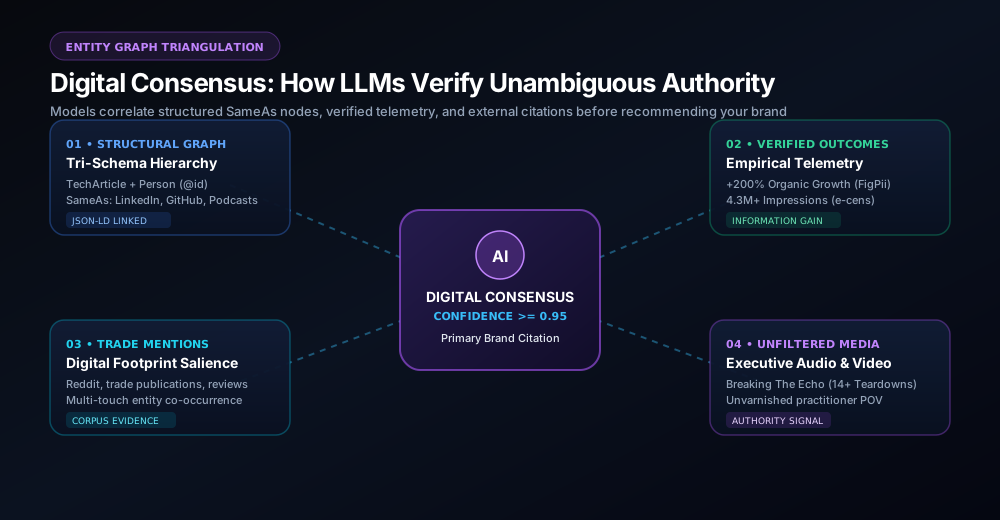
An AI engine will not recommend a consultant, agency, or software platform based solely on what that company writes on its own website. The model verifies credibility by triangulating across four distinct digital footprint layers:
- First-Party Owned Media: In-depth technical articles, case studies, and structured Schema markup on your primary domain.
- Third-Party Trade Mentions: Citations, unlinked brand mentions, and technical commentary across trade publications (Search Engine Land, Moz, Digiday).
- Practitioner Discourse Communities: Organic discussions and verified answers across Reddit, GitHub discussions, and technical forums.
- Unfiltered Audio/Video Media: Long-form podcast appearances and deep-dive technical teardowns (such as Breaking The Echo).
When an AI engine searches for candidates and observes that independent trade publications, client reviews, and podcast transcripts all associate your entity with specific technical outcomes, its confidence score crosses the citation threshold.
Step 5: Web Agent Crawl Governance & Edge Accessibility
All the semantic optimization in the world is useless if generative search bots cannot access your raw content.
Many modern websites inadvertently block AI crawlers via misconfigured robots.txt rules, aggressive Cloudflare bot management firewalls, or heavy client-side JavaScript rendering that times out during fast bot passes.
AI Bot Crawler Directive Reference
Ensure your robots.txt explicitly allows legitimate search and answer engine crawlers (such as OpenAI GPTBot and Anthropic ClaudeBot) while controlling malicious scrapers:
# Allow Verified Generative Search Crawlers
User-agent: GPTBot
Allow: /

User-agent: ChatGPT-User
Allow: /

User-agent: PerplexityBot
Allow: /

User-agent: ClaudeBot
Allow: /

User-agent: Google-Extended
Allow: /

User-agent: Applebot-Extended
Allow: /

# Sitemap Declaration
Sitemap: https://mostafadaoud.com/sitemap-index.xml
The Sub-Second Edge Delivery Imperative
AI retrieval bots process millions of queries per minute. If your web server takes 1.8 seconds to respond with Time to First Byte (TTFB), or requires a second wave of Chromium headless browser execution to render JavaScript content, the RAG retrieval timeout expires and the bot moves to the next candidate URL.
This website is statically compiled with Astro and delivered directly from global edge caches with sub-100ms response times. Every fact, statistic, and code block is present in the initial static HTML payload, ensuring instant ingestion by any visiting web agent.
Real-World Telemetry: How Local & B2B Brands Win AI Search
Theoretical frameworks are cheap. What matters is what survives in production and drives verifiable revenue.
Here are two distinct operational examples from my client systems demonstrating how Generative Engine Optimization generates inbound business pipeline:
1. High-Ticket Regional Brand: Inbound Deal from ChatGPT
For Moving to Stafford (a luxury regional relocation advisory), I engineered structured LocalBusiness and Person schema graphs, published localized cost-of-living data models, and mapped local municipal zoning regulations into passage-dense articles.
Within four months, when prospective high-net-worth buyers asked ChatGPT “Who is the top relocation specialist for moving to Stafford County?”, the model synthesized a direct recommendation for the founder, Naomi Hoehn, citing her neighborhood analyses. The result was a direct, closed multi-million-dollar real estate advisory engagement originating entirely from an AI prompt.
2. High-Scale B2B SaaS: Capturing Active Software Evaluation
For FigPii (an enterprise conversion rate optimization platform), I restructured legacy feature pages into intent-mapped technical teardowns and competitor alternative architectures.
Instead of writing shallow marketing copy, I published specific technical comparisons explaining how script execution sizes impact DOM rendering times. When technical buyers asked Perplexity and ChatGPT for CRO tool alternatives that avoid layout shift regressions, FigPii was cited as the primary recommendation, contributing directly to +200% organic growth over twelve months.
Strategic Diagnostic: Is Your Technical Stack AI-Ready?
If you lead engineering, marketing, or organic growth at an enterprise platform or high-growth venture, take ten minutes to audit your own domain against these three diagnostic questions:
+-------------------------------------------------------------------------+
|                  THE 3-POINT GEO DIAGNOSTIC CHECKLIST                   |
+-------------------------------------------------------------------------+
| [ ] 1. Do your key subheadings (H2s) provide direct, self-contained     |
|        answers in the first 60 words, or do they force readers to skim? |
|                                                                         |
| [ ] 2. Does your domain publish proprietary empirical data and primary  |
|        telemetry that competitors cannot copy or AI cannot infer?       |
|                                                                         |
| [ ] 3. Does your robots.txt and edge hosting allow sub-100ms HTML      |
|        delivery directly to GPTBot, PerplexityBot, and ClaudeBot?       |
+-------------------------------------------------------------------------+
If your platform relies on generic AI-generated summaries, hides content behind complex client-side JavaScript rendering, or lacks unambiguous Schema entity graphs, your brand is invisible to the fastest-growing search channel in modern commerce.
Explore my AI Search & GEO Services to see how I architect permanent generative visibility, review my Technical SEO Architecture for crawling fundamentals, or inspect my Engineering Execution Engine for my delivery frameworks.
Frequently Asked Questions
What is Generative Engine Optimization (GEO)?
Generative Engine Optimization (GEO) is the discipline of structuring, verifying, and distributing digital content so that artificial intelligence models like ChatGPT, Perplexity, Google Gemini, and Claude retrieve and cite your brand as the primary authority in conversational answers.
How does GEO differ from traditional SEO?
Traditional SEO focuses on crawling, indexing, keyword density, and PageRank backlinks to earn ten blue links on search engine results pages. GEO optimizes for Retrieval-Augmented Generation (RAG) pipelines, passage-level answer density, structured entity graphs, and multi-source digital consensus.
Will Generative Engine Optimization replace traditional SEO?
No. Generative engines rely directly on traditional search engine crawlers and web indexes to retrieve grounding documents in real time. Without clean crawl architecture, fast edge response times, and semantic HTML, AI answer engines cannot retrieve your content.
How do AI search engines like Perplexity and ChatGPT choose which sources to cite?
AI answer engines perform hybrid search combining dense vector embeddings and BM25 keyword matching across top search results. Cross-encoders re-rank candidate passages based on direct answer clarity, verified empirical data, source authority, and entity consensus.
What is the single most effective technique to improve GEO visibility?
According to empirical research from Princeton and Georgia Tech (arXiv:2311.09735), adding authoritative statistics, verifiable benchmarks, and direct technical citations increases generative engine visibility and citation rates by 30% to 40%.
Rank first page on Google. Get recommended when they ask AI.
Whether you need to eliminate structural crawl debt, optimize high-scale catalogs for RAG pipelines, or engineer entity consensus across ChatGPT and Perplexity, I work directly with your engineering and growth leaders to build compounding search equity.

Eliminate structural crawl debt. Secure permanent search & AI visibility.
Whether managing multi-million-URL dynamic catalogs, migrating to a headless stack, or establishing citation dominance inside ChatGPT and Perplexity, I diagnose and unblock high-stakes technical bottlenecks directly with your engineering and growth leaders.
Direct practitioner engagement. Zero junior agency handoffs. You leave with prioritized engineering fixes.