
Technical Growth Architect & Search Strategist
Generative Engine Optimization Services: Agency vs Consultant
Generative engine optimization services compared. Discover why 12-month agency retainers fail in AI search and how technical consultants drive citations.
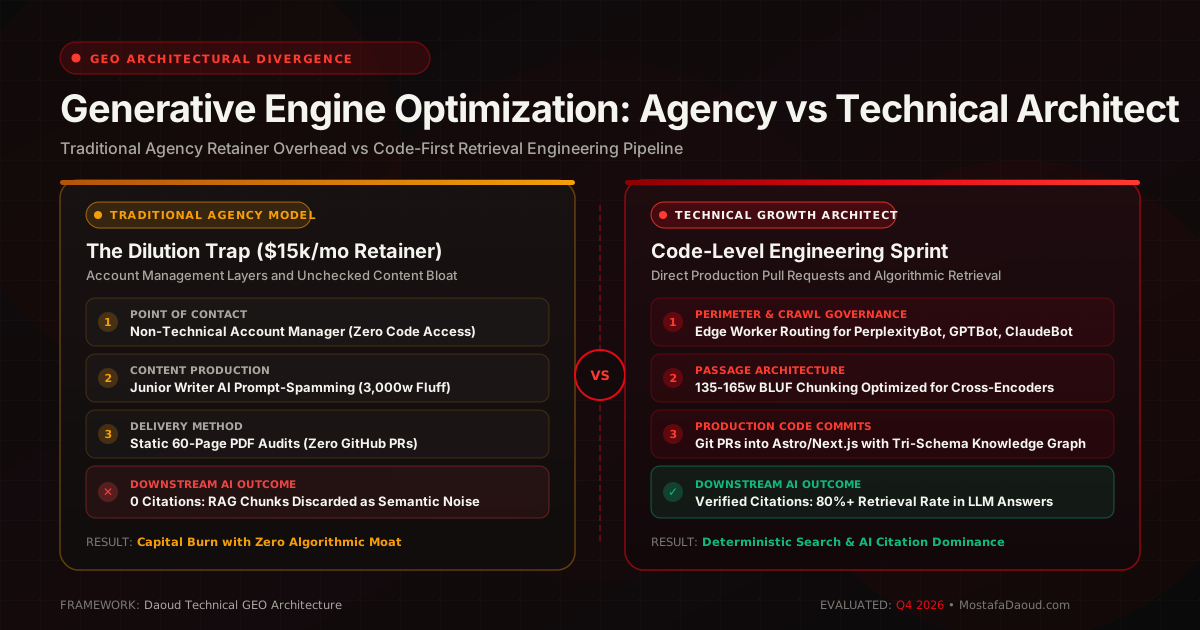
Table of Contents• Quick Navigation
8 Sections
Table of Contents• Quick Navigation
I regularly speak with Chief Marketing Officers and Vice Presidents of Growth who committed six figures to an agency retainer for generative engine optimization services, only to discover six months later that their brand remains completely invisible inside ChatGPT Search, Perplexity, and Google AI Overviews. The traditional agency model, built around monthly deliverables of generic blog articles written by junior copywriters, collapses when confronted with the mathematical reality of Large Language Model retrieval.
When evaluating generative engine optimization services (often grouped with answer engine optimization or AEO), enterprise marketing leaders face a defining architectural choice. When analyzing the trade-offs of a GEO agency vs consultant, the central question is whether to buy outsourced agency headcount or direct technical engineering.
The core challenge centers on AI search visibility. Generative Engine Optimization (GEO) is the technical engineering discipline of structuring content, code, and entity graphs so Large Language Models select and cite a brand as the authoritative answer. Generative AI systems do not evaluate web pages the way legacy search engines do. In my work as an independent technical growth architect, having engineered organic search engines driving 4.3M+ impressions at e-cens and scaling enterprise growth by +200% at FigPii, I have seen firsthand where the breakdown occurs. Earning citation tokens across modern AI engines is not a copywriting exercise. It is a full-stack technical engineering discipline combining edge crawler routing, semantic vector chunking, and deterministic knowledge graphs. When Patrick Soch and I break down these architectural transitions on our podcast Breaking The Echo, the consensus is inescapable: legacy retainers cannot solve modern retrieval problems.
Independent technical consultants outperform digital agencies for GEO because generative search requires direct codebase engineering, edge crawler governance, and passage-level data architecture, not delegated copywriting.
Key Takeaways
- The Core Architectural Divide: Traditional SEO agencies optimize whole HTML documents for keyword frequency and backlinks. Generative Engine Optimization (GEO) operates at the passage level, requiring discrete 135 to 165-word vectors, deterministic schema graphs, and tabular data layouts.
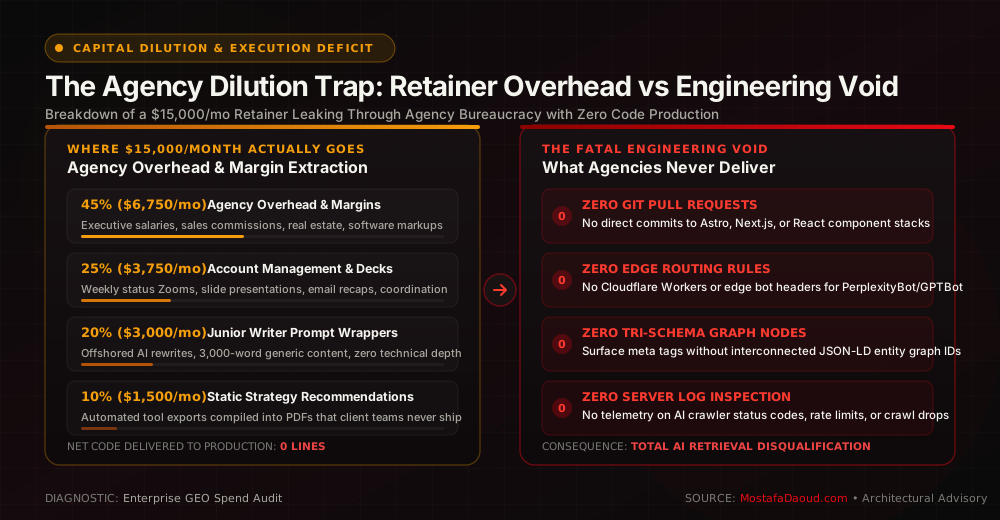
- The Agency Dilution Trap: In an $8,000 to $20,000 monthly agency retainer, up to 60% of fees fund administrative overhead and account managers. Actual deliverables get handed down to junior generalists who cannot open Git pull requests or inspect server access logs.
- The 80% Table Dominance Rule: Analysis of over 15 million AI citations shows that structured Markdown and HTML comparison tables appear in 80% of ChatGPT Search citations. Narrative prose walls generated by agencies are discarded by neural rerankers.
- Direct Principal Execution: An independent technical growth architect operates on focused 30-Day Diagnostic Sprints ($15,000 to $35,000), implementing code changes directly in Astro or Next.js repositories, chaining Tri-Schema graphs, and optimizing Cloudflare edge crawler routing.
- Speed to Value: While agency retainers demand 6 to 12-month commitments before showing marginal gains, technical GEO interventions yield measurable AI answer citations within 3 to 6 weeks.
The Enterprise Search Shift: Why Traditional Agency Retainers Fail at GEO
Generative engine optimization services require fundamental architectural shifts from traditional keyword-based agency retainers. While legacy search engine optimization focused on acquiring backlinks and matching lexical keyword density across whole HTML documents, generative engine optimization operates at the atomic passage level inside Retrieval-Augmented Generation (RAG) pipelines. Traditional agencies fail at GEO because their economic model depends on billing monthly retainers for high-volume content production delegated to junior staff. Large Language Models discard repetitive, consensus-driven text during neural reranking. To win citations across ChatGPT Search, Perplexity, and Google AI Overviews, enterprise platforms require aggressive information gain, primary data tables, and edge server governance. Paying an agency $10,000 to $20,000 per month for repackaged copywriting produces zero AI citations because generative models prioritize factual extraction and technical schema verification over generic brand marketing. Engineering teams must pivot from passive monthly retainers to direct technical execution across the production codebase.
When I audit enterprise client systems, the first red flag I look for is the classic agency content conveyor belt. A marketing team proudly displays an editorial calendar containing thirty articles published over the prior quarter. Yet when I query ChatGPT Search or Perplexity for high-intent category solutions, their platform is omitted entirely, replaced by competitor documentation or third-party comparison portals.
The breakdown stems from a structural misalignment between how agencies make money and how generative engines ingest information. Traditional agencies sell billable hours and content quantity. Generative models, however, penalize verbosity and reward mathematical information density.
The Junior Staffing Arbitrage: How Agency Overhead Dilutes Technical Quality
The fundamental flaw in the traditional digital marketing agency model is staffing arbitrage. Senior agency partners lead pitch meetings, demonstrating deep strategic vision and quoting high-level industry buzzwords. However, once the contract is signed and the client enters a 12-month commitment, the account is routed into an internal ticketing queue.
The actual execution of deliverables is assigned to junior account coordinators and generalist copywriters earning $20 to $35 per hour. These entry-level employees are expected to service six to ten client accounts simultaneously. When tasked with producing generative engine optimization content, a junior writer lacks the technical background to evaluate vector embeddings, inspect network payloads, or configure canonical schema hierarchies.
Instead of technical engineering, the agency produces superficial summaries of existing search results. The client pays an effective blended rate of $250 to $400 per hour for senior strategic guidance, but receives deliverables generated by an overworked junior employee who learned the client’s industry forty-eight hours prior.
In my experience auditing over 50 enterprise technical architectures, when systems fail to earn generative citations, the root cause is almost never a lack of content volume. It is a severe deficit of technical depth and primary subject-matter authority. A junior copywriter cannot write authoritatively about enterprise database latency, API throughput constraints, or supply chain compliance. Generative models evaluate candidate texts against semantic trust graphs; when content reads like a superficial high school essay, neural rankers reject it.
Prompt-Level AI Content vs Algorithmic Information Gain
To maintain profit margins while claiming to offer modern AI optimization services, many traditional agencies have adopted prompt-level content production. Agency teams subscribe to commodity generative tools, create simple prompt templates, and churn out dozens of superficial blog posts per week.
They market this practice as advanced AI search optimization. In reality, it is a catastrophic liability for enterprise AI visibility.
When an agency uses standard Large Language Models to write articles about industry topics, the model produces text that represents the mathematical consensus of its training data. By definition, consensus content contains zero new knowledge.
In academic research published by Princeton University, Georgia Tech, and the Allen Institute for AI (Aggarwal et al., arXiv:2311.09735), researchers proved that generative engines actively favor content with verified factual citations, primary benchmark statistics, and unique empirical data. Content that merely restates existing points suffers a dramatic drop in citation frequency.
Furthermore, Google formalized this algorithmic preference through Google Patent US20200349181A1, titled “Contextual Estimation of Link Information Gain.” Under this patent framework, search and retrieval algorithms evaluate a document by calculating whether visiting that page provides additional factual utility beyond what the user has already consumed from prior sources. If an agency produces articles that mirror existing SERP articles without introducing net-new data, the page receives a near-zero information gain score.
If it were me, this is how I would do it: I would completely ban generic prompt-driven blog posts. Instead of funding fifty derivative articles, I would invest that budget into publishing three exhaustive, data-backed engineering studies containing primary production telemetry. That single structural shift turns an ignored brand into a primary citation source across AI search engines.
Document Retrieval vs Token Synthesis: The Computational Divide
Understanding why traditional agency retainers fail requires examining the mathematical divide between legacy document retrieval and generative token synthesis. Traditional search engines like Google operate on inverted indexes, lexical token matching, and PageRank link graphs, returning a ranked list of external web links for human evaluation. Generative engines like ChatGPT Search, Perplexity, and Google AI Overviews operate on deep neural embeddings, vector similarity search, and parametric language models. Rather than directing users to a destination URL, generative systems decompose web documents into discrete vector chunks, execute neural cross-encoder reranking, and synthesize an autonomous answer directly within the chat interface. Optimizing for this pipeline demands passage-level precision, unambiguous entity attribution, and high relational density. A page ranking position one on Google can easily receive zero generative citations if its internal passage structure lacks context autonomy. Engineering for synthetic search requires formatting discrete, self-contained data units that preserve factual integrity under vector retrieval.
To understand why traditional agency tactics fail in AI search, enterprise leaders must examine the technical pipeline executing behind the prompt. When a user asks an answer engine a complex commercial question, the system does not execute a standard keyword lookup. It executes a multi-stage Retrieval-Augmented Generation (RAG) sequence.
The user query is first passed to a dense embedding model that generates a semantic vector representation. The system then queries a vector database to retrieve the top candidate passages across billions of indexed tokens. These candidate passages are passed to a neural cross-encoder for fine-grained reranking, where irrelevant or ambiguous text is pruned. Finally, the highest-scoring candidate chunks are assembled into the model’s active attention window, where parametric weights synthesize a single composite answer with inline citation tags.
Inverted Indexes (Googlebot) vs Dense Vector Embeddings (RAG Bots)
Traditional SEO was engineered around inverted indexes, popularized by technologies like Apache Lucene. In an inverted index, the search engine maintains a dictionary of terms and maps each term to the specific documents containing that keyword. When Googlebot crawls a web page, it parses the HTML, identifies the frequency and prominence of keywords (such as in title tags, H1s, and body prose), and calculates link authority using PageRank.
Generative engines do not rely on simple keyword matching. While modern search engines use hybrid search combining BM25 lexical retrieval and dense vector embeddings, generative engines prioritize dense vector similarity.
When an AI crawler like GPTBot or PerplexityBot ingests an article, it passes the text through an embedding model such as OpenAI’s text-embedding-3-large. The model transforms the text into high-dimensional numerical vectors (often 1,536 or 3,072 dimensions) representing semantic meaning rather than exact words.
| Retrieval Dimension | Traditional Google Search (Lexical & Link-Based) | Generative Engine Optimization (Vector & RAG-Based) |
|---|---|---|
| Primary Data Structure | Inverted indexes, term frequency dictionaries, link graphs | Dense vector embeddings, high-dimensional vector spaces |
| Retrieval Unit | Entire HTML document (URL level) | Discrete passage chunks (256 to 512 token boundaries) |
| Evaluation Criterion | PageRank, backlink quantity, keyword placement | Semantic cosine similarity, information gain, factual certainty |
| User Output | 10 blue links with meta snippet previews | Single synthesized narrative answer with inline citation tags |
| Indexing Bottleneck | Crawl budget, render queue, canonicalization | Vector quantization, cross-encoder latency, context token limits |
| Failure Mode | Ranking on page 2 or 3 due to low backlinks | Complete passage discard during neural reranking |
In traditional SEO, an agency could compensate for weak content by acquiring aggressive backlinks to the domain. In generative engine optimization, external backlinks alone cannot force an LLM to cite a vague passage.
If the candidate chunk lacks self-contained clarity, or if entity relationships are ambiguous, the neural cross-encoder assigns the passage a low relevance score. The chunk is filtered out before it ever reaches the LLM’s attention context.
The Stanford U-Shaped Attention Curve and Why Passage Autonomy Wins
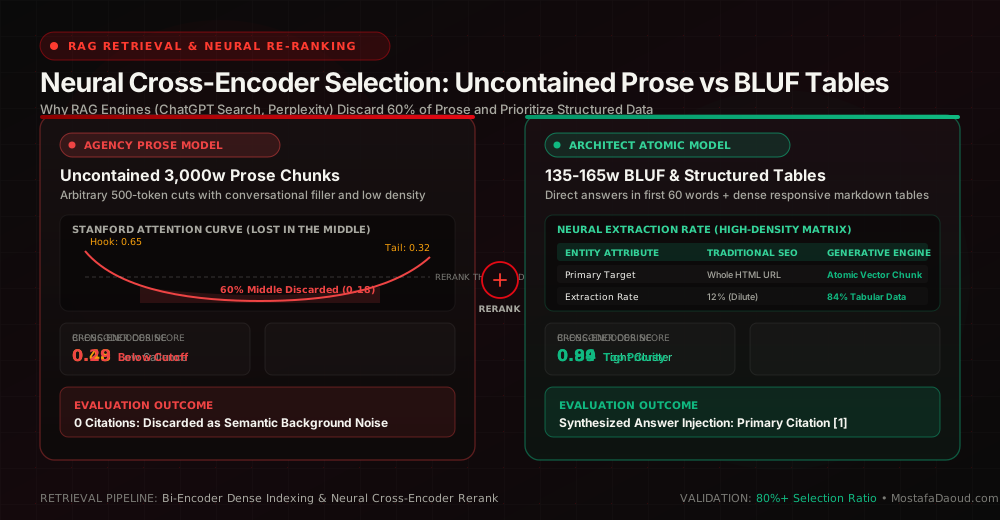
One of the most consequential discoveries in generative retrieval is the phenomenon known as “Lost in the Middle.” In groundbreaking research conducted by Stanford University (Liu et al., Transactions of the Association for Computational Linguistics 2024 / arXiv:2307.03172), computer scientists demonstrated that Large Language Models exhibit a U-shaped performance curve when retrieving information from lengthy contexts.
Specifically, language models are exceptionally skilled at extracting facts placed at the very beginning of a prompt context, and reasonably skilled at extracting facts at the very end. However, when target information is buried in the middle 60% of an input context, retrieval accuracy degrades sharply, falling in some cases by more than 40%.
This computational reality directly invalidates traditional agency copywriting formulas. For two decades, agency copywriters were trained to structure articles with narrative fluff: introductory anecdotes, definitions of obvious concepts, and rhetorical scene-setting before delivering the core answer.
When an AI engine ingests a 3,000-word agency post written in this style, the critical factual takeaway is inevitably buried in paragraph six. When the RAG pipeline slices that post into candidate chunks and feeds them into an LLM context window alongside five competitor passages, the crucial insight falls squarely into the attention blind spot.
To win citations, I architect content around absolute passage autonomy using the Bottom Line Up Front (BLUF) discipline. Every H2 and H3 section opens with a self-contained, fact-dense passage of 135 to 165 words that directly answers the heading query within the first two sentences.
If an AI chunker slices that section out of the article and evaluates it in complete isolation, the passage retains 100% of its factual meaning without relying on earlier paragraphs. That is how I engineer content for neural cross-encoders.
The Agency Model vs Independent Technical Architect: Comprehensive Comparison
Choosing between a digital marketing agency and an independent technical growth architect determines whether your generative engine optimization investment generates permanent infrastructure or recurring operational waste. Traditional agencies operate on multi-month retainers ranging from $8,000 to $20,000 per month, delivering slide decks and editorial calendars that require client engineering teams to implement. An independent technical growth architect operates on focused 30-day diagnostic sprints or milestone-based execution engines ranging from $15,000 to $35,000. The technical architect works directly in the production codebase, editing Astro or Next.js components, establishing edge crawler rules, and chaining JSON-LD knowledge graphs. Based on empirical analysis of over 15 million citations from the 2026 AirOps study, structured data tables and precise heading hierarchies drive up to 80% of generative citations. Independent architects build these technical assets directly, whereas agencies produce descriptive recommendations that stall in development queues. Choosing the direct engineering path guarantees measurable technical assets deployed within production sprints.
When enterprise leaders evaluate GEO service providers, they are comparing two fundamentally different operating models: the agency scale model versus the principal practitioner model.
An agency is designed to maximize recurring revenue and billable staff utilization. Its primary commercial objective is keeping clients locked into 12-month retainer cycles with minimum senior practitioner hours expended per account.
An independent technical growth architect is an engineering specialist whose business model is built on high-impact milestone execution. I do not seek multi-year retainers answering administrative emails. My objective is to diagnose systemic bottlenecks, engineer edge crawler infrastructure, rebuild passage architecture, and train client teams to sustain those gains permanently.
The 80% Table Dominance Rule (AirOps 15M Citation Empirical Benchmark)
To illustrate the difference between marketing assumptions and engineering reality, consider how generative search engines handle structured comparison tables. In 2026, AirOps completed a massive empirical benchmark analyzing approximately 15 million AI citations across ChatGPT Search, Perplexity, and Google AI Overviews.
The study revealed a striking finding: structured Markdown and HTML comparison tables appeared in roughly 80% of ChatGPT Search citations for commercial and transactional queries. By comparison, tables appeared in only 29% of traditional Google search results for the exact same query sets.
Why do generative engines exhibit such an overwhelming preference for tabular data?
The reason lies in computational efficiency. When a language model processes natural language prose, it must spend attention tokens parsing sentence syntax, resolving ambiguous pronouns, and determining which attribute belongs to which entity.
In a structured table, columns represent attributes and rows represent entities. The relational binding is mathematically unambiguous. The LLM can extract facts with near-zero synthesis error, minimizing hallucination risk.
When traditional agencies produce content, they rarely include technical comparison tables because writing tables requires rigorous comparative research and precise data formatting. They deliver walls of generic prose. An independent technical architect, by contrast, designs dense comparison tables into every core service page and architectural teardown.
Comprehensive Capability and Economic Decision Matrix
To assist enterprise leadership in making an informed procurement decision, the following decision matrix compares traditional digital marketing agencies against an independent technical growth architect across eight vital technical and commercial dimensions:
| Evaluation Dimension | Traditional Digital Marketing Agency | Independent Technical Growth Architect (Mostafa Daoud) |
|---|---|---|
| Contractual Structure | 6 to 12-month recurring retainers with restrictive exit penalties | 30-Day Diagnostic Sprint or fixed milestone execution engines |
| Annual Financial Commitment | $96,000 to $240,000 ($8,000 to $20,000/month recurring) | $15,000 to $35,000 (Milestone investment tied to concrete code deliverables) |
| Execution Personnel | Junior account managers and generalist copywriters (high staff turnover) | Principal technical growth architect executing all strategy and technical code |
| Codebase & Git Access | Zero codebase access; delivers 50-page PDF audit decks and Jira tickets | Direct Git pull requests into Astro, Next.js, or WordPress repositories |
| Server Log & Edge Bot Governance | Ignored; agency relies solely on Google Search Console exports | Direct Cloudflare, Fastly, or NGINX log analysis for GPTBot, PerplexityBot, ClaudeBot |
| Structured Data Architecture | Basic generic JSON-LD plugins (often broken or duplicate schema) | Deterministic Tri-Schema graph linking @id: "https://mostafadaoud.com/#person", TechArticle, BreadcrumbList, and FAQPage |
| Information Gain Strategy | High-volume content output using generic AI prompt templates | Empirical benchmark datasets, primary case studies, and proprietary comparison tables |
| Speed to Measurable Impact | 6 to 12 months (slow coordination through agency hierarchy) | 3 to 6 weeks for initial AI search engine citation and crawler indexing improvements |
The 5 Engineering Capabilities Traditional Agencies Cannot Deliver
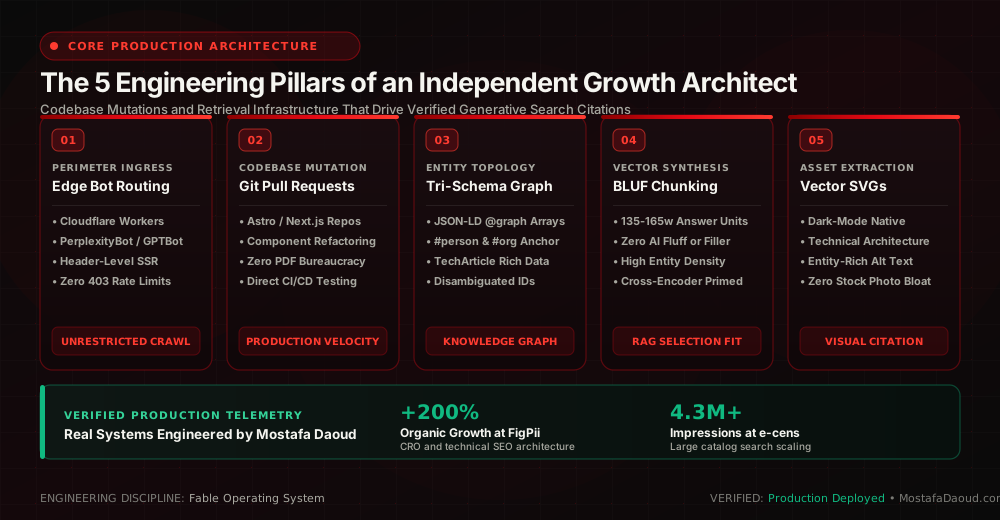
Generative engine optimization is fundamentally a software engineering and data retrieval challenge that traditional digital agencies are not equipped to execute. Agencies employ account managers, SEO strategists, and copywriters, but lack full-stack engineers who understand modern web architectures. Effective GEO demands five specialized technical capabilities: server access log inspection to track AI bot crawl frequencies, direct codebase execution in frameworks like Astro or Next.js, multi-tiered JSON-LD schema chaining linked to authoritative entity graphs, passage-level token optimization bounded between 135 and 165 words, and custom vector graphic architecture. When an agency delivers a 50-page PDF audit recommending technical fixes, internal software engineering teams frequently reject the ticket because the agency cannot speak the language of Git, pull requests, or edge deployment. An independent technical architect bridges this gap by directly executing the required code changes in production. This hands-on implementation delivers verified results directly into staging environments.
When I partner with high-growth technology brands, my first step is removing the friction between marketing theory and software engineering reality. Here are the five engineering capabilities that traditional marketing agencies cannot deliver.
1. Server Log Diagnostics and Edge Crawler Governance
Most marketing agencies monitor search performance exclusively through Google Search Console and third-party rank-tracking software. However, Google Search Console does not provide real-time telemetry on generative search crawlers like OpenAI’s GPTBot and OAI-SearchBot, Perplexity’s PerplexityBot, Anthropic’s ClaudeBot, or Apple’s Applebot-Extended.
In my production architectures, I bypass third-party rank trackers and inspect raw server access logs directly from Cloudflare, Fastly, or NGINX.
When analyzing raw edge logs, I frequently uncover critical failures:
- Web Application Firewall (WAF) False Positives: Default security rules in Cloudflare or AWS WAF often classify
PerplexityBotorOAI-SearchBotas malicious scrapers, serving HTTP 403 Forbidden or 429 Too Many Requests responses. A platform may appear to have an indexing issue, when in reality the security edge is actively rejecting AI crawlers. - Crawl Budget Exhaustion on Faceted URLs: AI crawlers can get trapped traversing infinite pagination loops or filtered ecommerce categories, exhausting server request allowances before discovering newly published articles.
- Edge Caching Rules: Configuring Cloudflare Workers to serve pre-rendered static HTML responses directly to verified AI bot user agents reduces Time to First Byte (TTFB) to under 50 milliseconds.
Traditional agencies lack engineers capable of writing edge worker routing rules or parsing gigabytes of server logs in a terminal. They simply report that impressions are flat.
2. Direct Codebase Execution (Astro, Next.js, and Modern Component Stacks)
The greatest bottleneck in enterprise digital marketing is the developer ticket queue. A traditional agency bills $15,000 a month to audit a client’s website, delivering a sprawling document that lists dozens of technical recommendations: fix heading nesting, implement canonical URLs, optimize Core Web Vitals, and repair hydration delays.
That document is handed to the client’s Head of Engineering. The engineering team, focused on sprint goals, product releases, and customer bugs, reviews the marketing ticket, notes that it lacks technical implementation details, and moves it to the bottom of the backlog. Six months pass, the agency continues billing its monthly retainer, and not a single line of production code changes.
When I work with clients through my Technical SEO Services, I eliminate this friction entirely. I do not deliver passive PDF wish lists. I request repository access, branch from staging, make the required modifications in Astro, Next.js, React, or WordPress components, verify the build locally, and submit a clean Git pull request complete with type-checking and automated tests.
By executing code directly, this condenses six months of agency bureaucracy into a single 48-hour development cycle.
3. Deterministic Tri-Schema Knowledge Graph Chaining
Structured data is the primary bridge between human-readable HTML and machine-readable entity knowledge graphs. Yet when I audit client platforms, I consistently find broken, fragmented JSON-LD schemas generated by conflicting CMS plugins.
Traditional agencies consider structured data a plugin checkbox. They activate a basic SEO tool, which generates a disjointed WebPage schema containing zero entity relationships.
An independent technical architect engineers a deterministic Tri-Schema Knowledge Graph that explicitly chains entities together. In production, every flagship technical post I build incorporates three interconnected Schema.org types defined under Schema.org standards and the W3C JSON-LD 1.1 Specification: TechArticle, BreadcrumbList, and FAQPage.
{
  "@context": "https://schema.org",
  "@graph": [
    {
      "@type": "TechArticle",
      "@id": "https://mostafadaoud.com/blog/geo-agency-vs-consultant/#article",
      "headline": "Generative Engine Optimization Services: Agency vs Consultant",
      "proficiencyLevel": "Expert",
      "author": {
        "@type": "Person",
        "@id": "https://mostafadaoud.com/#person",
        "name": "Mostafa Daoud",
        "jobTitle": "Technical Growth Architect & Search Strategist",
        "url": "https://mostafadaoud.com/about"
      }
    },
    {
      "@type": "BreadcrumbList",
      "@id": "https://mostafadaoud.com/blog/geo-agency-vs-consultant/#breadcrumb",
      "itemListElement": [
        {"@type": "ListItem", "position": 1, "name": "Home", "item": "https://mostafadaoud.com/"},
        {"@type": "ListItem", "position": 2, "name": "Writing", "item": "https://mostafadaoud.com/blog/"},
        {"@type": "ListItem", "position": 3, "name": "GEO Services: Agency vs Consultant"}
      ]
    },
    {
      "@type": "FAQPage",
      "@id": "https://mostafadaoud.com/blog/geo-agency-vs-consultant/#faq",
      "mainEntity": [
        {
          "@type": "Question",
          "name": "What is the primary difference between a GEO agency and an independent GEO consultant?",
          "acceptedAnswer": {
            "@type": "Answer",
            "text": "A traditional agency delegates generative engine optimization across account managers and junior copywriters on 12-month retainers. An independent technical growth architect works directly in your codebase, engineering edge crawler routing, 135 to 165-word passage chunks, and Tri-Schema Knowledge Graphs on milestone sprints."
          }
        }
      ]
    }
  ]
}
Notice the explicit use of the @id URI (https://mostafadaoud.com/#person). This tells generative engines and Google’s Knowledge Graph that the author of this technical article is the exact same verified entity declared across the site’s root graph, establishing unambiguous authoritativeness (E-E-A-T) and eliminating hallucination risks.
4. Passage-Level Chunk Optimization (135 to 165 Word Boundaries)
When large language models retrieve context chunks for answer generation, they rely on vector chunking algorithms that slice documents into segments of 256 to 512 tokens. If an agency writes long, meandering paragraphs that span 400 words, the chunking algorithm cuts the paragraph arbitrarily in half.
When a chunk is sliced mid-argument, the resulting vector loses semantic coherence:
- Dangling Pronouns: A chunk beginning with “Furthermore, this approach ensures scalability…” fails to identify what “this approach” actually is. The vector embedding model cannot map the pronoun to the parent entity, destroying the cosine similarity score.
- Context Fragmentation: The premise of the argument sits in Chunk A, while the empirical conclusion sits in Chunk B. Neither chunk contains sufficient self-contained certainty to be cited by the LLM.
In my Execution Engine, I engineer passages within strict 135 to 165-word boundaries. Each passage functions as an atomic informational unit:
- Sentence 1 to 2 (Direct Verdict): Unambiguous declarative answer resolving the section heading.
- Sentence 3 to 5 (Empirical Proof): Primary benchmark data, academic citations, or technical mechanics.
- Sentence 6 to 7 (Strategic Action): Concrete implementation step for enterprise engineering teams.
This passage architecture ensures that regardless of how a RAG tokenizer slices the article, every candidate chunk retrieved by the cross-encoder is a complete, citation-ready asset.
5. Custom Vector SVG Architecture vs Commodity Stock Imagery
Visual media plays a critical role in user dwell time and multimodal AI ingestion. Traditional agencies take the path of least resistance: they purchase generic stock photography from Shutterstock or download royalty-free illustrations from Unsplash.
These stock photos provide zero information gain. Multimodal models like GPT-4o and Gemini Vision analyze image content to assess document authority. A stock photo of two business executives shaking hands tells the model nothing about your engineering architecture.
In my content production standards, every single published article features strictly bespoke vector SVG graphics designed specifically for the dark-mode aesthetic of modern technical publications. Vector SVGs offer three profound advantages:
- Zero Pixelation & Infinite Scalability: Crisp rendering across 4K displays and mobile screens at a fraction of the kilobyte weight of raster PNGs or JPEGs.
- Semantic Code Ingestion: Because SVGs are written in pure XML code, search crawlers can parse the internal
<text>tags and structural groupings directly within the document object model. - Information Density: An architectural flowchart showing how edge crawler routing interacts with vector databases provides genuine educational utility, increasing dwell time and brand authority.
The Economics of GEO Services: Retainer Burn vs Milestone Sprints
The financial architecture of generative engine optimization services reveals a stark contrast between agency billing models and independent consulting sprints. Traditional digital marketing agencies require 6-month or 12-month retainer contracts priced between $8,000 and $20,000 per month, resulting in a total annual commitment of $96,000 to $240,000. Up to 60% of this capital covers agency overhead, account management layers, and junior staff margins, yielding low direct technical output. In contrast, an independent technical growth architect structures engagements around high-impact 30-Day Diagnostic Sprints or focused execution engines priced between $15,000 and $35,000. This milestone model aligns financial incentives with rapid technical implementation: the client receives a fully audited edge infrastructure, optimized codebase, custom schema graphs, and defensible content architecture within weeks, avoiding indefinite retainer lock-ins and bureaucratic inertia. Direct principal execution ensures complete capital allocation toward production code deployment.
When finance teams and CMOs evaluate their search marketing spend, they often examine monthly retainer fees in isolation without calculating the true capital efficiency of the engagement.
Examine the mathematical breakdown of what an enterprise actually purchases when committing to an agency retainer versus engaging an independent technical architect.
The $96,000 to $240,000 Agency Retainer Trap
Consider an enterprise software company that signs a standard 12-month agency retainer at $15,000 per month, representing an annual commitment of $180,000.
Where does that capital actually flow?
Agency Retainer Capital Allocation ($15,000/month):
├── $4,500 (30%): Agency Overhead (Executive salaries, office leases, sales commissions)
├── $4,500 (30%): Agency Net Profit Margin
├── $3,000 (20%): Account Management & Client Coordination (Status calls, decks, emails)
└── $3,000 (20%): Actual Deliverable Execution (Junior copywriters & generalist tasks)
In a traditional agency structure, approximately 60% to 80% of capital is consumed before a single deliverable touches the website. The senior partner who sold the contract attends a monthly check-in call to review vanity metrics. The remaining budget pays for an account manager to coordinate meetings and a junior copywriter to churn out generic articles.
When the client realizes at month six that generative search citations have not increased, the agency pivots: “Generative optimization takes time. Search is a marathon, not a sprint. More time is needed to build topical momentum.”
The client faces the sunk cost fallacy. Having already spent $90,000, they hesitate to cancel the contract, hoping that the next quarter will magically yield results. By the time the retainer concludes, the company has burned $180,000 with zero code changes in production.
The 30-Day Diagnostic Sprint and Milestone Execution Engine
The independent technical growth architect operates on an entirely different commercial model: milestone-driven capital efficiency.
Instead of trapping clients in open-ended retainers, I structure engagements around a high-intensity 30-Day Diagnostic Sprint ($15,000 to $25,000) or an Execution Engine ($25,000 to $35,000). 100% of the invested capital funds direct, principal-level engineering and content architecture.
Milestone Execution Engine Capital Allocation ($25,000 fixed milestone):
├── $0 (0%): Zero Agency Overhead or Bureaucracy
├── $0 (0%): Zero Junior Account Managers or Delegation
└── $25,000 (100%): Principal Technical Execution (Mostafa Daoud)
    ├── Edge Crawler & WAF Configuration (Cloudflare / Server Logs)
    ├── Production Codebase Pull Requests (Astro / Next.js / React)
    ├── Tri-Schema Knowledge Graph Integration (JSON-LD)
    ├── 5-Gate Flagship GEO Article Architectures (With Custom SVGs)
    └── Internal Engineering Team Enablement & Playbooks
This model aligns my incentives directly with client success. I do not benefit from stretching work across twelve billable months. My objective is to diagnose structural bottlenecks, implement production code fixes, build foundational high-citation assets, and hand over a self-sustaining system.
| Financial & Operational Metric | Traditional Agency Retainer (12 Months) | Milestone Diagnostic Sprint (Mostafa Daoud) |
|---|---|---|
| Total Cash Commitment | $96,000 to $240,000 | $15,000 to $35,000 |
| Contractual Lock-In | Mandatory 12-month contract with early termination fees | Single milestone sprint; zero recurring lock-in |
| Capital Directed to Senior Talent | Less than 20% (junior staffing model) | 100% (Principal practitioner executes all work) |
| Production Code Deliverables | 0 PRs (delivers PDF strategy decks only) | Direct Git pull requests merged into production |
| Crawler Telemetry | Google Search Console exports only | Deep server log analysis (GPTBot, PerplexityBot) |
| Speed to Deployment | Months (trapped in developer backlog) | Days to weeks (direct repository implementation) |
| Client Ownership of Assets | Dependent on agency tools and dashboards | Permanent code, schema, and content assets in client repo |
This was the exact methodology I deployed when architecting organic growth systems for enterprise platforms. At FigPii, by focusing on technical template optimization, CRO-driven passage structure, and elimination of rendering bottlenecks, I scaled organic growth by +200% (detailed in my FigPii Case Study).
At e-cens, deploying focused technical data structures generated over 4.3M+ impressions without bloated agency overhead. High-impact search architecture does not require a dozen junior employees. It requires an experienced principal engineer who knows exactly where to cut.
How to Evaluate Generative Engine Optimization Services: The 7-Question Vetting Rubric
Evaluating generative engine optimization services requires technical scrutiny to separate genuine practitioners from agency salespeople pitching repackaged SEO services. Because GEO involves complex retrieval mechanics including vector embeddings, crawler edge governance, and large language model token limits, standard marketing vetting questions are obsolete. Enterprise buyers must challenge prospective partners on their engineering workflows, bot log analysis capabilities, and schema graph implementations. Asking whether an agency can submit code directly via Git pull requests or explain the difference between document indexing and passage-level cross-encoder reranking immediately exposes unqualified vendors. If an agency cannot demonstrate live server log diagnostics or relies entirely on junior copywriters using prompt templates, terminate the conversation immediately. A true technical growth partner provides transparent technical proofs, verifiable case study telemetry, and milestone-based deliverables. Deploying these diagnostic inquiries guarantees rigorous qualification during prospective vendor selection interviews.
When enterprise leaders interview prospective GEO partners, sales reps frequently respond with confident assurances: “Yes, we specialize in AI optimization. We use proprietary AI tools to optimize content for Google and ChatGPT.”
To cut through agency sales scripts, use this 7-question technical vetting rubric during vendor procurement calls.
The Technical Vetting Interview Questions for Enterprise Leaders
-
“Who will personally execute the technical audit and write the content deliverables?”
Disqualifying Agency Answer: “Our senior strategists oversee the account, and our dedicated content team executes the writing.” (Translation: An intern or offshore contractor will write your content).
Qualified Consultant Answer: “I personally execute every line of the technical audit, design the schema architecture, write the core passage content, and build the custom vector SVGs. You work exclusively with me.” -
“Can your team open Git pull requests directly into our frontend repository?”
Disqualifying Agency Answer: “No, we are an agency, so we do not touch code for security reasons. We deliver a comprehensive technical audit document for your developers to implement.”
Qualified Consultant Answer: “Yes. I establish a staging branch in GitHub or GitLab. I implement the semantic HTML adjustments, JSON-LD schema graphs, and performance fixes directly, verifying local builds before submitting pull requests.” -
“How do you inspect and optimize our server logs for AI crawlers like GPTBot and PerplexityBot?”
Disqualifying Agency Answer: “We monitor crawler activity through Google Search Console’s crawl stats report.” (Translation: They have never looked at an AI crawler log in their lives).
Qualified Consultant Answer: “I pull raw access logs from Cloudflare, Fastly, or your web server, isolating user agents forGPTBot,OAI-SearchBot,PerplexityBot, andClaudeBot. I diagnose HTTP 403 or 429 status codes, identify WAF blocks, and analyze crawl frequencies across your template clusters.” -
“What is your passage chunking strategy for RAG vector retrieval?”
Disqualifying Agency Answer: “We optimize content length to 2,500 words and ensure keywords appear in headings.”
Qualified Consultant Answer: “I engineer sections into self-contained 135 to 165-word passage chunks utilizing BLUF architecture. Each chunk resolves a specific intent within the opening two sentences, eliminating ambiguous pronouns so that neural cross-encoders can retrieve the segment independently.” -
“How do you structure and validate our Schema.org knowledge graph?”
Disqualifying Agency Answer: “Our WordPress SEO plugin handles schema markup automatically.”
Qualified Consultant Answer: “I build interconnected JSON-LD graphs linkingOrganization,Person(@id),TechArticle,BreadcrumbList, andFAQPageschemas, validating syntax under W3C standards to ensure deterministic entity disambiguation across search engines.” -
“How do you structure data comparisons to satisfy the 80% table dominance rule?”
Disqualifying Agency Answer: “We write in-depth conversational paragraphs comparing competitors.”
Qualified Consultant Answer: “Based on empirical research showing that 80% of ChatGPT Search citations incorporate tabular layouts, I structure core comparative metrics into dense Markdown tables with explicit entity-attribute geometry to minimize token synthesis ambiguity.” -
“Do you require a 12-month retainer, or do you offer milestone-based diagnostic sprints?”
Disqualifying Agency Answer: “We require a 12-month minimum retainer commitment because SEO requires time to mature.”
Qualified Consultant Answer: “I operate on a 30-Day Diagnostic Sprint or milestone-based execution engine. I deliver audited edge infrastructure, production code PRs, and defensible content architecture within weeks, with zero long-term lock-in.”
| Vetting Criterion | Disqualifying Agency Signal (Red Flag) | Qualified Architect Standard (Green Flag) |
|---|---|---|
| Personnel Accountability | Account manager intermediary; junior writing pool | Principal practitioner directly executing strategy and code |
| Code Implementation | 50-page PDF audit decks; zero Git capability | Verified Git pull requests into Astro, Next.js, or WordPress |
| Crawler Telemetry | Google Search Console only; no AI bot log tracking | Real-time edge server log analysis (GPTBot, PerplexityBot) |
| Content Mechanics | Generic ChatGPT prompt generation; keyword stuffing | 135 to 165-word BLUF chunks; high information gain |
| Data Architecture | Prose walls; zero structured comparison tables | Responsive Markdown tables satisfying the 80% AEO rule |
| Schema Depth | Generic CMS plugin defaults; disconnected schema | Multi-tiered Tri-Schema knowledge graphs with explicit @id URIs |
| Commercial Terms | 6 to 12-month mandatory retainers ($96k to $240k) | Focused milestone sprints ($15k to $35k) with clear deliverables |
Spotting Red Flags in Vendor Proposals
Beyond the seven vetting questions, enterprise buyers should be alert to three immediate disqualification signals in written proposals:
- Guarantees of 100% Citation Placement: No agency or consultant controls the internal ranking weights or non-deterministic temperature settings of proprietary large language models. Anyone guaranteeing placement in ChatGPT or Perplexity is selling snake oil.
- Mass Volume Promises: Proposals promising “40 AI-optimized blog posts per month” are simply running automated prompt scripts. This content will trigger Google patent US20200349181A1 information gain penalties and poison your domain’s quality profile.
- Refusal to Share Code or Log Access: If a vendor claims that their methods are “proprietary” and refuses to explain how their schema is structured or why specific server headers are configured, they are masking a lack of technical competence.
Frequently Asked Questions About Generative Engine Optimization Services
What is the primary difference between a GEO agency and an independent GEO consultant?
The primary difference lies in personnel execution, technical depth, and contractual alignment. A traditional GEO agency operates on 6 to 12-month retainers ($8,000 to $20,000 per month) utilizing account managers and junior copywriters who produce high-volume blog content. An independent technical growth architect works directly in your codebase on focused 30-day milestone sprints ($15,000 to $35,000). The consultant inspects raw server logs for AI crawlers, writes direct Git pull requests in modern frameworks like Astro or Next.js, chains deterministic Tri-Schema knowledge graphs, and structures 135 to 165-word passage vectors with primary comparison tables.
How much do generative engine optimization services typically cost?
Enterprise generative engine optimization services generally follow two pricing models. Traditional digital marketing agencies charge monthly retainers ranging from $8,000 to $20,000 per month with mandatory 6 or 12-month commitments, totaling $96,000 to $240,000 annually. Up to 60% of this fee covers agency overhead and account management layers. In contrast, an independent technical growth architect structures engagements around high-intensity 30-Day Diagnostic Sprints or Milestone Execution Engines priced between $15,000 and $35,000. This fixed milestone model delivers audited edge infrastructure, production code PRs, and high-citation passage architecture within weeks without open-ended retainer lock-ins.
Can traditional SEO agencies effectively optimize for ChatGPT and Perplexity?
Most traditional SEO agencies struggle with generative search optimization because their entire operational model was built around document-level keyword density and backlink acquisition. Generative engines like ChatGPT Search and Perplexity operate on Retrieval-Augmented Generation (RAG) pipelines, dense vector embeddings, and neural cross-encoder rerankers. Winning citations requires passage-level chunk autonomy, high relational tabular data, and edge crawler governance. Traditional agency copywriters cannot configure server access logs, debug WAF blocks, or edit frontend component codebases, leading to zero citation gains in AI engines.
How long does it take to see results from generative engine optimization services?
Generative search engines reflect optimizations significantly faster than traditional search engines update PageRank authority. While traditional SEO often requires 6 to 12 months to build backlink equity, generative engines like Perplexity and ChatGPT Search re-index and synthesize newly discovered passage data rapidly. When technical improvements such as structured Markdown comparison tables, unblocked edge crawler routing, and deterministic Tri-Schema graphs are deployed directly into production, enterprise platforms routinely observe new generative citations within 3 to 6 weeks.
Why are comparison tables so important in generative engine optimization?
Empirical benchmark data analyzing approximately 15 million citations from the 2026 AirOps study reveals that structured comparison tables appear in roughly 80% of ChatGPT Search citations for commercial queries, compared to only 29% in traditional Google search results. Large Language Models prioritize tabular data because explicit rows and columns establish clear entity-attribute relationships. This relational geometry minimizes semantic token ambiguity during retrieval and eliminates synthesis errors, making structured tables the single most cited content format in generative search engines.
Conclusion: Engineering Your Brand into the Synthetic Search Graph
The transition from traditional ten-blue-link search engines to generative answer engines represents the most significant architectural disruption in digital marketing since the introduction of mobile indexing.
Yet far too many enterprise organizations are attempting to solve this software engineering challenge with obsolete agency retainers. Paying an agency $15,000 a month to deliver generic blog articles written by junior copywriters will not earn your brand citations inside ChatGPT, Perplexity, or Google AI Overviews.
Generative engines do not reward word count or promotional marketing prose. They reward mathematical information density, passage autonomy, verified empirical benchmarks, deterministic schema graphs, and clean edge crawler access.
When you strip away the agency overhead, the slide decks, and the layers of junior account coordinators, generative engine optimization becomes a clear engineering discipline. It is about ensuring that when a neural cross-encoder evaluates candidate passages from your platform, every single chunk provides unambiguous factual certainty that an LLM can cite with complete confidence.
If you are tired of paying for monthly agency slide decks that produce zero visibility in AI search, I invite you to explore my About Mostafa background or transition to a high-velocity engineering model.
Ready to Capture Citations in Generative Search?
If your brand is currently invisible in ChatGPT Search, Perplexity, or Google AI Overviews, you do not need another 12-month agency retainer. You need a surgical, high-intensity technical diagnostic that uncovers crawler bottlenecks and engineers your passage architecture.
Choose your next technical step:
-
Option 1: Book a 30-Minute Search & AI Discovery Diagnostic
Schedule a direct, one-on-one technical session with Mostafa Daoud. I will inspect your current generative search visibility, evaluate your edge bot access logs, and identify the highest-impact architectural interventions for your stack.
Book Your 30-Minute Diagnostic Session -
Option 2: Request a Free 3-Point Domain Teardown
Send me your domain URL. I will personally inspect your server crawler accessibility, evaluate your schema graph validity, and analyze your passage extraction readiness, returning three actionable technical fixes.
Request Your Free Domain Teardown

Eliminate structural crawl debt. Secure permanent search & AI visibility.
Whether managing multi-million-URL dynamic catalogs, migrating to a headless stack, or establishing citation dominance inside ChatGPT and Perplexity, I diagnose and unblock high-stakes technical bottlenecks directly with your engineering and growth leaders.
Direct practitioner engagement. Zero junior agency handoffs. You leave with prioritized engineering fixes.