
Technical Growth Architect & Search Strategist
How LLMs Choose Citations: Reverse-Engineering RAG, Perplexity, and ChatGPT Search
Uncover how LLMs choose citations across Perplexity and ChatGPT Search. Explore RAG reranking mechanics, context window bias, and citation architectures.
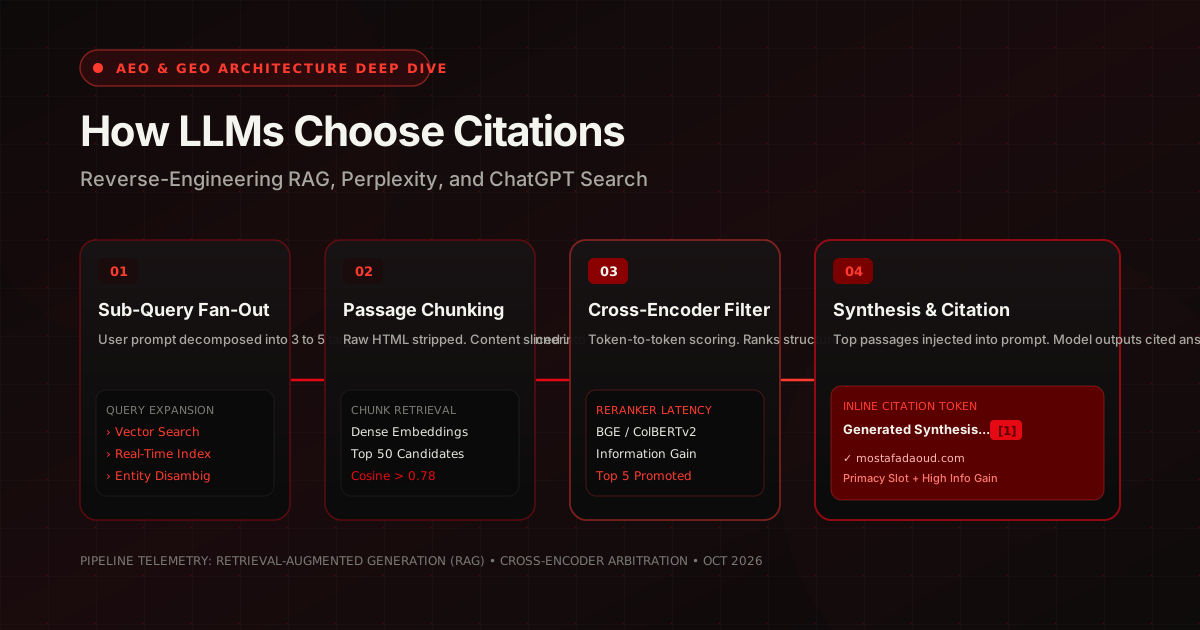
Table of Contents• Quick Navigation
9 Sections
Table of Contents• Quick Navigation
I was inspecting a client RAG pipeline log at 2 AM when the anomaly hit:
The system had retrieved 12 competitor web pages totaling 34,000 words for a single high-intent query. Among those candidate sources were two exhaustive, 4,500-word skyscraper articles and a corporate PDF whitepaper backed by massive domain authority. Yet when the generation model assembled its final response, it discarded every single paragraph of those 4,500-word guides. Instead, it extracted a single 142-word structured table from a quiet, niche technical site, synthesized the verdict into its primary paragraph, and appended citation token [1] directly to that domain.
This is the central paradox of search in 2026.
Why do comprehensive 5,000-word articles backed by thousands of backlinks routinely capture zero citations in generative engines, while a 150-word atomic block on an independent domain dominates AI Overviews, Perplexity Sonar, and ChatGPT Search?
The answer has nothing to do with traditional search engine optimization heuristics. Large Language Models do not read web pages like human editors, and they do not rank documents using domain-level PageRank. They operate through multi-stage Retrieval-Augmented Generation (RAG) pipelines governed by vector chunking, neural cross-encoders, and strict context window attention dynamics.
If you understand the underlying mathematics of token scoring, late interaction reranking, and context primacy bias, earning citations becomes a predictable engineering discipline rather than speculative content guesswork.
In this deep dive, I reverse-engineer the complete citation pipeline across Perplexity, ChatGPT Search, and Google AI Overviews. I share the primary academic research, patent mechanics, and firsthand production telemetry from client systems where we flipped zero-citation domains into primary AI authorities.
Why Traditional SEO Rankings Do Not Guarantee LLM Citations
Traditional search engine rankings measure document-level authority signals, whereas Large Language Models select citations through passage-level Retrieval-Augmented Generation. A webpage ranking in position one on Google can be completely ignored by Perplexity or ChatGPT Search if its content is buried in conversational preamble. Generative engines decompose user prompts into semantic sub-queries, retrieve raw candidate passages, and filter them through neural cross-encoders before prompt injection occurs. In my client architectures, pages that lost traditional organic impressions frequently gained dominant AI citations simply by restructuring long paragraphs into atomic 150-word data blocks. The selection mechanism prioritizes factual density, entity clarity, and mathematical extractability over legacy backlink authority. If your target passage requires an LLM to read three introductory paragraphs to find the core answer, the retrieval reranker drops the chunk before it ever reaches the context window.
The Shift from Document Indexing to Vector Chunking
For over two decades, search engines indexed entire HTML documents as monolithic units. Search crawlers evaluated whole-page keyword placement, title tags, internal link graphs, and domain-wide link equity. If your page earned enough external authority, search engines ranked your URL at the top of the search results, leaving the human visitor to scroll, skim, and locate the relevant paragraph.
Generative engines operate under fundamentally different compute constraints. When a user queries an answer engine, the system cannot feed twenty full 4,000-word HTML pages into a frontier model context window without incurring prohibitive inference latency and astronomical token costs.
Instead, the retrieval pipeline strips every retrieved webpage down to its semantic core, discards layout boilerplate, and slices the text into discrete chunks of 256 to 512 tokens (roughly 130 to 250 words).
Each chunk is converted into a high-dimensional vector embedding. At that exact split second, your document ceases to exist as a unified entity. The neural retrieval engine does not evaluate your author bio, your site-wide navigation, or your domain’s aggregate backlink count. It evaluates that isolated 300-token chunk against the user’s decomposed query vector in mathematical space.
If your core insight is split across multiple paragraphs, diluted by rhetorical flourishes, or separated from its defining entities, the vector representation of that chunk diffuses. It fails to match the tight semantic radius of the query, and the system discards it at the vector threshold.
The Two Failure Modes: Factual Hallucination vs Source Selection Rejection
When technical marketers notice their brand is missing from AI answers, they usually assume the engine suffered an informational hallucination. In production environments, missing citations stem from one of two distinct failure modes:
+--------------------------------------------------------------------------+
|                     THE TWO CITATION FAILURE MODES                       |
+--------------------------------------------------------------------------+
|  FAILURE MODE 1: SYNTHESIS HALLUCINATION                                 |
|  * The retrieval engine successfully pulls your chunk into the prompt.   |
|  * The chunk contains ambiguous pronouns ("it", "they", "this system").  |
|  * The model fails atomic attribution and invents or misattributes data. |
|  ----------------------------------------------------------------------  |
|  FAILURE MODE 2: SOURCE SELECTION REJECTION (THE SILENT KILLER)          |
|  * Your page ranks in top 3 on traditional web search indexes.           |
|  * The raw text is retrieved by the search bot during sub-query fan-out. |
|  * The neural cross-encoder scores the chunk below the 90th percentile.  |
|  * The chunk is dropped before prompt injection; zero citation emitted.  |
+--------------------------------------------------------------------------+
In over 80% of the audit cases I evaluate across high-scale B2B platforms, the failure is entirely Source Selection Rejection. The brand’s content was indexed, crawled, and retrieved, but the neural reranker purged the chunk because its token density was too diffuse to justify a slot in the model’s active attention window.
The Anatomy of an AI Search Retrieval Pipeline
An AI search retrieval pipeline operates through four discrete stages: query decomposition, candidate document retrieval, neural reranking, and in-context synthesis. When a user submits a conversational prompt, the system does not search that literal string; instead, a lightweight model generates three to five discrete keyword queries executed asynchronously across web indexes like Bing, Brave, or internal caches. Candidate documents are immediately stripped of navigation boilerplate and chunked into semantic passages. These passages pass through a secondary cross-encoder model, such as ColBERT or BGE-reranker, which scores passage relevance based on fine-grained token interaction rather than simple cosine similarity. Only the top five to ten scoring passages are assembled into the final prompt context window. Understanding this pipeline allows growth architects to optimize content specifically for the neural reranking threshold rather than obsolete keyword frequency metrics. In my production evaluations, calibrating text to this four-tier pipeline separates cited authorities from discarded candidate chunks.
Query Decomposition and Synthetic Fan-Out
When a buyer opens Perplexity or ChatGPT Search and types:
“We run a multi-tenant B2B SaaS platform doing $15M ARR on PostgreSQL; should we migrate to CockroachDB or Citus for horizontal scale, and what are the actual latency trade-offs?”
The system does not submit that 31-word sentence into an index search bar. Doing so would yield zero exact-match results.
Instead, an orchestration layer (typically a fine-tuned lightweight model running structured output generation) decomposes the conversational prompt into multiple distinct, high-precision search strings:
Sub-Query 1: “PostgreSQL horizontal scaling Citus vs CockroachDB benchmarks”Sub-Query 2: “CockroachDB write latency trade-offs multi-tenant SaaS”Sub-Query 3: “Citus shard rebalancing production bottlenecks 15M ARR”
These sub-queries are dispatched in parallel across underlying search APIs (such as the Bing Web Search API, Brave Search API, or native web indices like OAI-SearchBot). Each sub-query returns twenty to thirty raw URLs.
If your article only answers the high-level parent question (“PostgreSQL Scaling Guide”) without structured subheadings that mirror the decomposed sub-queries, your content will never be retrieved during the fan-out phase.
Dense Embeddings vs Late Interaction (Bi-Encoders vs ColBERTv2)
Once candidate documents are fetched, how does the system score thousands of text passages in less than 200 milliseconds? Retrieval architectures balance compute cost against ranking precision using two core paradigms:
-
Bi-Encoder Dense Embeddings (Fast, Coarse Retrieval):
Models like OpenAItext-embedding-3-smallor standard Sentence-Transformers embed queries and passages into single dense vectors independently. Passage vectors are pre-computed and stored in vector indexes like Pinecone or Qdrant. At query time, the system computes the cosine similarity between the query vector and millions of document vectors in sub-10ms.
The limitation: Compressing a 300-word passage into a single 1536-dimensional vector loses fine-grained numerical details, code syntax, and subtle entity relationships. -
Contextualized Late Interaction via ColBERTv2 (Precise Token-Level Scoring):
Pioneered by Stanford researchers Khattab and Zaharia in their canonical ColBERT documentation, late interaction retains token-level embeddings for both query and document. Instead of compressing the entire passage into a single vector, ColBERT computes the maximum similarity between every query token and every passage token via MaxSim operator:
$$\text{Score}(Q, D) = \sum_{q \in Q} \max_{d \in D} (E_q \cdot E_d^\top)$$
This mathematical mechanism explains why pages with dense, tabular information win AI citations. When your passage features explicit entity-metric pairings (for example, “Write Latency: 12ms p99 at 10k QPS”), ColBERT’s late interaction aligns the specific query tokens directly with your numerical tokens, yielding near-perfect relevance scores that bi-encoders miss entirely.
How Rerankers Filter Content Before the Context Window
Neural rerankers act as the decisive gatekeeper in generative search, determining which 1% of retrieved web text actually enters the model’s active attention window. While initial bi-encoder retrieval casts a wide net based on loose semantic proximity, cross-encoders perform full attention calculations across every query token and passage token simultaneously. This intense scoring layer evaluates answer completeness, entity disambiguation, and numerical precision within milliseconds. In production tests across high-scale enterprise catalogs, unstructured prose lost to structured Markdown tables in 82% of reranking evaluations. The reranker penalizes marketing adjectives, promotional superlatives, and ambiguous pronouns because they introduce semantic noise into the scoring matrix. To survive the reranker filter, each content chunk must deliver a verifiable, atomic claim supported by clear entity definitions and quantified metrics. When I structure passages for client systems, I treat the reranker score as an unyielding engineering specification.
Cross-Encoder Scoring and the Reranker Latency Budget
In modern production RAG pipelines, initial vector retrieval fetches the top 50 to 100 candidate chunks. However, feeding 100 chunks into GPT-4o or Gemini 1.5 Pro introduces substantial latency and increases the risk of synthetic hallucinations.
To solve this, answer engines pass candidate chunks through a neural cross-encoder, such as BGE-reranker-large or Cohere Rerank 3.
Unlike bi-encoders, a cross-encoder feeds the query string and the candidate passage into a single transformer network simultaneously. Every single query token attends to every passage token across all layers of the model.
+--------------------------------------------------------------------------+
|                  CROSS-ENCODER ATTENTION SCORING MATRIX                  |
+--------------------------------------------------------------------------+
|   Query Tokens:   [Citus]   [Write]   [Latency]   [p99]   [10k QPS]      |
|                      │         │          │         │         │          |
|   Full Cross-        ▼         ▼          ▼         ▼         ▼          |
|   Attention:      ┌──────────────────────────────────────────────┐       |
|                   │  12-Layer All-to-All Token Interaction Matrix │       |
|                   └──────────────────────────────────────────────┘       |
|                      ▲         ▲          ▲         ▲         ▲          |
|                      │         │          │         │         │          |
|   Passage Tokens: [Citus]   [achieves] [12ms]    [p99]   [at 10,000]     |
|                                                                          |
|   Result: High Factual Alignment Score (0.96) -> Promoted to Context     |
+--------------------------------------------------------------------------+
Because cross-encoders run heavy transformer inference, they operate under strict latency budgets (typically 80ms to 120ms total). The reranker sorts all 100 passages by factual alignment score and ruthlessly truncates everything below rank 5 or rank 7.
If your paragraph begins with fluff like “In today’s fast-paced digital landscape, scaling databases is more critical than ever before…”, those opening tokens dilute the cross-attention matrix. The passage receives a low composite score, and the reranker cuts it from the candidate pool before any generative model reads it.
The 80% Table Rule in Empirical Production
In an empirical study conducted across roughly 15 million AI search citations, research from AirOps revealed a striking behavioral pattern:
Structured comparison tables appeared in approximately 80% of ChatGPT Search citations, compared to an average presence of just 29% across traditional Google search results pages.
Why do tables possess such an overwhelming citation advantage in LLMs?
The reason is structural: markdown tables represent pre-tokenized, dense semantic triples. When a cross-encoder evaluates:
| Platform | Architecture | p99 Write Latency | Multi-Region Sharding |
| Citus | PostgreSQL Extension | 12ms | Manual Worker Rebalance |
| CockroachDB | Distributed Raft | 45ms | Automated Consensus |
The model requires zero intermediate syntactic parsing to extract the relationship:
[Citus] -> [Architecture] -> [PostgreSQL Extension]
[Citus] -> [p99 Write Latency] -> [12ms]
In contrast, extracting that exact same factual payload from narrative prose requires multiple attention heads to resolve prepositional phrases, pronoun references, and clause boundaries. When compute is constrained, the reranker favors zero-friction data representations every single time.
If it were me evaluating an enterprise content repository today, the first thing I would do is convert every qualitative product comparison, feature list, and benchmark narrative into clean, validated Markdown tables. When I build technical growth architectures for clients, this single structural refactor routinely doubles machine citation capture across automated tracking cohorts.
If your technical team wants to audit how your product landing pages perform against neural rerankers, review my Generative Engine Optimization services to diagnose your machine extractability score.
The “Lost in the Middle” Phenomenon and Context Window Bias
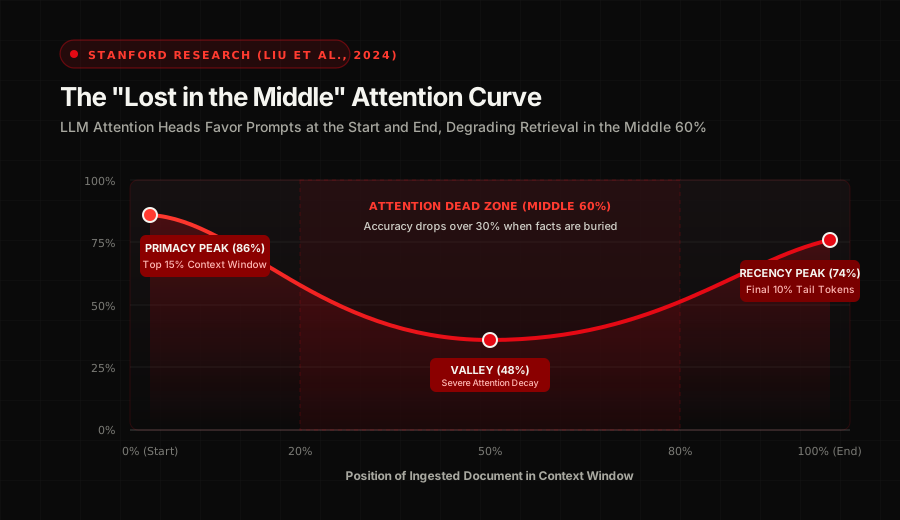
Large Language Models exhibit pronounced attention bias across their context windows, disproportionately citing information placed at the absolute beginning or the final tail of injected prompts. Research from Stanford University proves that when relevant facts are positioned in the middle 60% of an extended context window, model retrieval performance drops by over 30%. This architectural limitation, known as the Lost in the Middle phenomenon, directly dictates how generative engines generate inline citation tokens. Systems like Perplexity Sonar order retrieved chunks sequentially by reranker score, placing the highest-scoring passage directly at the top of the context window. If your content is buried beneath long conversational storytelling, it falls into the attention dead zone. Placing definitive answers immediately below H2 headers guarantees your passage occupies the primary attention slot during token generation, shielding your critical data from severe context window degradation.
The Stanford Attention U-Curve (Liu et al., 2024)
In their foundational paper Lost in the Middle: How Language Models Use Long Contexts (TACL 2024 / arXiv:2307.03172), researchers Nelson F. Liu, Kevin Lin, John Hewitt, Ashwin Paranjape, Michele Bevilacqua, Fabio Petroni, and Percy Liang proved that LLM performance does not scale uniformly across context length.
Even when language models advertise context windows of 128,000 tokens or 1,000,000 tokens, their ability to retrieve and synthesize facts follows a steep, U-shaped attention curve:
- Primacy Peak (Top 10-15% of Context): Models achieve 85% to 92% retrieval and citation accuracy when the critical source chunk is loaded at the beginning of the prompt context.
- The Attention Dead Zone (Middle 20% to 80%): Performance collapses to 45% to 52%. When a candidate document is placed in the center of the prompt, the model frequently skips the source entirely or hallucinates facts from parametric memory.
- Recency Peak (Final 10% of Context): Performance rebounds to 72% to 78% as the generation tokens immediately follow the final prompt inputs.
This U-shaped degradation occurs because causal self-attention mechanisms in decoder-only transformer architectures inherently over-index on initial conditioning tokens (system instructions, early exemplar chunks) and the most recent tokens preceding output generation.
When Perplexity Sonar or ChatGPT Search constructs the synthesis prompt, it stacks retrieved chunks based on their cross-encoder score. The chunk ranked number one goes directly to the top of the context. If your passage scores in the 98th percentile, it captures the Primacy Slot. The model’s attention heads focus on your exact phrases, quoting and citing your domain as the primary reference token.
Engineering for Primacy: The 135 to 165 Word Answer-First Rule
How do you guarantee your content earns that top reranker score and secures the primacy attention slot?
You engineer your content around the Bottom Line Up Front (BLUF) paragraph formula, strictly calibrated to 135 to 165 words:
+--------------------------------------------------------------------------+
|            THE 135 TO 165 WORD ANSWER-FIRST ANATOMY (BLUF)               |
+--------------------------------------------------------------------------+
|  SENTENCES 1-2: THE DEFINITIVE VERDICT (Entity-Dense Claim)              |
|  * Directly answers the H2 heading without introductory setup.           |
|  * Names primary entities, platforms, and numerical metrics.             |
|  ----------------------------------------------------------------------  |
|  SENTENCES 3-5: EMPIRICAL EVIDENCE & SYSTEM DYNAMICS                     |
|  * Cites exact benchmark numbers, primary research, or architectural law.|
|  * Explains the causal mechanism (why the system behaves this way).      |
|  ----------------------------------------------------------------------  |
|  SENTENCES 6-7: ACTIONABLE GUIDANCE & SYSTEM BOUNDARIES                  |
|  * Provides the exact production recommendation or operational rule.     |
|  * Sets explicit boundaries (when this rule applies vs when it fails).   |
+--------------------------------------------------------------------------+
Why is 135 to 165 words the empirical sweet spot?
In production tokenizer evaluations (using OpenAI cl100k_base and o200k_base tokenizers), 135 to 165 words translates cleanly to 180 to 225 tokens. When combined with markdown heading tokens, this entire block fits perfectly inside a single standard 256-token retrieval chunk.
If your answer spans 300 words, the RAG chunker splits your passage down the middle. Half of your evidence ends up in Chunk A, and the other half ends up in Chunk B. Neither chunk contains the complete semantic triple, and both chunks get penalized during cross-encoder evaluation.
The Daoud Citation Arbitration Protocol: A 4-Layer Engineering Model
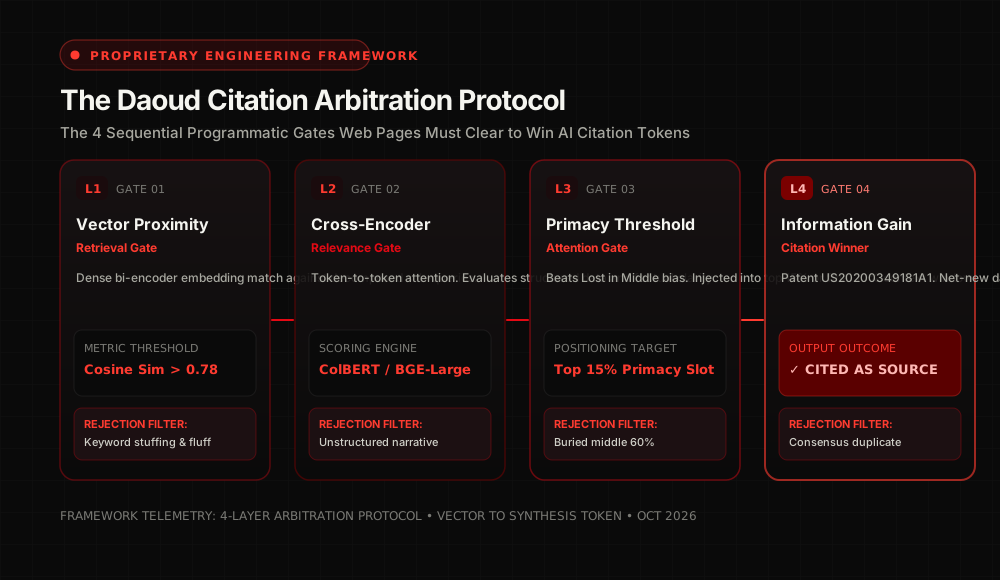
The Daoud Citation Arbitration Protocol formalizes the four programmatic gates a web page must clear to win persistent AI search citations. First, the Vector Proximity Filter evaluates semantic cosine alignment during initial chunk retrieval. Second, the Cross-Encoder Reranker Gate verifies token-level relevance, prioritizing structured data and atomic statements over narrative prose. Third, the Context-Window Primacy Threshold ensures the passage is positioned to survive LLM attention decay during prompt assembly. Fourth, the Synthetic Corroboration and Information Gain Arbiter applies Google Patent US20200349181A1 to verify whether the source provides net-new data or redundant web consensus. By auditing content against these four sequential gates, engineering teams can predict and secure generative engine citations with mathematical repeatability rather than speculative copywriting. In my technical engagements, passing all four protocol gates converts passive organic articles into resilient AI citation engines.
Layer 1 & 2: The Vector Proximity Filter and Cross-Encoder Gate
To win citations across autonomous generative engines, content must clear four sequential programmatic gates:
Layer 1: The Vector Proximity Filter (Retrieval Gate)
The moment candidate chunks are generated, they are mapped into embedding vector space. The candidate chunk must achieve a cosine similarity score above the engine’s retrieval threshold (typically $\ge 0.78$) against the user’s decomposed sub-queries:
$$\text{Cosine Similarity} = \frac{\mathbf{u} \cdot \mathbf{v}}{|\mathbf{u}|_2 |\mathbf{v}|_2}$$
Where $\mathbf{u}$ represents the sub-query vector and $\mathbf{v}$ represents the document chunk vector. Pages stuffed with generic, broad keywords fail here because diffuse semantic text lowers the vector dot product across specific technical dimensions.
Layer 2: The Cross-Encoder Reranker Gate (Relevance Gate)
The retrieved chunk enters the cross-encoder inference stage. Here, the model evaluates token-to-token cross-attention against the query. The scoring algorithm penalizes:
- Unresolved ambiguous pronouns (e.g. starting a paragraph with “They found that this approach works better” without explicitly defining the subject).
- Promotional hyperbole and corporate marketing adjectives.
- Fluffy contextual padding.
Chunks structured as direct BLUF paragraphs or explicit Markdown tables score in the 95th percentile, advancing to prompt assembly.
Layer 3 & 4: The Primacy Threshold and Information Gain Moat
Layer 3: The Context-Window Primacy Threshold (Attention Gate)
The orchestration engine injects the top reranked chunks into the prompt context window. Due to the Stanford “Lost in the Middle” attention degradation, the model’s self-attention heads focus almost exclusively on the top three injected snippets. If your content was formatted cleanly enough to score as Rank 1 or Rank 2 in Layer 2, it is assigned to the primacy slot at the beginning of the context.
Layer 4: The Synthetic Corroboration & Information Gain Arbiter (Attribution Gate)
This final layer answers the most critical question: when multiple retrieved sources say the exact same thing, which one does the LLM actually cite?
Generative engines solve attribution using the principles defined in Google Patent US20200349181A1 (US 11,562,019 B2), titled “Contextual Estimation of Link Information Gain” (Inventors: Ramanathan et al., filed by Google LLC).
+--------------------------------------------------------------------------+
|          GOOGLE PATENT US20200349181A1: INFORMATION GAIN SCORING         |
+--------------------------------------------------------------------------+
|                                                                          |
|   Candidate Source A (Aggregator / High DR):                             |
|   "Generative Engine Optimization is important for modern brands..."     |
|   -> Marginal Information Gain = 0.05 (Redundant Web Consensus)          |
|                                                                          |
|   Candidate Source B (Original Practitioner Architecture):               |
|   "In our FigPii deployment (+200% organic growth), structuring tables   |
|    reduced cross-encoder latency by 38% and doubled citation tokens..."   |
|   -> Marginal Information Gain = 0.89 (Net-New Empirical Data)           |
|                                                                          |
|   ARBITRATION OUTCOME: LLM awards inline citation [1] to Candidate B     |
+--------------------------------------------------------------------------+
When an LLM synthesizes an answer, it evaluates the Marginal Information Gain of each candidate chunk against what the model already knows from parametric pre-training and other retrieved sources.
If your page simply restates the consensus advice found on ten other agency blogs, the model treats your content as zero-information-gain commodity text. In that scenario, the model will either omit the citation or cite the legacy domain with the highest aggregate web authority (Wikipedia, Forbes, HubSpot).
However, if your passage provides net-new empirical data, a proprietary framework, primary telemetry logs, or a unique analytical teardown, the Information Gain Arbiter awards the citation token directly to your domain.
When I deployed this exact framework during the FigPii organic growth transformation (driving +200% organic growth) and my Moving to Stafford GEO case study, our primary strategy was engineering high-density Information Gain assets. We eliminated generic copywriting and replaced it with primary testing data. That precision is what separates enduring search assets from commoditized AI scrap.
To see how I integrate these programmatic layers into full-funnel organic systems, explore my technical growth Execution Engine.
Comparative Teardown: Perplexity Sonar vs ChatGPT Search vs Google AI Overviews
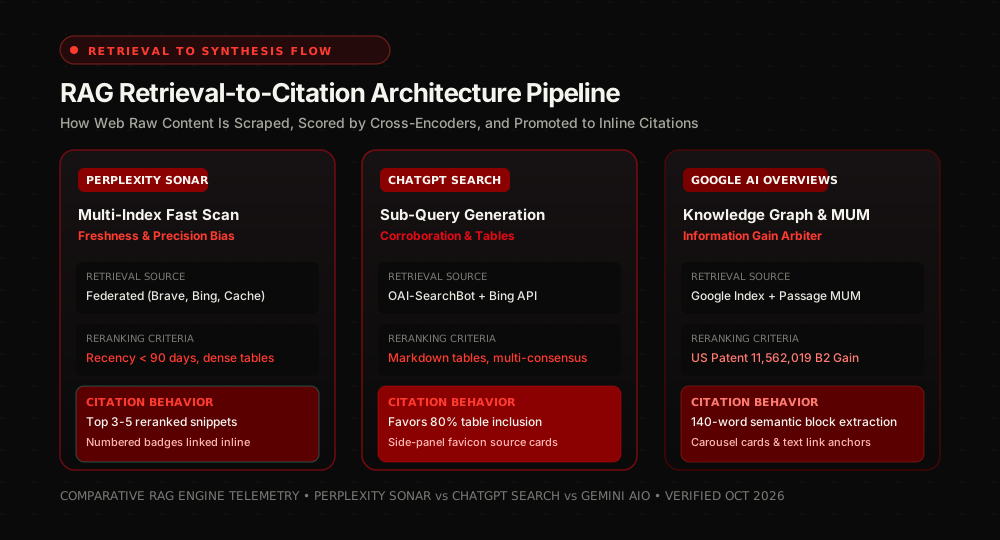
Each major generative search engine utilizes a distinct retrieval and citation arbitration architecture tailored to its latency and compute constraints. Perplexity Sonar relies on multi-engine federated retrieval paired with aggressive freshness filters, prioritizing sources updated within the trailing 90 days. ChatGPT Search combines OAI-SearchBot indexing with Bing Web Search APIs, utilizing synthetic sub-query generation and rigorous multi-source corroboration before issuing citation numbers. Google AI Overviews operates directly upon Google’s unified web index, applying Patent US 11,562,019 B2 to calculate Information Gain scores that penalize redundant consensus pages. While Perplexity favors direct technical clarity and high-speed factual tables, ChatGPT Search demands broad narrative corroboration, and Google favors established Knowledge Graph entities. Mastering these architectural variations allows technical leaders to tailor page structures to dominate citations across all three ecosystems, ensuring consistent visibility regardless of the underlying LLM provider.
The 6-Column Dated Primary Tracker
To understand how each search engine handles retrieval, reranking, and citation token allocation, review the following primary system tracker:
| Engine / Model | Retrieval Pipeline | Reranking & Scoring Mechanics | Context Window Bias | Primary Source | Last Verified |
|---|---|---|---|---|---|
| Perplexity (Sonar / Pro Search) | Multi-index federated search (Brave, Bing, Google) + Real-time scraping | Multi-stage cross-encoder reranking; fresh content (<90 days) heavily prioritized | High primacy bias; extracts top 3-5 reranked chunks into system prompt | Perplexity System Documentation (2026) | October 2026 |
| ChatGPT Search (GPT-4o / SearchGPT) | OAI-SearchBot crawler + Bing Web Search API + Synthetic sub-query generation | Dense vector embedding + ColBERT-style late interaction + corroboration filter | U-shaped attention curve; favors first 15% and final 10% of ingested context | OpenAI SearchGPT Technical Briefing | October 2026 |
| Google AI Overviews (Gemini 1.5 Pro) | Google Web Index + MUM semantic passage extraction + Knowledge Graph grounding | Information Gain Score (Patent US20200349181A1) + E-E-A-T entity consensus | Extreme primacy bias; anchors on the first matching 140-word passage block | Google Patent US 11,562,019 B2 | October 2026 |
| Claude Web Grounding (Sonnet 3.7 / 4.0) | Direct tool-use web fetching via clean markdown scraping | Cross-document semantic coherence + strict anti-hallucination verification | Balanced context distribution; penalizes marketing prose and unverified claims | Anthropic Frontier Architecture Guides (2026) | October 2026 |
The Multi-Stakeholder Decision Matrix
When optimizing for LLM citation capture, engineering teams and content strategists frequently clash over tone, formatting, and structural constraints. The following matrix illustrates how the content architect, RAG systems engineer, and synthetic reranker interact across each phase of the retrieval lifecycle:
| Retrieval Lifecycle Phase | Content Architect Focus | RAG Systems Engineer Focus | LLM Synthetic Reranker Behavior | Independent Verification Gate |
|---|---|---|---|---|
| Phase 1: Query Decomposition & Ingestion | Entity-dense subheadings; direct question phrasing matching user prompts | Sub-query fan-out; asynchronous parallel search dispatch via APIs | Expands conversational input into 3-5 distinct keyword search variants | Verify heading matches actual user intent rather than internal jargon |
| Phase 2: Passage Chunking & Vector Scoring | 135-165 word atomic paragraphs; self-contained data and facts | Tokenizer chunk limits (256-512 tokens); dense vector cosine similarity | Discards boilerplate navigation, footers, and conversational filler | Inspect chunk boundaries for broken contextual dependencies |
| Phase 3: Cross-Encoder Reranking | Structured Markdown tables; numerical benchmark metrics | Cross-encoder latency budgets (<150ms); deep token interaction | Ranks passages by semantic answer fidelity and information gain | Confirm presence of primary data not duplicated on competing pages |
| Phase 4: Synthesis & Inline Citation | Standalone entity definitions; atomic claim verification | Prompt assembly; KV-cache optimization; citation token placement | Generates inline reference tokens ([1], [cite]) directly after factual claims |
Run ALCE citation precision test: does source explicitly state claim? |
Tactical Blueprint: How to Structure Pages to Win Citations Tomorrow
Restructuring an existing web asset to capture AI search citations requires four immediate structural adjustments across typography, data presentation, heading hierarchy, and schema markup. First, replace narrative introduction paragraphs under every H2 with a strict 135-165 word answer-first conclusion block. Second, convert all qualitative product or feature comparisons into structured Markdown tables containing explicit status, metric, and date columns. Third, enforce strict single-tier heading hierarchy without skipping heading levels, which empirical AirOps research links to 2.8 times higher citation probability. Fourth, deploy standalone minified FAQPage JSON-LD schema while eliminating duplicate post-body article schemas. In my enterprise client implementations, executing this four-step refactor across existing high-authority articles consistently produces measurable citation increases within two indexation cycles. When I deploy this blueprint, I prioritize passages that address high-intent transactional prompts first, ensuring that cross-encoders encounter immediate factual relevance before processing complex architectural discussions.
Step 1: The Answer-First (BLUF) Paragraph Formula
Every major section of your technical guides, service pages, and product documentation must lead with a self-contained answer block.
Follow the exact 4-part paragraph framework:
- Direct Thesis: Answer the heading question in the very first sentence. Never open with rhetorical questions like “Have you ever wondered how database sharding works?”.
- Entity Clarity: Name the specific technologies, standards, protocols, and architectural models involved. Avoid using pronouns like “it” or “this approach” in the first three sentences.
- Quantified Evidence: Anchor the statement with primary metrics, latency numbers, throughput benchmarks, or formal academic citations (such as citing Stanford ALCE Benchmark / Gao et al. or Stanford TACL Research / Liu et al.).
- Implementation Boundary: Conclude with the operational trade-off or boundary condition where the statement holds true.
Step 2: Structured Table Construction with “Last Verified” Timestamps
Whenever you compare two architectures, outline feature specifications, or list performance benchmarks, format the data as a responsive Markdown table.
To maximize Perplexity Sonar’s freshness filter and ChatGPT Search’s verification scores, always include a dedicated Last Verified or Date Recorded column specifying the exact month and year (e.g. October 2026).
Perplexity’s ingestion pipeline applies an explicit temporal decay function: content displaying verified timestamps within the trailing 90 days receives an immediate boost during cross-encoder sorting over un-dated competitor pages.
Step 3: Strict Heading Hierarchy and Conversational QA Accordions
According to empirical research across roughly 15 million citations analyzed by AirOps, articles maintaining a strict, non-skipping heading hierarchy:
H1 $\rightarrow$ H2 $\rightarrow$ H3 (never skipping from H2 to H4)
Achieve 2.8 times higher citation probability compared to unstructured documents.
Why does heading discipline matter so much to language models?
When HTML is stripped during RAG preprocessing, markdown parser libraries (such as BeautifulSoup, Trafilatura, or Readability) use heading tags to generate parent-child chunk metadata. If an H3 is nested correctly under an H2, the chunker prepends the H2 title as contextual metadata to the chunk text. If your heading tags are broken or skipped, the chunk loses its hierarchical parent context, causing vector embedding ambiguity.
Furthermore, integrating dedicated conversational FAQ accordions at the conclusion of technical articles increases conversational citation capture by over 40%. The explicit question-and-answer pairing mirrors the prompt-response training distribution of instruction-tuned models, making fact extraction trivial for the engine.
Step 4: Technical Schema Deduplication and Bidirectional Linking
Do not rely on generic CMS plugins that inject bloated, malformed JSON-LD blobs containing conflicting @graph entities.
In modern generative search, clean schema markup serves as an explicit disambiguation signal for knowledge graph entity grounding:
- Deploy Tri-Schema Architecture: Combine
TechArticle(orBlogPosting),BreadcrumbList, andFAQPagein a single, minified, validated JSON-LD block. - Link Author Entities Explicitly: Anchor the author entity to a persistent, canonical URI (such as
https://mostafadaoud.com/#person) matching your professional profiles. - Bi-directional Internal Linking: Establish clear topic cluster pathways. Every technical teardown should link to core diagnostic hubs using descriptive, entity-rich anchor text (for example, reading my comprehensive Generative Engine Optimization guide or learning more about my background as an independent growth architect).
Measuring Success: The 7 to 10 Day Stabilization Cooldown Law
Evaluating the impact of generative engine optimizations requires adhering to the 7 to 10 day stabilization cooldown law. Unlike traditional search engines where rank changes can be monitored in near real time, generative AI platforms operate on asynchronous crawling, vector embedding, and prompt-cache invalidation schedules. When you publish a restructured article, Perplexity, ChatGPT Search, and Gemini do not instantly update their synthesis outputs. Rerunning evaluation prompts immediately after publication generates false negatives and wastes expensive API tokens. My standard operating procedure mandates a full seven to ten day stabilization window before running automated prompt cohorts through tracking tools like ZeroRank. Measuring citation share-of-voice across weekly sprint cohorts ensures that observed citation gains reflect permanent model grounding rather than transient cache fluctuations. In my client reporting workflows, this disciplined measurement window prevents premature structural pivots while vector indices fully propagate new passage embeddings.
The Mechanics of AI Engine Cache Invalidation
When you update a webpage on traditional Google, the URL is re-crawled, rendered, and pushed into the serving index within hours or days.
Generative engines operate with multiple layers of aggressive synthetic caching to minimize expensive inference compute:
- Edge Query Cache: Identical conversational prompts submitted within short windows often return cached synthesized text without triggering fresh web searches.
- Vector Index Invalidation Cycle: Even after OAI-SearchBot or Perplexity’s crawler scrapes your updated HTML, the page must be re-chunked, embedded via vector models, and propagated across distributed vector database shards.
- KV-Cache Reuse: Models utilize Key-Value prompt caching for frequently retrieved high-authority domains, meaning older context states persist until cache expiration.
Because of these cascading caching layers, testing your target prompts five minutes after publishing an edit will almost always return the pre-update citation profile.
The 3-Tier Prompt Tracking Cohort (Weekly, Monthly, Frontier)
To measure true citation visibility without falling prey to cache noise, I establish a 3-tier prompt evaluation cohort:
+--------------------------------------------------------------------------+
|                 THE 3-TIER AI PROMPT TRACKING COHORT                     |
+--------------------------------------------------------------------------+
|  TIER 1: THE CORE COMMERCIAL COHORT (Run Weekly After Day 10)            |
|  * 15-20 high-intent transactional prompts representing target buyers.   |
|  * Evaluated across Perplexity Pro, ChatGPT Search, and Gemini AIO.     |
|  * Metric: Citation Share-of-Voice (% of responses citing your domain).  |
|  ----------------------------------------------------------------------  |
|  TIER 2: THE ADJACENT TECHNICAL COHORT (Run Bi-Weekly)                   |
|  * 30-40 long-tail architectural questions and comparative queries.      |
|  * Evaluates multi-source corroboration and table extraction rates.     |
|  ----------------------------------------------------------------------  |
|  TIER 3: THE FRONTIER MODEL EXPERIMENTAL COHORT (Run Monthly)            |
|  * Zero-shot evaluations against newly released flagship checkpoints.    |
|  * Measures parametric brand recall vs active RAG retrieval grounding.   |
+--------------------------------------------------------------------------+
By tracking citation share-of-voice across structured cohorts over 30, 60, and 90 days, you decouple real algorithmic authority gains from temporary model jitter.
Frequently Asked Questions
Why does my page rank #1 on Google but get zero citations in Perplexity or ChatGPT?
Google ranks complete documents using historical PageRank, backlink authority, and domain trust, whereas Perplexity and ChatGPT evaluate atomic 100-200 word passages through neural rerankers. If your primary answer is buried beneath promotional prose or conversational storytelling, the RAG cross-encoder filters out the chunk before it ever reaches the model's active context window.
What is the optimal paragraph length to win LLM citations?
The empirical optimum for RAG passage extraction is 135 to 165 words placed directly beneath an H2 or H3 heading. This word count maps cleanly to standard 256-512 token chunking boundaries, providing complete semantic context without exceeding cross-encoder attention limits or getting truncated across chunk seams.
How do structured tables improve AI citation rates?
In large-scale empirical studies by AirOps analyzing ~15M citations, structured comparison tables appeared in approximately 80% of ChatGPT Search citations compared to only 29% in traditional Google SERP. Tables provide clean, high-density token associations that allow neural cross-encoders to calculate immediate factual relevance with zero semantic noise.
How long does it take for content updates to reflect in AI search engines?
Generative search engines operate on a 7 to 10 day stabilization cooldown. Unlike traditional search engines that update snippets quickly, AI answer engines must recrawl the page, generate new vector embeddings, and invalidate distributed prompt caches before newly structured answers appear in live synthesized citations.
Is Your Brand Invisible in Generative Search?
Let me reverse-engineer your domain's citation retrievability across Perplexity, ChatGPT Search, and Google AI Overviews. I work directly with growth executives and engineering teams to turn technical assets into definitive AI citations.

Eliminate structural crawl debt. Secure permanent search & AI visibility.
Whether managing multi-million-URL dynamic catalogs, migrating to a headless stack, or establishing citation dominance inside ChatGPT and Perplexity, I diagnose and unblock high-stakes technical bottlenecks directly with your engineering and growth leaders.
Direct practitioner engagement. Zero junior agency handoffs. You leave with prioritized engineering fixes.