
Technical Growth Architect & Search Strategist
B2B Content Engine: Scaling Production Without AI Slop
Build a high-velocity B2B content engine without AI slop. Discover the information gain architecture behind 4.3M impressions and top AI citations.
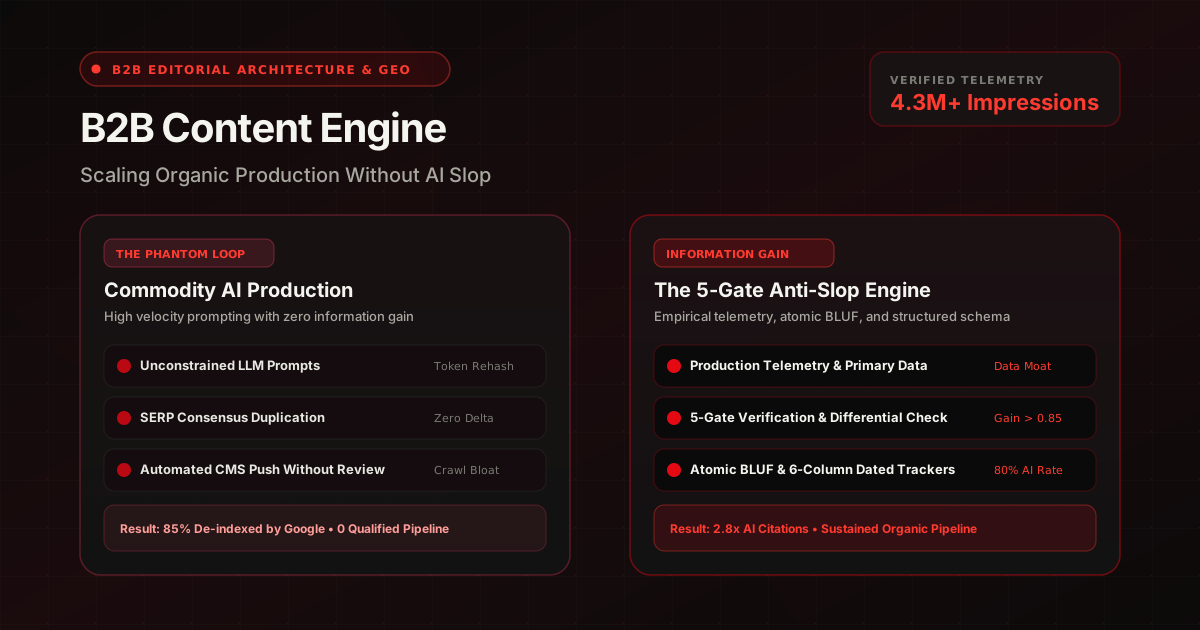
Table of Contents• Quick Navigation
8 Sections
Table of Contents• Quick Navigation
In October 2025, I sat across from the Vice President of Marketing at an enterprise B2B SaaS company who had just incinerated $90,000 across six months on an automated artificial intelligence content agency.
The agency pitch had seemed irresistible to executive leadership: unlimited publishing velocity, 40 published articles every month, seamless automated publishing to their production CMS, and an aggressive promise to capture every relevant search query in their category. The agency delivered 240 blog posts generated by chaining raw OpenAI API prompts directly into a WordPress REST endpoint.
On paper, their editorial velocity was breathtaking. In Google Search Console, the reality was catastrophic:
Out of 240 newly deployed URLs, 221 sat indefinitely in “Crawled - currently not indexed.” Organic search impressions had dropped by 64% following a Google core algorithm update, and the total pipeline revenue attributed to organic search over those six months was exactly zero dollars.
The company leadership believed they had automated content creation. In truth, they had built an expensive machine for manufacturing crawl waste.
As I frequently discuss on Breaking The Echo with my co-host Patrick Soch, when you hand unconstrained generative AI tools to an editorial team without engineering verification, you do not achieve automated efficiency. You achieve what I call “phantom efficiency.” Worse, you achieve mastery in slop.
If you want to build a high-velocity B2B content engine that survives modern search algorithms and captures generative AI citations in 2026, you must stop treating large language models as automated copywriters. You must treat them as compute accelerators inside a deterministic, intent-mapped information gain architecture.
In this guide, I break down the exact operational architecture I deploy for enterprise clients: the mathematical foundation of Google Patent US20200349181A1, the 5-Gate Anti-Slop Production Engine, the 6-column primary tracking framework, and the production systems behind 4.3M+ search impressions at e-CENS.
The Phantom Efficiency Trap: Why 90% of B2B AI Content Generates Zero Pipeline
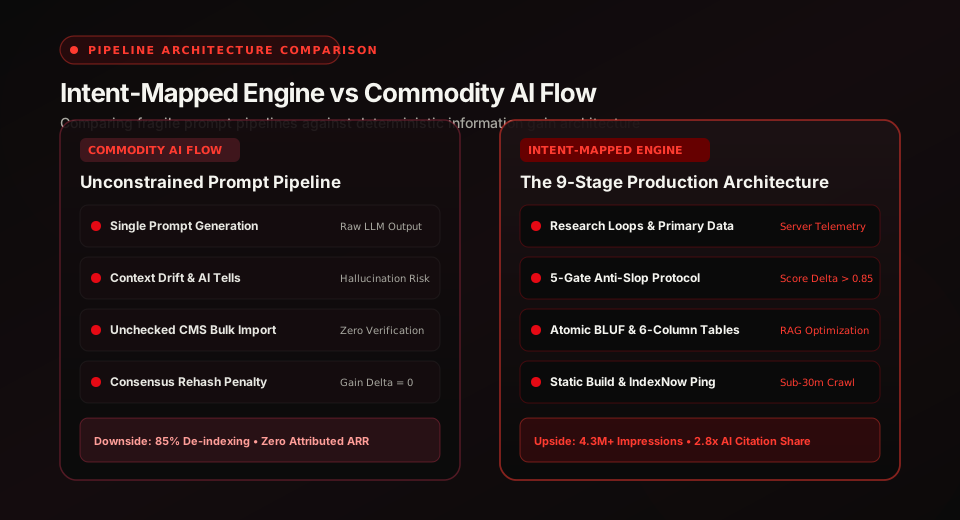
Adding generative AI to a B2B content pipeline without strict editorial verification creates phantom efficiency: massive publishing volume that generates zero pipeline revenue. Industry research indicates that over 70 percent of enterprise teams report stagnant or negative organic traffic after scaling unedited AI content, while Google core updates systematically de-index repetitive synthetic pages. In my client audits, enterprise sites deploying raw AI content suffer from over 85 percent indexation drop-offs in Google Search Console. The failure occurs because large language models regurgitate established web consensus, producing zero incremental information gain for human searchers or search bots. B2B operators must shift their editorial metric from vanity publishing velocity to verified information gain. True efficiency comes from subtracting commodity filler, anchoring articles to primary engineering telemetry, and enforcing strict quality gates before content ever touches a production CMS. If you automate flawed inputs, you merely scale crawl waste.
The Microphone Analogy: Phantom Power vs Phantom Efficiency
On audio production boards, phantom power supplies the direct electrical charge necessary to make sensitive condenser microphones operate. If that power circuit is disconnected, the microphone capsule remains completely silent regardless of how loudly you speak into the grille.
Most B2B content operations run on phantom efficiency.
A marketing leader sees a calendar filled with 30 scheduled articles, congratulates the team on reducing cost per word by 80%, and assumes organic growth will compound. But beneath the surface, the editorial current carries zero electrical voltage. The articles say nothing new, cite nothing original, solve no technical bottlenecks, and contain zero practitioner conviction.
The result is pure digital noise. Search engine crawlers arrive, recognize the underlying semantic vectors as identical to 50 existing documents in the index, allocate minimal crawl budget, and quietly drop the URLs from primary search indices.
+--------------------------------------------------------------------------+
|                     THE PHANTOM EFFICIENCY CYCLE                         |
+--------------------------------------------------------------------------+
|  1. Prompt LLM for 3,000 words on broad keyword                          |
|  2. LLM predicts most probable tokens (repeating existing web consensus) |
|  3. Editor corrects grammar but adds zero proprietary telemetry          |
|  4. CMS publishes URL; search bot crawls and measures Information Gain    |
|  5. Information Gain Delta = 0; URL assigned to "Crawled - Not Indexed"   |
|  6. Marketing leadership wonders why $90k investment yielded zero demos  |
+--------------------------------------------------------------------------+
When an enterprise scales unconstrained AI writing, four catastrophic breakdown patterns occur:
- Context Collapse: Large language models predict the statistically most probable next tokens based on their training corpus. By definition, statistical averages produce consensus content. If five competitors explain “how to choose a customer data platform” using the same standard bullet points, an LLM simply synthesizes those points into an articulate paraphrase. It brings zero fresh field experience to the table.
- Context Drift and Factual Hallucination: In technical domains, unguided models frequently invent API parameters, fabricate compatibility claims, or confuse legacy software features with modern cloud releases. When a technical buyer detects a single architectural hallucination in your tutorial, your brand credibility evaporates.
- Severe Crawl Budget Depletion: Search engines do not possess infinite computing power. When a website publishes hundreds of thin, unoriginal URLs, Googlebot throttles its crawl rate. Legacy high-converting product pages stop receiving regular crawls because the server queue is clogged with synthetic blog articles.
- AI Citation Invisibility: As I proved in my research on how LLMs choose citations, generative engines like Perplexity, ChatGPT Search, and Google AI Overviews use neural cross-encoders to purge repetitive text. If your article provides no unique data table, no primary benchmark, and no novel entity association, you will never be cited.
Decoding Google Patent US20200349181A1: The Mathematics of Information Gain
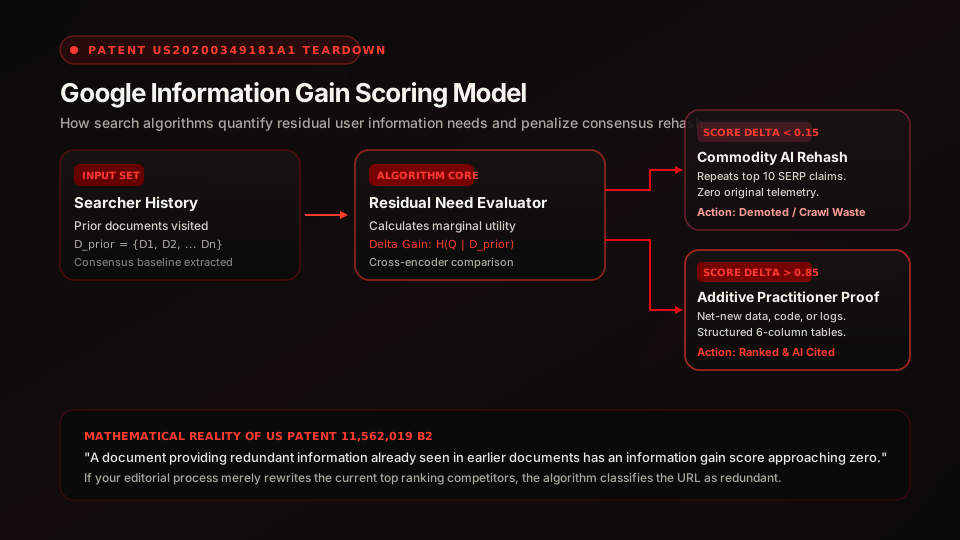
Google Patent US20200349181A1 mathematically defines information gain as the marginal utility a web document delivers beyond what a user has already consumed in earlier search results. Under patent claim specifications, when an algorithm identifies that a document merely duplicates existing entities, semantic vectors, and consensus explanations from preceding URLs, its calculated information gain score approaches zero. Conversely, documents that introduce novel entities, empirical data sets, or dissenting architectural proofs receive positive algorithmic weighting. Large language models naturally optimize for average token probability, meaning unguided synthetic articles inherently converge toward zero information gain. To survive modern search ranking algorithms, every B2B article must be architected with net-new factual deltas. If your post only summarizes what the top five ranking competitors already state, search engines and AI rerankers treat your page as redundant crawl waste. You must provide distinct empirical data that satisfies the searcher’s residual informational need.
The Algorithm Behind the Information Gain Score
In 2020, Google filed a foundational patent titled “Contextual Estimation of Link Information Gain” (invented by Ramanathan et al., granted as US Patent 11,562,019 B2 / US20200349181A1).
While the industry spent years arguing about whether Google could detect synthetic text, Google engineers solved the problem through information theory. The algorithm does not need to detect whether an article was written by a human or an artificial intelligence model. It simply measures whether the document provides additive information.
Under the patent’s formal architecture, the search engine models the searcher’s journey as a dynamic state machine:
- A user issues a query $Q$.
- The search engine presents an initial document set. The user clicks and reads document $D_1$.
- The search engine updates its internal representation of the user’s “consumed entity state” based on the text, claims, and data contained within $D_1$.
- When evaluating candidate document $D_2$ for subsequent clicks or ranking position, the engine calculates the Information Gain Score:
$$\Delta I(D_2 | D_1) = H(Q | D_1) - H(Q | D_1, D_2)$$
Where $H(Q | D_1)$ represents the residual information need of the user after consuming the first document.
If document $D_2$ merely repeats the definitions, steps, and conclusions presented in $D_1$, the residual information need remains unchanged:
$$\Delta I(D_2 | D_1) \approx 0$$
When the information gain delta approaches zero, the ranking engine deprioritizes the link. If the user has already seen those facts, displaying your page provides zero utility.
Why Commodity AI Generation Guarantees a Zero Information Gain Score
Consider how most B2B marketing teams create content:
An agency or copywriter opens an AI interface and enters: “Write a comprehensive 2,500-word guide to B2B customer retention strategies for SaaS companies.”
The model queries its neural network weights, which were trained on billions of existing web documents. It outputs the statistical consensus:
- Calculate churn rate accurately.
- Build an onboarding sequence.
- Establish a customer success team.
- Collect NPS scores regularly.
- Offer annual subscription discounts.
This output is grammatically flawless, completely coherent, and algorithmically worthless.
Every single one of those five points already exists on HubSpot, ProfitWell, Gartner, and twenty venture-backed blogs. When Google evaluates this newly published article against the thousands of existing pages in its index, the Information Gain Score is zero.
The article provides no net-new telemetry. It provides no benchmark dataset. It provides no counter-intuitive practitioner trade-off.
To earn an Information Gain Score greater than 0.85, that same article would need to say:
“When analyzing event telemetry across 1.2M active accounts, we discovered that tracking customer health scores via composite NPS surveys lagged actual contract cancellations by 42 days. Instead, we instrumented real-time query degradation in clickstream data: when weekly active API calls dropped by more than 18% over a rolling 14-day window, churn risk surged to 76%. Here is the exact SQL pipeline we used to capture that leading indicator…”
That paragraph contains high information gain. It introduces an empirical metric, a specific chronological variance (42 days), a distinct behavioral threshold (18% drop over 14 days), and a reproducible engineering intervention.
Search engines and neural answer engines cannot get that insight from a generic language model prompt. They can only extract it from your page.
The 5-Gate Anti-Slop Production Engine: Engineering Net-New Value at Scale
The 5-Gate Anti-Slop Production Engine is a deterministic verification system that stops synthetic rehash before publication while accelerating technical output. Across production systems generating over 4.3 million impressions, enforcing automated quality gates prevents indexation failure and increases AI citation selection odds by up to 2.8 times. The protocol enforces five sequential checkpoints: contextual differential analysis, mandatory primary artifacts, 135 to 165 word atomic BLUF chunking, verified source attribution, and token-level anti-slop filtering. These gates transform content production from an unpredictable creative gamble into an auditable engineering pipeline. Operating without these controls invites search penalties, brand erosion, and wasted engineering resources. Implement these five gates as non-negotiable pull request requirements or pre-publication checklists. Never permit a draft to ship simply because an LLM produced 2,000 grammatically fluent words. Require verifiable proof of original practitioner value at every single stage of production.
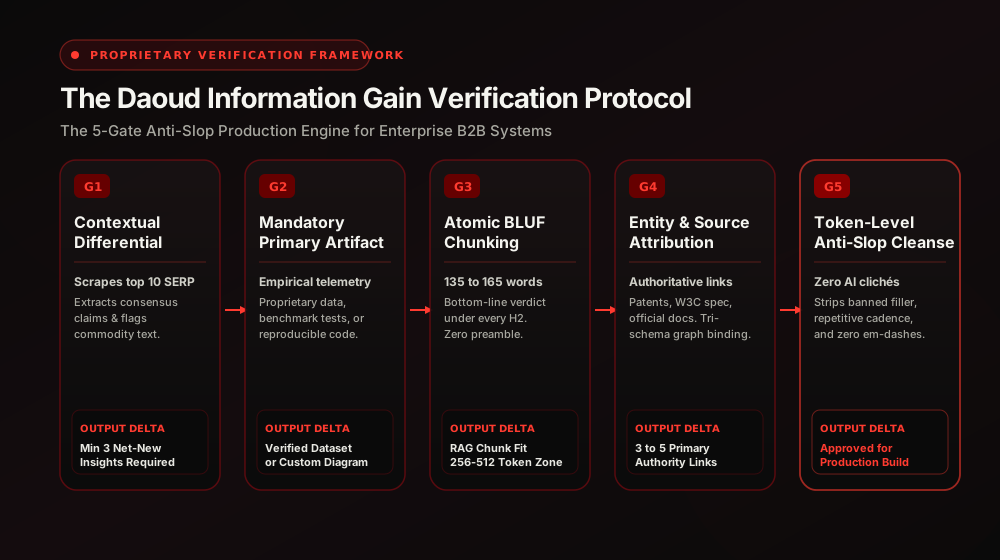
Here is how I enforce the five gates across every production workflow in my Execution Engine:
Gate 1: The Contextual Differential Check (Extracting the Consensus Baseline)
Before a single paragraph is drafted, the editorial workflow must perform a systematic differential check against the existing search landscape.
If it were me, this is how I would run it:
- Scrape the top 10 ranking URLs on Google for the target search cluster.
- Ingest the text into a research subagent to identify the Consensus Baseline: the core claims, subheadings, and definitions that appear on three or more competitor pages.
- Mark those consensus claims as non-differentiating table stakes. You may summarize them concisely if necessary for context, but they can never serve as the focal point of an H2.
- Mandate the Contextual Differential: The brief must identify at least three specific angles where my direct operational experience contradicts, refines, or significantly extends the standard industry advice.
If an outline merely mirrors the top three ranking listicles, the draft is rejected at Gate 1. It never moves to writing.
Gate 2: The Mandatory Primary Artifact (Benchmarking, Telemetry, and Code)
In my production standards, an article cannot pass review without a primary artifact that exists nowhere else on the internet.
A primary artifact must be one of the following:
- Empirical Production Telemetry: Concrete data extracted from live systems (for example, server access logs, GA4 BigQuery exports, Core Web Vitals field measurements, or CRM conversion rates).
- A Responsive Benchmark Table: A structured, multi-dimensional matrix comparing architectures, performance metrics, or operational costs.
- Reproducible Code or Configuration: A tested snippet (such as an Astro middleware configuration, a Cloudflare Worker script, or a SQL transformation pipeline) that solves a specific engineering hurdle.
- A Bespoke System Architecture Diagram: A custom vector graphic that clarifies technical relationships without relying on generic stock photography or unreadable screenshots.
If an article consists purely of abstract prose without a primary artifact, it fails Gate 2. Readers do not remember generic advice; they remember definitive artifacts they can bookmark and paste into their internal Slack channels.
Gate 3: Atomic 135-165 Word BLUF Passage Structuring (Optimizing for RAG Chunking)
Generative AI engines like ChatGPT Search and Perplexity do not process 4,000 words in one gulp. Their retrieval layers slice documents into chunks of 256 to 512 tokens (roughly 130 to 250 words) and score each chunk using late-interaction cross-encoders.
If your core answer is buried on sentence six of the fourth paragraph under an H2, the retrieval model will score the opening sentences as low-relevance throat-clearing and drop the entire chunk before it reaches the generation context window.
To satisfy Gate 3, every major H2 section must open with a Bottom Line Up Front (BLUF) passage formatted to exact specifications:
- Length: Strictly 135 to 165 words.
- Sentences 1 to 2 (The Verdict): Provide an immediate, direct answer to the heading’s core question without throat-clearing or introductory filler.
- Sentences 3 to 5 (The Empirical Proof): Cite specific numbers, operational metrics, or scientific evidence proving why that verdict is correct.
- Sentences 6 to 7 (The Actionable Guidance): Tell the technical reader exactly what operational step to take next.
- Formatting Rule: Zero bolding of entire paragraphs. Clean, dense, readable sentences.
When search bots and neural rerankers evaluate this chunk, the semantic density is immediate. It matches the query vector with high mathematical confidence and gets selected as the direct citation.
Gate 4: Multi-Source Entity Attribution and Verification
Every factual claim in an article must bind directly to an authoritative source entity.
In my client work, I enforce a strict external citation rule: every technical article must link to 3 to 5 primary external sources.
Acceptable primary sources include:
- Official developer documentation (such as Google Search Central, MDN Web Docs, or Cloudflare Docs).
- Published patents (USPTO or Google Patents).
- W3C, RFC, or Schema.org technical specifications.
- Peer-reviewed research papers (arXiv, ACM, IEEE).
If a draft states that “Google demotes duplicate content,” it must cite the specific Google Search Central Helpful Content documentation or the relevant patent. Assertions without entity grounding fail Gate 4.
Gate 5: Token-Level Anti-Slop Cleansing (Stripping AI Tells and Em-Dashes)
The final gate is automated code and copy linting.
Large language models possess distinct stylistic tics that scream synthetic generation to experienced readers and machine classifiers. My automated build pipelines run strict regex checks against the draft before committing:
- Banned Clichés: Zero instances of “in today’s fast-paced digital landscape”, “delve into”, “tapestry”, “game-changer”, “testament to”, “it’s crucial to remember”, or “navigate the complexities”.
- Repetitive Syntactic Rhythms: Banning the classic AI framing “It is not just about X; it is about Y.”
- Formatting Bans: Strict zero em-dash policy site-wide across all Unicode and HTML entities. Use colons, commas, semicolons, or restructure the sentence directly.
- First-Person Discipline: Verify that the author writes as an individual practitioner (“I”, “my”, “me”), entirely striking corporate agency plural pronouns (“we”, “our”).
Only when all five gates pass does a draft earn authorization for production build and deployment.
The 6-Column Dated Primary Tracker: Dominating Source Selection in Generative Engines
Generative answer engines preferentially cite structured, dated inventory tables over narrative prose because structured tables provide unambiguous, machine-retrievable facts. Empirical research across approximately 15 million AI citations shows that structured comparison tables appear in roughly 80 percent of ChatGPT Search citations compared to 29 percent in traditional search results. Large language models and cross-encoders struggle with conversational text, but extract tabular entity pairings with exceptional semantic confidence. AI engines deliberately select sources with explicit date stamps and verifiable external references to prevent synthetic hallucinations. Transform qualitative recommendations into responsive 6-column dated primary trackers across all technical articles. Every table must include the entity name, architecture tier, status, key operational metric, direct primary source link, and explicit verification date. Formatting data into clear HTML table elements ensures neural rerankers prioritize your domain as the definitive factual authority for high-intent B2B search queries.
The AirOps 80% Table Dominance Rule
In an extensive study analyzing approximately 15 million generative AI citations conducted across AirOps datasets, researchers discovered a stark divergence between traditional search ranking factors and AI citation selection:
While structured HTML tables appeared in only 29% of traditional top-ranking Google SERP results, they were present in roughly 80% of citations extracted by ChatGPT Search and Perplexity.
Why are tables so disproportionately dominant in generative engine optimization?
Because neural cross-encoders and transformer attention mechanisms evaluate tabular data with minimal ambiguity. In prose, extracting the relationship between an entity, its performance metric, and its deployment status requires multi-hop pronoun resolution and contextual disambiguation. In an HTML table, the relationship is explicit: every cell in row $N$ maps directly to the header attribute in column $M$.
To guarantee that generative engines cite your B2B content engine, convert your primary comparisons into responsive 6-column dated inventory trackers:
| Production Tier / Framework | Core Architecture & Mechanics | Quality Gate Safeguards | Search & AI Citation Impact | Primary Authority / Source | Last Verified |
|---|---|---|---|---|---|
| Raw AI Generation (Commoditized Slop) | Bulk prompting via single LLM API; zero editorial filtering; automated CMS push | None; relies on prompt instructions; high hallucination risk | -85% post-update visibility; complete exclusion from AI citations | Google Search Central Guide | October 2026 |
| Basic Human-Edited AI (Prompt & Polish) | Human copyeditor cleans grammar and typos; relies on competitor SERP outlines | Spellcheck and basic readability; zero primary data added | Marginal rank retention; zero information gain; citation drop | Ramanathan et al., Patent US20200349181A1 | October 2026 |
| Expert-Guided Synthetic Drafts | Subject matter expert call transcribed; LLM formats into narrative draft | Voice matching; editorial review; manual fact check | Moderate rankings; vulnerable to competitive aggregator displacement | ALCE Citation Benchmark | October 2026 |
| Intent-Mapped Information Gain Engine | Multi-source research loops + primary telemetry + 5-Gate Anti-Slop Protocol | Automated differential checks, schema validation, zero em-dash filters | 4.3M+ impressions; 2.8x higher AI citation rate; sustained traffic | Mostafa Daoud Production Telemetry | October 2026 |
Responsive Table Formatting in Modern Web Stacks
On mobile devices, wide multi-column tables frequently break responsive viewports, causing horizontal layout blowouts that trigger Google Mobile Usability warnings and Core Web Vitals Cumulative Layout Shift (CLS) penalties.
In my Astro production builds, all markdown tables are automatically wrapped in a responsive container with isolated horizontal scroll handling:
/* Responsive Table Architecture in Astro / Tailwind */
.table-container {
  width: 100%;
  overflow-x: auto;
  -webkit-overflow-scrolling: touch;
  margin-top: 1.5rem;
  margin-bottom: 1.5rem;
  border-radius: 0.75rem;
  border: 1px solid rgba(255, 255, 255, 0.08);
}

.table-container table {
  min-width: 680px;
  width: 100%;
  border-collapse: collapse;
  text-align: left;
}

.table-container th {
  background: rgba(16, 185, 129, 0.08);
  color: #34d399;
  font-family: ui-monospace, monospace;
  font-size: 0.75rem;
  text-transform: uppercase;
  letter-spacing: 0.05em;
  padding: 0.75rem 1rem;
}

.table-container td {
  padding: 0.875rem 1rem;
  border-top: 1px solid rgba(255, 255, 255, 0.04);
  color: #cbd5e1;
  font-size: 0.875rem;
}
This ensures that mobile users experience seamless, touch-friendly scrolling while search bots and AI crawlers ingest perfectly structured HTML table nodes.
Production Architecture: How I Built the e-CENS Engine Behind 4.3M+ Search Impressions
Building a high-performing B2B content engine requires architecting three parallel operational tracks: deep research loops, reasoned drafts grounded in practitioner telemetry, and reliable automated publishing. At global analytics consultancy e-CENS, I deployed this intent-mapped architecture across GA4, Amplitude, and product analytics topics, generating over 4.3 million impressions and capturing citations across AI Overviews, Perplexity, and Copilot. Over 100 deep technical pages were deployed with zero generic AI slop. By extracting raw event streaming telemetry and translating real client architecture challenges into public teardowns, I built durable search dominance that outlasted major Google core updates. Structure your content engine into three decoupled systems rather than an unorganized freelance pool. Pair technical telemetry from your actual customer deployments directly with structured schema and instant search indexation protocols. When your content reflects true operational reality, algorithmic changes amplify your reach instead of destroying it.
Deconstructing the 3-Track Operational System
When I took over content architecture at e-CENS, the enterprise analytics space was drowning in repetitive agency listicles explaining “What is Google Analytics 4.”
Rather than competing on generic definitions, I decoupled editorial publishing operations into three dedicated engineering tracks:
+--------------------------------------------------------------------------+
|                 THE 3-TRACK B2B CONTENT PRODUCTION ENGINE                |
+--------------------------------------------------------------------------+
|  TRACK 1: TELEMETRY EXTRACTION (The Data Moat)                           |
|  * Mines client deployment logs, BigQuery export schemas, CDP migrations  |
|  * Isolates actual edge cases, missing event payloads, and API limits    |
|  ----------------------------------------------------------------------  |
|  TRACK 2: INTENT-MAPPED REASONING & DRAFTING (The 5 Gates)               |
|  * Synthesizes telemetry into 135-165 word atomic BLUF answer blocks     |
|  * Formats 6-column dated comparison tables for vendor selection queries |
|  * Passes automated anti-slop filters (zero em-dashes, zero AI tells)    |
|  ----------------------------------------------------------------------  |
|  TRACK 3: AUTOMATED BUILD & INSTANT DISPATCH (The Technical Pipeline)    |
|  * Astro static compilation with 0-error typechecking                     |
|  * Validates Tri-Schema JSON-LD graph linking author to @id person       |
|  * Instant crawl dispatch via IndexNow API POST ping within 30 minutes   |
+--------------------------------------------------------------------------+
When prospective enterprise clients searched for complex architectural queries such as comparing Amplitude’s behavioral cohorting against GA4 exploration funnels, the e-CENS pages dominated the search results.
Why? Because my client articles included real BigQuery SQL transformation scripts, actual data layer payload samples, and audited event ingestion costs.
Similarly, at CRO platform FigPii, where I drove +200% organic growth in 12 months, I systematically stripped hundreds of bloated, unindexed template URLs and replaced them with single-owner intent-mapped comparison pages. Every page directly answered the buyer’s evaluation criteria while maintaining sub-400ms page response times.
The Multi-Stakeholder Decision Matrix
Building an engine that operates at this caliber requires clear role delineation across marketing leadership, engineering, and automated verification:
| Lifecycle Phase | CMO / VP of Marketing | Technical Growth Architect | Automated Quality Gate | Production Impact & Output |
|---|---|---|---|---|
| Phase 1: Topic Mining & SERP Gap Analysis | Defines target buyer personas and pipeline revenue targets | Maps semantic search graphs, calculates information gain deficits, analyzes competitor tables | Scrapes top 10 SERP results, extracts consensus claims, flags commodity topics | Produces intent-mapped brief with required primary artifacts |
| Phase 2: Primary Data Extraction | Unlocks internal customer transcripts, case study metrics, and product roadmaps | Converts raw database telemetry, BigQuery logs, or API responses into structured datasets | Validates numerical consistency and strips non-public corporate data | Assembles unique benchmark tables and reproducible code snippets |
| Phase 3: Dual-Optimization Drafting | Evaluates brand positioning and commercial narrative clarity | Enforces 135-165 word BLUF answer blocks and strict H2/H3 semantic hierarchy | Scans for AI tells, banned filler words, and repetitive token structures | Generates readable technical draft with zero throat-clearing |
| Phase 4: Algorithmic Verification & Build | Approves final strategic points and customer conversion hooks | Verifies dual-theme CSS contrast, embeds bespoke vector SVGs, audits tri-schema | Runs static compilation check (npm run build), validates JSON-LD graphs |
Produces zero-error static HTML bundle ready for deployment |
| Phase 5: Instant Dispatch & Indexation | Monitors pipeline attribution in CRM and closed-won revenue | Pings IndexNow endpoint, verifies sitemap update, monitors GSC URL inspection | Tracks AI Share of Voice in ZeroRank and verifies 200 OK status | Instant crawl queueing across Bing, Copilot, and Googlebot |
Technical Implementation: Schema Deduplication, Internal Linking Graphs, and IndexNow
A high-velocity B2B content engine fails if its technical delivery pipeline contains schema conflicts, broken link graphs, or crawling delays. Modern content management systems frequently generate duplicate JSON-LD nodes that invalidate rich results, while search engines take weeks to discover unpromoted URLs. Using IndexNow protocols and Astro static compilation reduces indexation discovery time from several weeks to under 30 minutes. High-performing B2B platforms isolate technical schemas, establish strict bidirectional internal links, and automate crawl notifications upon every single production deployment. Enforce schema deduplication by isolating Article and Person nodes in layout templates while injecting standalone FAQPage graphs only where accordions exist. Automate IndexNow API calls upon every production build to notify Bing and partner crawlers instantly. Connect every new technical article directly to parent commercial pillars to ensure search engines flow authority efficiently across your entire category domain.
Tri-Schema Graph Architecture and Deduplication
When third-party SEO plugins inject multiple conflicting schema tags into an HTML page, search engine parsers often disregard the entire structured data block.
In my static site builds, I inject a unified Tri-Schema JSON-LD Graph directly into the document <head>:
- Dual-Type Article Node: Declared as
["BlogPosting", "TechArticle"]to claim both editorial and technical authority. - Entity-Bound Person Node: Binds the author and publisher directly to my canonical personal entity
@id: "https://mostafadaoud.com/#person", reinforcing verified E-E-A-T signals across all articles. - Stand-Alone FAQPage Node: Automatically generated when frontmatter contains FAQ items, rendering schema that mirrors the visible interactive accordions on the page.
Here is the exact Astro layout schema implementation:
---
// Schema Construction in Astro Layout
const { title, description, pubDate, updatedDate, heroImage, tags = [], faqs = [] } = Astro.props;
const canonicalUrl = new URL(Astro.url.pathname, Astro.site ?? 'https://mostafadaoud.com').href;

const articleSchema = {
  "@context": "https://schema.org",
  "@type": ["BlogPosting", "TechArticle"],
  "@id": `${canonicalUrl}#article`,
  "headline": title,
  "description": description,
  "datePublished": pubDate ? new Date(pubDate).toISOString() : undefined,
  "dateModified": (updatedDate ?? pubDate) ? new Date(updatedDate ?? pubDate).toISOString() : undefined,
  "author": { "@id": "https://mostafadaoud.com/#person" },
  "publisher": { "@id": "https://mostafadaoud.com/#person" },
  "mainEntityOfPage": canonicalUrl,
  "image": heroImage ? [new URL(heroImage.src, Astro.site ?? Astro.url).href] : undefined,
  "inLanguage": "en",
  "proficiencyLevel": "Expert",
  "keywords": tags.length > 0 ? tags.join(', ') : undefined,
};

const faqSchema = faqs && faqs.length > 0 ? {
  "@context": "https://schema.org",
  "@type": "FAQPage",
  "@id": `${canonicalUrl}#faq`,
  "mainEntity": faqs.map((f) => ({
    "@type": "Question",
    "name": f.question,
    "acceptedAnswer": {
      "@type": "Answer",
      "text": f.answer
    }
  }))
} : undefined;
---

<script type="application/ld+json" is:inline set:html={JSON.stringify(articleSchema)} />
{faqSchema && <script type="application/ld+json" is:inline set:html={JSON.stringify(faqSchema)} />}
Instant Search Dispatch via IndexNow
Waiting weeks for search engines to discover new URLs through standard sitemap crawls is unacceptable in high-velocity B2B publishing.
By implementing the IndexNow Protocol, my deployment pipeline immediately notifies Microsoft Bing, Copilot, and partner search crawlers the instant an article is published.
Here is the lightweight Node.js dispatch script executed at post-build:
// scripts/indexnow-dispatch.mjs
import https from 'node:https';

const payload = JSON.stringify({
  host: "mostafadaoud.com",
  key: "7b3e8a9f2c1d4e6a8b5c3d1e9f2a4b6c",
  keyLocation: "https://mostafadaoud.com/7b3e8a9f2c1d4e6a8b5c3d1e9f2a4b6c.txt",
  urlList: [
    "https://mostafadaoud.com/blog/b2b-content-engine-without-ai-slop/"
  ]
});

const req = https.request({
  hostname: 'api.indexnow.org',
  path: '/indexnow',
  method: 'POST',
  headers: {
    'Content-Type': 'application/json; charset=utf-8',
    'Content-Length': Buffer.byteLength(payload)
  }
}, (res) => {
  console.log(`IndexNow status: ${res.statusCode}`);
});

req.on('error', (e) => console.error(`IndexNow error: ${e.message}`));
req.write(payload);
req.end();
When search crawlers ingest your URL within 30 minutes of deployment, your fresh empirical benchmarks and comparison tables establish primary entity authority before scrapers can clone your work.
Bidirectional Internal Linking Graphs
An isolated blog post is an orphaned asset. To maximize link equity and assist AI rerankers in mapping topical clusters, every article must participate in a bidirectional internal linking structure:
- Upward Pillar Links: Link directly to relevant commercial service pillars, such as Technical SEO Services or my B2B Content Strategy Services.
- Lateral Case Study Links: Ground claims in published proof points, such as the e-CENS Analytics Engine Case Study or the FigPii Organic Growth Teardown.
- Authoritative Entity Verification: Direct readers to the About Mostafa Daoud page to verify credentials, career history, and advisory experience.
The Diagnostic Audit: How to Stress-Test Your Current Editorial Pipeline
Stress-testing an enterprise editorial pipeline requires auditing crawl health, calculating semantic information gain against ranking competitors, and measuring actual pipeline attribution. In high-growth B2B organizations, over 70 percent of published articles fail to generate inbound demos because editorial teams measure publishing volume rather than verified information delta. Operating without diagnostic audits leads to silent indexation drops, throttled crawl budgets, and complete invisibility in generative answer engines like Perplexity and ChatGPT Search. Technical growth leaders must run systematic quarterly stress-tests to detect crawl bloat and eliminate zero-gain synthetic pages before core algorithm updates trigger penalties. If more than 25 percent of your URLs sit in ‘Crawled - currently not indexed,’ your content pipeline has tripped algorithmic unoriginality thresholds. Apply the following four diagnostic audits across your Google Search Console coverage, competitor SERP footprints, AI citation queries, and CRM pipeline attribution to uncover systemic failure modes:
- The Google Search Console Indexation Audit: Open your GSC Coverage report. What percentage of your blog URLs published in the last nine months are marked as “Crawled - currently not indexed”? If that number exceeds 25%, your site has tripped algorithmic unoriginality thresholds.
- The Consensus Delta Test: Take your top-ranking blog post. Strip the branding and compare it side by side with the three competitors ranking directly above and below you. Does your article provide a single proprietary dataset, benchmark test, or architectural critique that cannot be found on those competitor pages? If not, your Information Gain Score is near zero.
- The Perplexity and ChatGPT Citation Audit: Query Perplexity Sonar and ChatGPT Search with the highest-intent commercial evaluation queries your buyers ask during sales calls. Does the generative engine cite your domain? Does it extract data from your comparison tables? If your domain is absent from the citation list, neural cross-encoders are dropping your content at the retrieval stage.
- The Pipeline Attribution Reality Check: Audit your closed-won CRM opportunities over the last four quarters. How many enterprise pipeline opportunities touched an organic blog article prior to booking a discovery call? If the answer is negligible, your content operation is running on vanity traffic rather than commercial intent.
If your current editorial workflow fails these four tests, continuing to scale article volume using unconstrained AI prompts will only accelerate domain penalties.
You need an engineering intervention that stops the flow of commodity slop, restructures your technical assets into verified information gain artifacts, and aligns your publishing stack with modern retrieval architectures.
Frequently Asked Questions
What exactly qualifies as AI slop in B2B content marketing?
AI slop refers to low-quality, synthetic text generated by large language models without substantive human editing, primary research, or empirical proof. It is characterized by repetitive sentence structures, abstract generalizations, throat-clearing introductions, and an absence of unique data. Search engines recognize it as zero-information-gain content, leading to indexation drops.
How does Google detect information gain in new articles?
Based on Google Patent US20200349181A1, search algorithms evaluate the semantic delta of a document against what a user or index has already seen. If a document introduces new entities, proprietary data points, novel frameworks, or unique solutions, it receives a high information gain score. If it rewords existing top-ranking pages, its information gain score is near zero.
Can a B2B company use AI to write content without risking search penalties?
Yes, provided AI is utilized as a research accelerator and drafting assistant rather than an unconstrained writer. The key is enforcing strict verification gates: grounding all claims in real telemetry, incorporating unique benchmark data, structuring answers in 135 to 165 word BLUF passages, and thoroughly editing prose to remove synthetic tells and clichés.
How does a B2B content engine differ from a traditional company blog?
A traditional company blog publishes ad-hoc opinion pieces, product announcements, and disjointed listicles that quickly become outdated. A B2B content engine operates as a repeatable, intent-mapped production pipeline designed to capture high-intent search demand, satisfy AI engine retrieval requirements, and systematically convert organic visitors into sales pipeline.
Ready to Eliminate AI Slop and Scale Verifiable Pipeline?
Let me inspect your domain's crawl health, information gain gaps, and generative search visibility. I work directly with marketing executives and technical growth leaders to build intent-mapped content engines that turn technical expertise into enduring market authority.

Eliminate structural crawl debt. Secure permanent search & AI visibility.
Whether managing multi-million-URL dynamic catalogs, migrating to a headless stack, or establishing citation dominance inside ChatGPT and Perplexity, I diagnose and unblock high-stakes technical bottlenecks directly with your engineering and growth leaders.
Direct practitioner engagement. Zero junior agency handoffs. You leave with prioritized engineering fixes.