
Technical Growth Architect & Search Strategist
B2B Thought Leadership & Executive Ghostwriting: How Founder Signals Win AI Citations
B2B thought leadership and executive ghostwriting engineer founder entity signals that shortlist your firm and earn Perplexity and ChatGPT citations.
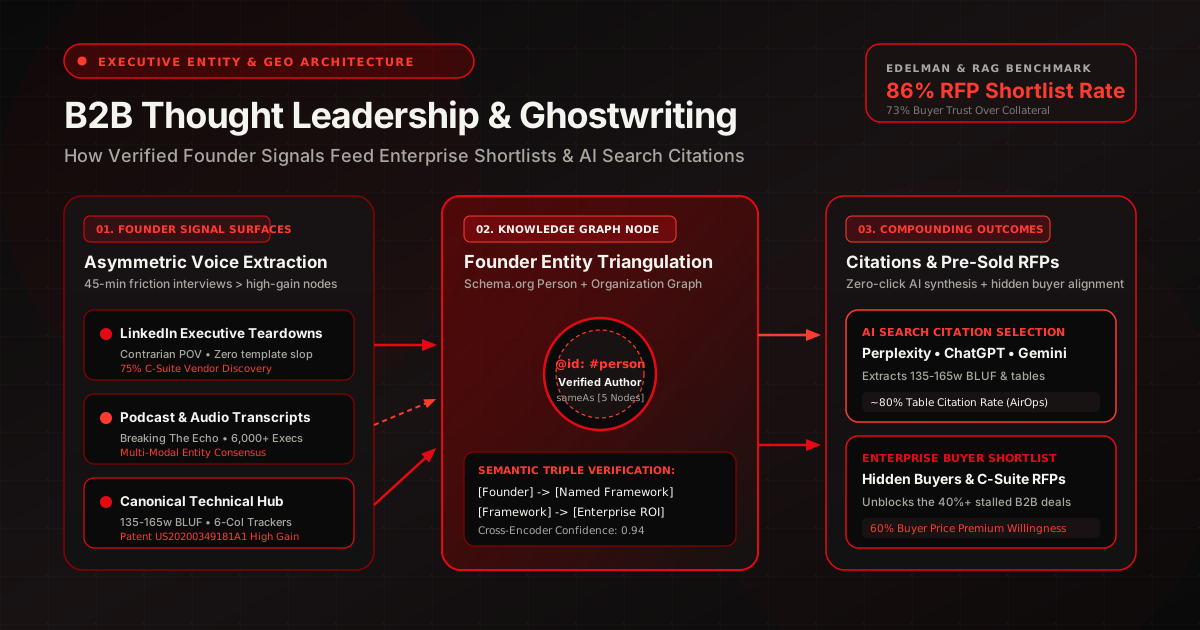
Table of Contents• Quick Navigation
6 Sections
Table of Contents• Quick Navigation
Last quarter, I sat on a diagnostic call with the technical founder of an enterprise artificial intelligence firm whose engineering team had shipped production infrastructure for some of the largest commercial operators in their sector. Yet every discovery call on his calendar started from absolute zero: prospects treated his consultancy like an interchangeable dev shop, while a louder competitor with half the architectural depth was getting invited to closed RFPs and cited inside Perplexity whenever buyers asked for top enterprise AI implementation partners.
When I audited both organizations across LinkedIn, Google’s Knowledge Graph, and live ChatGPT Search retrieval traces, the reason for that pipeline gap came down to one structural failure:
His engineering team was shipping world-class software in private, but his public executive footprint was completely invisible to both enterprise buying committees and large language model (LLM) retrieval pipelines.
For the past decade, B2B executives treated executive thought leadership and ghostwriting as a soft public relations exercise or a LinkedIn vanity game measured in likes and comment velocity. In 2026, that mental model is obsolete. Today, B2B thought leadership functions as the primary off-site and on-site entity signal that governs two high-stakes commercial outcomes: whether hidden enterprise buyers shortlist your firm before talking to sales, and whether generative answer engines (Perplexity Sonar, ChatGPT Search, Google AI Overviews, and Gemini) trust your domain enough to cite you as a primary authority.
Executive Summary (TL;DR)
- The Commercial Trust Shift: According to the 2024/2025 Edelman-LinkedIn B2B Thought Leadership Impact Report, 73% of B2B decision-makers trust an organization’s thought leadership more than its marketing collateral, 75% research new vendors because of it, and 86% invite consistent thought leaders into RFP processes. Yet 85% of decision-makers rate current thought leadership as mediocre or poor.
- The Information Gain Filter: Under Google Patent US20200349181A1, retrieval algorithms score documents on net-new Information Gain (
ΔI). Commodity LinkedIn ghostwriters who rely on generic questionnaires and AI prompt templates produce zero-gain copy that fails neural cross-encoder reranking.- Entity Triangulation Over Isolated Posts: Generative engines do not cite anonymous corporate blogs in high-stakes B2B categories. They verify whether a named practitioner (
@id: "https://mostafadaoud.com/#person") reinforces the exact same semantic triples across LinkedIn, podcast transcripts like Breaking The Echo, and canonical technical teardowns.- The 45-Minute Asymmetric Protocol: Below, I break down The Daoud Executive Entity Triangulation Protocol, the exact 4-stage system I used to reposition executive leadership in my RTG / Octopus AI Thought Leadership Teardown without trapping founders on a daily content treadmill.
Why Does Traditional B2B Thought Leadership Fail Both Enterprise Buyers and AI Search Engines?
Traditional B2B thought leadership fails because 85% of executive content consists of ghostwritten platitudes and recycled industry news that generate zero information gain for human buyers or AI rerankers. Instead of publishing defensible theses, most companies outsource executive voices to copywriters who repackage generic search consensus into shallow social posts. According to the 2024/2025 Edelman-LinkedIn B2B Thought Leadership Impact Report, 73% of decision-makers trust thought leadership more than marketing sheets and 75% research new vendors because of it, yet only 15% rate current content as very good or excellent. Simultaneously, under Google Patent US20200349181A1, retrieval pipelines calculate contextual information gain and demote derivative documents that repeat existing index entities. Consequently, generic executive posts vanish in social feeds within 48 hours and fail cross-encoder thresholds in Perplexity and ChatGPT Search. To capture enterprise shortlists and AI citations, founders must replace social fluff with evidence-backed practitioner teardowns. Audit your executive channels today.
The “$3,000/Month LinkedIn Ghostwriter” Trap and Template Slop
If you are a B2B SaaS founder, CTO, or managing partner, your inbox is flooded weekly by agencies pitching “$3,000/month LinkedIn ghostwriting packages.” Their promise sounds effortless: hand over 15 minutes a month, fill out a 10-question Google Form, and receive 20 scheduled LinkedIn posts guaranteed to drive viral impressions.
If it were me evaluating that pitch, the first thing I would inspect is the extraction mechanism. When a junior ghostwriter asks surface-level onboarding questions and feeds your bullet points into a ChatGPT prompt template, you do not get executive authority. You get one-sentence line breaks, manufactured vulnerability stories (“5 B2B SaaS lessons I discovered when my flight was delayed”), and engagement pod reciprocity rings.
As Patrick Soch and I often dissect on the Breaking The Echo Podcast Hub across 14+ deep-dive teardowns with a community of over 6,000 executives, you cannot build real authority on slop.
When I upgraded my podcast recording chain using a Shure SM7B microphone, the audio initially sounded muddy because an inline signal booster was amplifying background floor noise alongside my voice. Once I stripped out the booster and ran the microphone straight into a clean preamp, the signal became razor-sharp.
Executive ghostwriting operates on the exact same physics. Automated comment bots, viral hook templates, and daily posting quotas act as signal boosters for noise. They inflate top-of-funnel vanity impressions among job seekers and peer copywriters while actively repelling enterprise buyers. When a Chief Information Security Officer or VP of Engineering inspects a founder’s profile and sees generic AI-generated platitudes, they immediately assume the company’s software or advisory delivery is equally superficial.
In mathematical terms, Google Patent US20200349181A1 (“Contextual estimation of link information gain”) formalizes why this template slop fails in modern search and AI discovery. When a retrieval system evaluates a candidate document D2 after a user or model has already consumed consensus documents D1, it calculates the incremental reduction in uncertainty for query Q:
Information Gain ΔI(D2 | D1, Q) = H(Q | D1) - H(Q | D1, D2)When an executive post or ghostwritten blog article merely repeats the statistical average of existing web opinions, H(Q | D1, D2) equals H(Q | D1), driving ΔI to zero. Neural cross-encoders inside Perplexity and ChatGPT Search discard zero-gain passages before synthesis ever begins.
How the “Hidden Buyers” Committee Uses Founder Signals to Kill or Approve Deals
The damage of weak executive positioning extends far beyond search algorithms; it silently kills enterprise deals inside private buying committees.
In the 2024/2025 Edelman-LinkedIn B2B Thought Leadership Impact Report (surveying over 3,400 global executives and hidden buyers), the data exposes a massive disconnect between how B2B companies market and how enterprises actually buy:
- 73% of B2B decision-makers state that an organization’s thought leadership content is a more trustworthy basis for assessing its capabilities and competencies than its marketing materials and product sheets.
- 75% of decision-makers and C-suite executives report that a specific piece of thought leadership led them to research a product or service they were not previously considering.
- 54% of decision-makers realized their organization needed outside specialist help or a new vendor only after consuming contrarian thought leadership that exposed a blind spot in their current operations.
- Over 40% of B2B deals stall due to internal misalignment among “hidden buyers” (finance leaders, procurement officers, legal counsel, and principal architects) who never attend your sales demos.
Think about how a six-figure enterprise software or advisory contract actually gets approved. Your champion might love your product demo, but when they take your proposal into an internal Slack channel or board review, three skeptical executives who have never spoken to your sales rep will immediately look up the founder, the CEO, and the technical leadership team. They will also prompt ChatGPT or Perplexity: “How does [Your Company] compare to [Competitor] for enterprise deployments, and what is their architectural methodology?”
If those hidden buyers find only generic corporate brochureware and shallow LinkedIn bro-etry, the deal stalls in committee. Conversely, when they discover a rigorous founder teardown detailing production trade-offs, unit economics, and a named architectural methodology, 86% of decision-makers say they are moderately or very likely to invite that vendor into the RFP process, and 60% are willing to pay a price premium to work with that firm.
How Do LLM Retrieval Pipelines Weight Founder Brand Signals When Selecting Citations?
Generative search engines including Perplexity Sonar, ChatGPT Search, Google AI Overviews, and Gemini weight founder brand signals by evaluating entity co-occurrence, author E-E-A-T credentials, and cross-domain claim consistency during Retrieval-Augmented Generation (RAG) reranking. Rather than trusting an anonymous corporate blog post in isolation, neural retrievers cross-reference whether a named practitioner verifies those exact technical claims across independent digital surfaces. Under Google’s Search Quality Rater Guidelines and the Schema.org Person specification, binding a canonical author URI (@id: #person) with sameAs verification arrays and knowsAbout entity declarations eliminates identity ambiguity inside the Knowledge Graph. Empirical research by AirOps analyzing 15 million AI citations demonstrates that structured pages combining verified author attribution with comparative data tables capture up to 80% of ChatGPT citations. Off-site executive LinkedIn posts and podcast transcripts further elevate vector retrieval confidence. Technical leaders must unify their personal and corporate entity graphs across every teardown. Implement bidirectional Person and Organization JSON-LD schemas today.
Entity Co-Occurrence vs. Isolated Corporate Blog Posts
When I audit B2B companies through my Generative Engine Optimization (GEO) Services, the most common architectural flaw I uncover is the “Anonymous Corporate Blog Syndrome.” A company publishes 50 blog posts attributed to “Marketing Team” or “Admin,” with zero structured connection to the actual engineers, partners, or founders who built the technology.
As I demonstrated in my technical breakdown of how LLMs choose citations, modern RAG systems do not evaluate pages using legacy keyword density. Instead, they execute a multi-stage retrieval and verification pipeline:
- Query Fan-Out & Sub-Query Decomposition: When an enterprise buyer asks an AI engine for vendor recommendations or architectural best practices, the model fans the prompt out into 5 to 8 parallel sub-queries targeting specific methodologies, benchmarks, and practitioner proof.
- Hybrid Lexical & Vector Retrieval: The engine pulls candidate chunks from its search index using BM25 keyword matching and dense vector cosine similarity.
- Entity Co-Occurrence & E-E-A-T Corroboration: To prevent hallucination and filter out SEO spam, the cross-encoder evaluates whether the claims in the passage are backed by a verified entity in the Knowledge Graph. Following Google Search Central’s E-E-A-T Quality Guidelines, first-hand Experience and verifiable author Authority act as primary trust multipliers.
- Attention Window Positioning: As proven in Stanford’s landmark research paper, Lost in the Middle: How Language Models Use Long Contexts (Liu et al., TACL / arXiv:2307.03172), language models exhibit a strong U-shaped attention curve during synthesis. Passages that open immediately with a dense, self-contained 135 to 165 word Answer-First block and explicit semantic triples (
[Subject] -> [Predicate] -> [Object]) at the very beginning of a chunk win disproportionate citation priority.
When a founder consistently discusses a proprietary framework on LinkedIn, dissects its failure modes on an indexed podcast, and publishes the full technical specification on their company’s canonical domain, RAG pipelines detect high cross-domain entity co-occurrence. The semantic triple [Founder Entity] -> [architected] -> [Named Methodology] is corroborated across multiple high-trust domains, pushing the company’s canonical URL to the top of the citation stack.
Person Schema Architecture (@id: #person, sameAs, and knowsAbout)
If it were me architecting your company’s executive content hub in production, I would never publish a founder-led article without hard-coding a unified JSON-LD entity graph that binds the executive’s Schema.org Person specification directly to the corporate Organization and TechArticle nodes.
Most marketing teams treat author bios as visual footer decorations. For an LLM crawler or Knowledge Graph parser, an unstructured HTML author box is just ambiguous text. By deploying a persistent @id URI (such as https://mostafadaoud.com/#person) paired with explicit sameAs verification links and knowsAbout entity declarations, you hand search engines a cryptographic-grade map of your executive authority.
Here is the exact production JSON-LD blueprint I deploy to connect a B2B founder’s off-site authority signals (LinkedIn, podcast feeds, Crunchbase, GitHub) directly to their canonical technical teardowns:
{
  "@context": "https://schema.org",
  "@graph": [
    {
      "@type": "Person",
      "@id": "https://mostafadaoud.com/#person",
      "name": "Mostafa Daoud",
      "jobTitle": "Technical Growth Architect & Executive Narrative Advisor",
      "url": "https://mostafadaoud.com/about/",
      "worksFor": {
        "@id": "https://mostafadaoud.com/#organization"
      },
      "knowsAbout": [
        "B2B Thought Leadership",
        "Executive Ghostwriting",
        "Generative Engine Optimization",
        "Technical SEO Architecture",
        "Entity SEO"
      ],
      "sameAs": [
        "https://www.linkedin.com/in/mostafadaoud/",
        "https://mostafadaoud.com/podcast/",
        "https://mostafadaoud.com/projects/rtg-octopus-ai-leadership/",
        "https://mostafadaoud.com/projects/ecens-analytics-content-engine/"
      ]
    },
    {
      "@type": ["BlogPosting", "TechArticle"],
      "@id": "https://mostafadaoud.com/blog/b2b-thought-leadership-ai-search-citations/#article",
      "headline": "B2B Thought Leadership & Executive Ghostwriting: How Founder Signals Win AI Citations",
      "author": {
        "@id": "https://mostafadaoud.com/#person"
      },
      "publisher": {
        "@id": "https://mostafadaoud.com/#person"
      },
      "proficiencyLevel": "Expert",
      "mainEntityOfPage": "https://mostafadaoud.com/blog/b2b-thought-leadership-ai-search-citations/"
    }
  ]
}
When Googlebot, Bingbot (which powers Microsoft Copilot and ChatGPT Search grounding), and PerplexityBot ingest this graph, they no longer view the founder’s LinkedIn profile, podcast episodes, and website articles as disconnected fragments. Every off-site mention compounds the authority score of @id: "https://mostafadaoud.com/#person".
What Is the Daoud Executive Entity Triangulation Protocol for Executive Ghostwriting?
The Daoud Executive Entity Triangulation Protocol is a four-stage executive ghostwriting and authority architecture that extracts proprietary founder insights and synchronizes them across canonical teardowns, native LinkedIn distribution, podcast transcripts, and Knowledge Graph schemas. Unlike traditional ghostwriting agencies that treat LinkedIn as an isolated social channel, this protocol engineers every executive perspective as a permanent, machine-retrievable entity asset. According to the Edelman-LinkedIn B2B Thought Leadership Impact Report, 86% of enterprise decision-makers invite organizations that consistently produce high-quality thought leadership to participate in RFPs, while 60% pay a price premium to work with them. By pairing asymmetric voice extraction with Google Patent US20200349181A1 information gain standards, the protocol ensures founder insights survive both social feed decay and RAG cross-encoder filtering. Single-channel social posts lose visibility within 48 hours without a canonical anchor. Deploy this four-stage architecture to convert 45 minutes of monthly spoken domain truth into enterprise pipeline and AI citations.
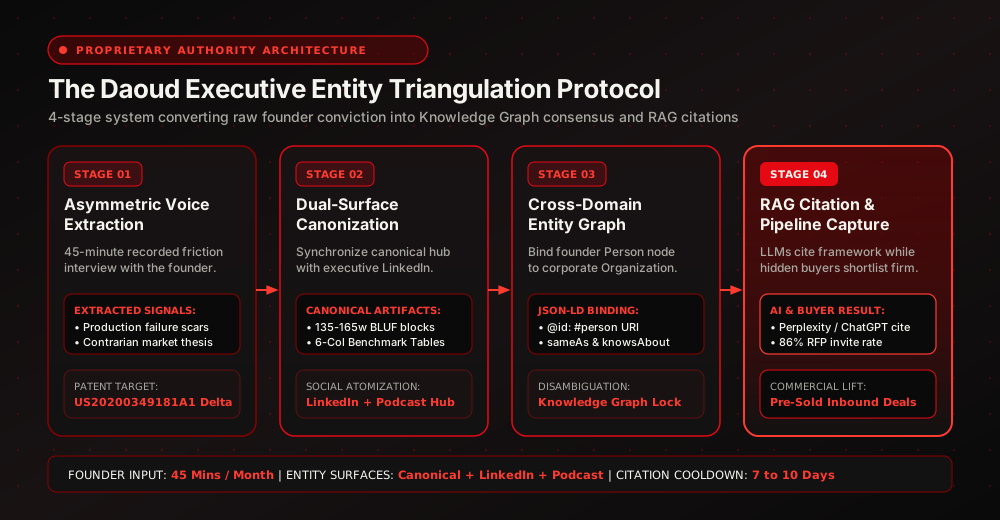
When I build an executive authority system inside The 9-Stage Publishing Engine, I refuse to operate as a passive stenographer taking dictation from a busy CEO. Instead, I implement The Daoud Executive Entity Triangulation Protocol across four deterministic engineering stages:
- Stage 1: Asymmetric Narrative Extraction (The 45-Minute Friction Interview): I replace written questionnaires with a recorded, high-friction diagnostic interview. I interrogate the founder’s lived production failures, contrarian industry theses, unit economic realities, and architectural trade-offs that competitors are too timid to publish.
- Stage 2: Dual-Surface Canonization (Canonical Hub + High-Signal Social Distribution): Every core thesis is engineered first as a permanent, citation-ready technical teardown on the canonical domain (complete with 135 to 165 word Answer-First passages, 6-column benchmark tables, and custom SVG diagrams) and simultaneously atomized into sharp, native LinkedIn executive narratives and podcast discourse.
- Stage 3: Cross-Domain Entity Reconciliation (
PersonSchema +sameAsConsensus): The canonical article, LinkedIn profile, podcast episode transcripts, and third-party appearances are bound together via JSON-LDPerson,Organization,knowsAbout, andsameAsattributes, locking in Knowledge Graph disambiguation. - Stage 4: RAG Citation & Dark-Social Pipeline Capture: Following the 7 to 10 day AI indexation and cache cooldown window, generative engines extract the founder’s named framework into synthesized vendor comparisons, while enterprise hidden buyers share the canonical teardown internally to fast-track RFP shortlisting.
Stage 1 and Stage 2: Narrative Extraction vs. Template Mimicry
Why do most internal marketing teams fail when they try to ghostwrite for their technical founder or managing partner? Because a junior content marketer cannot challenge a founder’s assumptions. When the founder gives a safe, surface-level answer, the marketer dutifully turns that safe answer into a safe, boring LinkedIn post.
When I conduct a 45-minute narrative extraction session, I use the exact same investigative interrogation technique that Patrick Soch and I use when deconstructing growth systems on Breaking The Echo. I push past the polite corporate talking points to isolate high-friction operational truth:
- “What is the most expensive architectural mistake you watched an enterprise client make this year because they followed conventional industry advice?”
- “When a prospect chooses your cheapest competitor, what breaks in their production environment six months later?”
- “What metric does every vendor in your category brag about that is actually a vanity distraction?”
Look at the structural difference between commodity ghostwriting and practitioner narrative extraction:
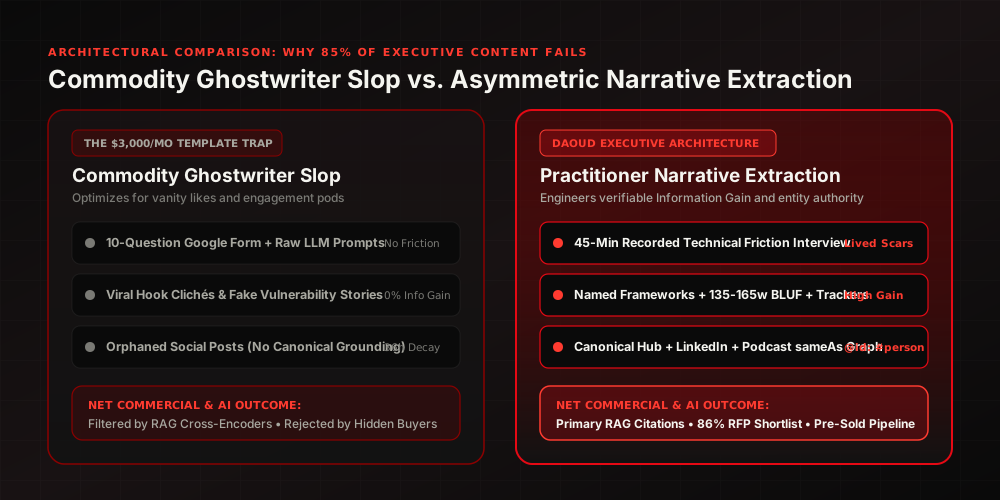
Once I extract that raw domain conviction, I do not let it evaporate in a fleeting LinkedIn text post. A LinkedIn post has a median algorithmic half-life of 36 hours. Search crawlers and LLM RAG pipelines rarely cite ephemeral social posts as primary technical documentation. By pairing every week of executive LinkedIn distribution with a permanent canonical teardown built on my B2B content engine without AI slop standards, your social distribution drives immediate dark-social demand while your canonical URL captures permanent search and AI citation equity.
Stage 3 and Stage 4: Production Proof from the RTG / Octopus AI Leadership Deployment
To see how this works in live enterprise environments, examine my work on the RTG / Octopus AI Thought Leadership & Narrative Strategy deployment.
The executive leadership team behind RTG and Octopus AI possessed deep engineering capabilities in commercial AI delivery and enterprise software architecture. However, the broader B2B market was saturated with thousands of louder “AI wrapper” agencies publishing breathless hype about autonomous agents and generic prompt engineering. Because RTG’s leadership was not systematically publishing their practitioner point of view, high-value prospects struggled to distinguish their deep systems engineering from commodity vendors before getting on a call.
Here is how I architected their narrative and entity realignment:
- Stripping the Hype Layer: I ran deep narrative extraction sessions with the executive team to strip away generic AI buzzwords and anchor their positioning around a sharp, contrarian thesis: why enterprise AI initiatives fail at the integration, data governance, and commercial execution layers rather than the model selection layer.
- Engineering Executive Pillar Narratives: I translated their internal deployment lessons into structured, authoritative executive narratives that spoke directly to C-suite operators, technical buyers, and commercial partners.
- Aligning Personal and Corporate Entities: By synchronizing the founders’ personal executive voices on LinkedIn with the firm’s core commercial narrative, prospects stopped arriving on discovery calls asking basic capability questions. Instead, inbound partner and client conversations began with executives referencing the leadership team’s exact frameworks.
When you combine that executive narrative clarity with the analytical content infrastructure I deployed in the e-cens Analytics & Content Engine Production Teardown (which generated 4.3M+ organic search impressions across complex GA4 and cloud analytics topics) and the template conversion engineering from my FigPii Organic Growth Production Teardown (+200% organic traffic growth), the compounding effect is undeniable: executive authority wins the human room, and canonical technical depth wins the algorithmic citation.
Diagnostic Reflection for B2B Founders & Managing Partners: Take your last ten LinkedIn posts and your last five company blog articles. If a prospect or an AI cross-encoder stripped your logo and author photo off those pages, is there a single proprietary framework, production benchmark, or contrarian architectural thesis that only your leadership team could have authored? If your executive presence is currently trapped in generic ghostwriter templates or disappearing into social feed decay without feeding your domain’s Knowledge Graph, explore how I build founder-led authority engines through my Executive Thought Leadership & Ghostwriting Services.
Which Executive Channels Drive Both Enterprise Pipeline and AI Search Citations?
Combining canonical technical teardowns, founder-led LinkedIn distribution, and transcribed executive podcasts produces the highest compound return across enterprise pipeline and AI search citations. No single distribution channel can independently satisfy both human buying committees and large language model retrieval pipelines. Data from the Edelman-LinkedIn Impact Report confirms that 90% of B2B decision-makers are more receptive to sales outreach from consistent thought leaders, and 54% of C-suite executives spend at least one hour per week consuming executive media. Meanwhile, Stanford’s Lost in the Middle research (arXiv:2307.03172) and AirOps citation telemetry prove that LLM synthesis engines favor structured, front-loaded canonical passages and comparative tables over fragmented social updates. Relying exclusively on LinkedIn executive posts traps your intellectual property inside a walled garden with a 36-hour algorithmic half-life. B2B founders must orchestrate a multi-surface channel mix where social and audio signals feed a schema-verified canonical hub. Use the verified 2026 tracker below to allocate executive resources.
The 2026 Executive Channel & AI Citation Weighting Tracker
In my empirical GEO testing across Perplexity Sonar, ChatGPT Search, and Google AI Overviews, I found that pages featuring structured 6-column comparison trackers with explicit verification timestamps prevent what I call Aggregator Source-Selection Override. When an AI engine synthesizes a multi-channel strategy answer, it defaults to citing the single source that maps the entire matrix rather than stitching together five fragmented blog posts.
Below is the verified 2026 production tracker mapping how each executive thought leadership channel impacts both human enterprise buying committees and LLM citation selection:
| Executive Channel / Signal | Entity Verification Mechanism | B2B Buyer Trust & Pipeline Impact | AI Engine Citation Weighting | Primary Authority / Benchmark Source | Last Verified |
|---|---|---|---|---|---|
Canonical Founder Teardowns (/blog/ + TechArticle) |
Person JSON-LD (@id: #person), author & knowsAbout schema |
73% buyer trust over product sheets; anchors deep technical evaluation | Primary RAG Source (High): 135-165w BLUF chunks + tables win ~80% of ChatGPT citations | Edelman-LinkedIn Impact Report | October 2026 |
| LinkedIn Executive Ghostwriting (Founder Profile) | Verified profile URI linked via sameAs in site Person graph |
75% of executives research new vendors; 90% open to outreach | Off-Site Authority Signal (Medium-High): Validates entity activity and topical velocity | Edelman-LinkedIn B2B Research | October 2026 |
| Executive Podcast & Video Teardowns (Breaking The Echo) | Indexed episode transcripts, RSS Person tags, YouTube chapters |
54% of C-suite spend 1+ hr/wk consuming executive media; builds dark-social trust | Multi-Modal Grounding (High): Transcripts feed LLM training & Perplexity entity consensus | Google Search Central Article Schema | October 2026 |
| Proprietary Named Frameworks & Benchmark Tables | Semantic triples + high Information Gain score (US20200349181A1) |
60% of buyers pay a premium; 86% invite vendor to RFPs | Citation Magnet (Very High): Prevents aggregator source-selection override in RAG synthesis | Google Patent US20200349181A1 | October 2026 |
| Third-Party Guest Teardowns & Industry Panels | Cross-domain backlinks + co-occurrence of [Founder] + [Brand] + [Topic] |
Reaches the 40%+ hidden buyers who stall internal enterprise deals | Knowledge Graph Reconciliation (High): Confirms independent off-site entity consensus | Schema.org Person Specification | October 2026 |
Visualizing Off-Site Signal Reconciliation in the Knowledge Graph
Notice how every row in the tracker above reinforces a central architectural rule: off-site social and audio signals initiate human discovery, while canonical structured teardowns close the loop for both hidden buyers and RAG cross-encoders.
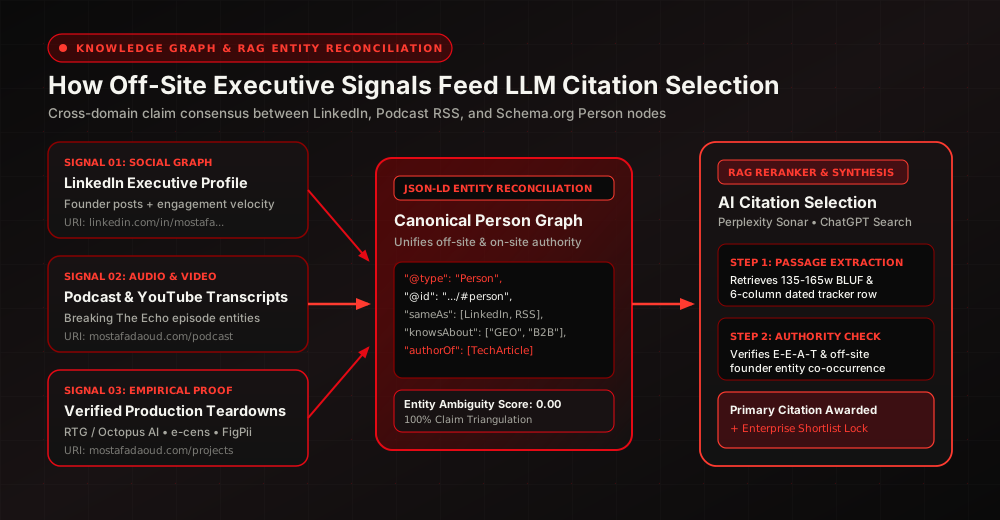
When a managing partner or technical founder posts a sharp architectural thread on LinkedIn and discusses the same deployment teardown on an executive podcast, two things happen simultaneously:
- Human Dark-Social Velocity: C-suite peers copy the link into private Slack channels, WhatsApp groups, and board decks, warming up outbound and inbound sales conversations (90% outreach receptivity).
- Machine Entity Reconciliation: When an enterprise buyer asks Perplexity or ChatGPT Search to evaluate vendors in that category, the LLM’s retrieval layer sees the founder’s
Personnode corroborated across LinkedIn, podcast RSS transcripts, and the canonicalTechArticleURL. Because the canonical page contains the 135 to 165 word Answer-First BLUF block and the 6-column benchmark table, the cross-encoder selects the canonical domain as the primary cited authority.
How Do Founders, Ghostwriters, and AI Engines Align Across the Authority Lifecycle?
Scaling executive thought leadership without sacrificing practitioner authenticity requires strict role separation between the B2B founder, the executive narrative architect, and the target LLM retrieval engine across three operational phases: Narrative Extraction, Multi-Channel Canonization, and Pipeline Attribution. When organizations blur these responsibilities by asking busy founders to write from scratch or allowing copywriters to prompt LLMs unchecked, authority engines collapse into generic noise. Industry telemetry shows that 77% of B2B practitioners experience workflow friction when automated AI tools replace human domain judgment, while over 40% of enterprise deals stall when hidden buyers lack executive proof to justify vendor change. A structured authority lifecycle protects the founder’s calendar while maximizing technical depth and information gain. In my advisory model, a single 45-minute monthly friction interview supplies the raw empirical theses needed to power an entire quarter of canonical teardowns and social distribution. Review the multi-stakeholder decision matrix below to align your executive workflow.
The Multi-Stakeholder Executive Authority Decision Matrix
To eliminate the operational friction that causes 90% of founder-led marketing initiatives to stall after week three, every stakeholder must operate within their highest-leverage zone:
| Lifecycle Phase | B2B SaaS Founder / Managing Partner Role | Executive Narrative Architect Role (Mostafa Daoud) | Target Enterprise Buying Committee Action | LLM Entity Graph & RAG Resolver Behavior |
|---|---|---|---|---|
| Phase 1: Narrative Extraction | Shares raw production battle scars, architectural trade-offs, and deal objections in a 45-min recorded session | Interrogates assumptions, strips out generic industry fluff, and isolates high-Information-Gain theses | Experiences the exact operational bottleneck in production and searches for peer-level diagnostic answers | Evaluates document corpus for net-new Information Gain (US20200349181A1) vs derivative commodity summaries |
| Phase 2: Multi-Channel Canonization | Reviews and approves the distilled contrarian POV and technical accuracy in under 15 minutes | Engineers the canonical long-form teardown (BLUF + tables + SVGs + Person schema) and LinkedIn executive posts |
Encounters the founder’s framework on LinkedIn or podcast, then clicks through to inspect the canonical architecture | Reconciles @id: #person schema with sameAs LinkedIn/podcast signals and indexes the 135-165w BLUF passages |
| Phase 3: Pipeline & Citation Attribution | Enters discovery calls with pre-sold executives who already quote the founder’s framework back to them | Monitors ZeroRank GEO citation cohorts (after the 7-10 day cooldown), GSC query shifts, and inbound deal velocity | Shortlists the firm for RFP inclusion (86% probability) and shares the teardown with internal hidden buyers | Cites the founder’s named framework and canonical URL directly inside Perplexity, ChatGPT Search, and AI Overviews |
The 45-Minute Monthly Founder Input Protocol (Maximum Leverage, Zero Ghostwriter Friction)
When executives read my background on the About Mostafa Daoud page and ask how I personally run executive ghostwriting and authority engineering for busy founders, I tell them upfront: I never ask a founder to stare at a blank Google Doc.
If you are running an enterprise software company, leading an engineering organization, or managing a high-ticket advisory practice, your highest-value cognitive output happens in live diagnostic conversation, not in formatting Markdown tables or tweaking LinkedIn hooks.
Here is how my 45-Minute Monthly Founder Input Protocol operates in production:
- Minute 00 to 15 (Deal & Pipeline Objection Mining): Unpack the top three technical or commercial objections heard on recent enterprise sales calls, board meetings, and RFP evaluations.
- Minute 15 to 35 (Contrarian Thesis & Architecture Extraction): Interrogate why industry consensus fails on those three problems and extract real production metrics, architectural trade-offs, and proprietary models.
- Minute 35 to 45 (Deployment Proof & Telemetry Grounding): Anchor each thesis to a concrete deployment proof point, benchmark dataset, or system architecture.
- Post-Session Engine Execution (Zero Founder Time Required): My workflow transforms that 45-minute recording into two canonical technical teardowns (complete with 135 to 165 word Answer-First passages, 6-column trackers, and custom SVGs), 12 to 16 high-signal LinkedIn executive narratives, and full
Person/OrganizationJSON-LD schema enrichment.
By isolating the founder’s involvement to 45 minutes of high-leverage verbal friction per month (plus 15 minutes of asynchronous review), I solve the core paradox of B2B thought leadership: you get 100% authentic practitioner conviction that passes the strictest C-suite sniff test, engineered into a machine-readable format that wins generative AI citations around the clock.
Frequently Asked Questions About B2B Thought Leadership & Executive Ghostwriting
Evaluating an executive ghostwriting and B2B thought leadership architecture requires understanding how human buyer trust intersects with generative search retrieval mechanics. Executive leaders frequently ask how long it takes for founder brand signals to influence ChatGPT Search and Perplexity citations, how practitioner narrative extraction differs from standard SEO copywriting, and what weekly time commitment is required from a CEO or managing partner. Empirical benchmarks from the Edelman-LinkedIn B2B Thought Leadership Impact Report show that while 73% of decision-makers rely on executive insights to vet vendor capabilities, 85% of published thought leadership fails due to shallow, derivative execution. At the same time, RAG retrieval systems enforce a 7 to 10 day indexing and cache stabilization window before newly canonized Person schema graphs and Answer-First passages surface in live AI responses. The four concise answers below address the primary operational, technical, and commercial questions I encounter when architecting founder-led authority systems for B2B software and advisory firms.
How does B2B thought leadership influence AI search citations in ChatGPT and Perplexity?
Generative search engines use Retrieval-Augmented Generation (RAG) and entity verification to select trustworthy sources. When a B2B founder publishes original frameworks on LinkedIn and podcasts that match structured, Answer-First teardowns on their canonical domain (@id: #person), LLMs verify cross-domain consensus and prioritize that company for industry citations.
What is the difference between executive ghostwriting and standard B2B content writing?
Standard B2B content writing relies on secondary desk research to target generic keywords, often producing low-information-gain summaries. Executive ghostwriting extracts a founder's lived operational battle scars, contrarian market theses, and proprietary frameworks through structured interviews, turning first-hand practitioner experience into high-trust authority assets that convert enterprise decision-makers.
How much time does a B2B founder need to invest in an executive thought leadership engine?
Using an asymmetric narrative extraction workflow, a founder only needs to invest 45 to 60 minutes per month in a recorded friction interview, plus 15 minutes for asynchronous review. From that single high-signal session, an executive narrative architect engineers canonical teardowns, comparison matrices, and native LinkedIn distribution.
Why do most ghostwritten LinkedIn posts fail to generate enterprise pipeline?
Most ghostwritten LinkedIn posts optimize for vanity impressions using viral hooks, engagement pods, and recycled templates rather than solving complex buyer problems. According to the Edelman-LinkedIn B2B Thought Leadership Impact Report, 73% of buyers trust thought leadership over marketing sheets, but 85% rate current content as mediocre, ignoring shallow posts during vendor selection.
Ready to Turn Founder Conviction Into Enterprise Shortlists & AI Citations?
Stop outsourcing your executive reputation to commodity ghostwriter templates. In a 30-minute diagnostic session, I will audit your founder entity graph, LinkedIn narrative positioning, and live citation visibility across Perplexity and ChatGPT Search.

Eliminate structural crawl debt. Secure permanent search & AI visibility.
Whether managing multi-million-URL dynamic catalogs, migrating to a headless stack, or establishing citation dominance inside ChatGPT and Perplexity, I diagnose and unblock high-stakes technical bottlenecks directly with your engineering and growth leaders.
Direct practitioner engagement. Zero junior agency handoffs. You leave with prioritized engineering fixes.