
Technical Growth Architect & Search Strategist
CRO-Led Technical SEO for B2B SaaS: Why Traffic Without Pipeline Fails (And How I Tripled FigPii Organic Trials)
Master CRO-led technical SEO for B2B SaaS: align crawl architecture, bottom-funnel intent, and speed to convert organic traffic into trial pipeline.
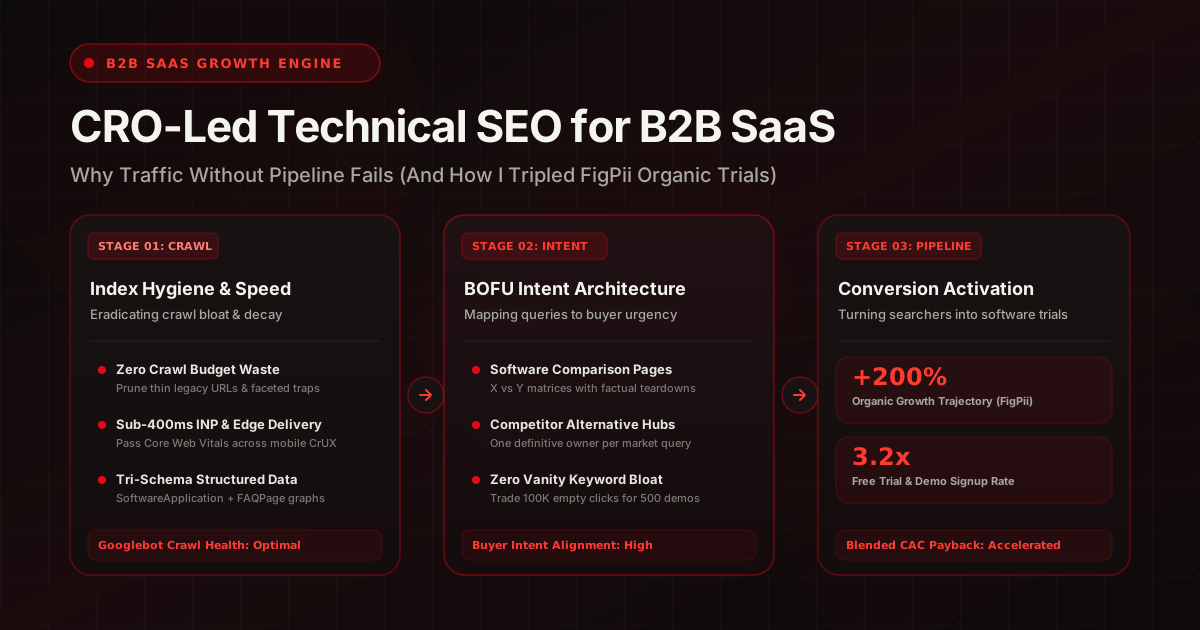
Table of Contents• Quick Navigation
8 Sections
Table of Contents• Quick Navigation
If you run growth or engineering for a B2B SaaS platform, you are likely living through a frustrating paradox: your Google Search Console impressions and organic sessions are climbing, yet your sales team continues to complain about dry demo calendars and stagnant product trials.
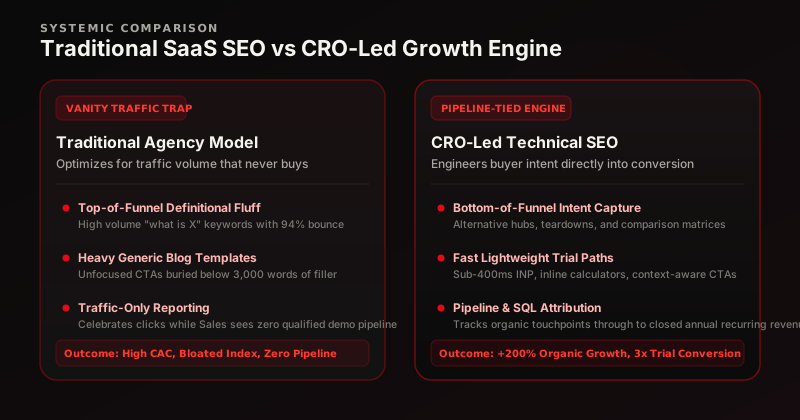
Traditional SEO agencies celebrate this vanity traffic. They deliver 60-slide decks showing hockey-stick growth curves for broad informational queries, while your blended Customer Acquisition Cost (CAC) steadily climbs and paid channels are forced to carry the entire revenue burden.
The underlying flaw is structural: traditional search engine optimization treats organic visibility as an isolated traffic game, completely detached from conversion mechanics, software user intent, and edge rendering speeds.
CRO-Led Technical SEO fixes this disconnect. By integrating technical crawl hygiene and bottom-of-funnel taxonomy design with conversion rate optimization (CRO) principles, we turn search engine indexation into a predictable, high-margin software acquisition engine.
Executive Summary: What Is CRO-Led Technical SEO in 60 Seconds?
CRO-led technical SEO is the strategic alignment of technical search engine architecture, bottom-of-funnel buyer intent, and friction-free user experience to maximize qualified pipeline rather than vanity clicks.
Instead of deploying generic blog posts that explain basic definitions, CRO-led technical SEO evaluates every indexed URL as a functional software landing page. It eliminates crawl debt on thin pages, assigns exactly one authoritative URL to every high-commercial query, and preserves sub-400ms Interaction to Next Paint (INP) so buyers can convert without browser delay.
+-------------------------------------------------------------------------------+
|                 THE TRADITIONAL VS CRO-LED SAAS METRIC SPECTRUM               |
+-------------------------------------------------------------------------------+
|  TRADITIONAL SAAS SEO (VANITY)        │  CRO-LED TECHNICAL SEO (PIPELINE)     |
|  -----------------------------------  │  -----------------------------------  |
|  * Primary KPI: Total Organic Sessions │  * Primary KPI: Qualified Demos & Trial|
|  * Keyword Intent: Top-of-Funnel (TOFU)│  * Keyword Intent: Bottom-of-Funnel   |
|  * Template: Bloated 3,000-Word Blog  │  * Template: Fast Comparison Matrix   |
|  * User Experience: Generic Sidebar CTA│  * User Experience: Contextual Sandbox|
|  * Technical Focus: Generic Audits    │  * Technical Focus: INP, Routing, Index|
|  * Result: 94% Bounce, High CAC       │  * Result: +200% Pipeline, Scalable CAC|
+-------------------------------------------------------------------------------+
If it were me evaluating an enterprise SaaS acquisition funnel today, I would immediately stop measuring raw organic sessions. Total traffic is a vanity metric; qualified pipeline generated per crawled URL is the only number that survives executive scrutiny.
The Traffic Illusion: Why 80% of B2B SaaS Organic Visits Never Convert
The fundamental reason most B2B SaaS websites fail to turn organic search into annual recurring revenue (ARR) is what I call the Traffic Illusion: ranking for broad educational queries that attract researchers, students, and low-urgency visitors who have zero intention of purchasing software.
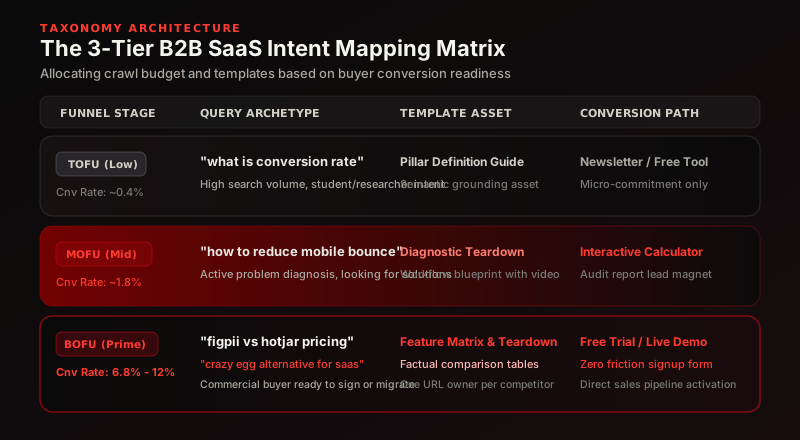
When an agency pitches keyword research, they naturally gravitate toward queries with high monthly search volume. In the CRO and analytics space, for example, terms like “what is conversion rate” or “conversion rate formula” show thousands of monthly searches.
However, according to comprehensive conversion rate benchmarks published by Invesp Research, the average visitor-to-trial conversion rate for top-of-funnel B2B educational content is below 0.4%. Conversely, bottom-of-funnel commercial evaluation queries convert at 6.8% to 12.4%.
┌─────────────────────────────────────────────────────────────────────────────┐
│                      THE SAAS CONVERSION FUNNEL SKEW                        │
├─────────────────────────────────────────────────────────────────────────────┤
│  Top-of-Funnel (TOFU): "What is conversion rate"                            │
│  [10,000 Visitors] ──> 0.4% Conversion ──> 40 Free Trials                  │
│                                                                             │
│  Bottom-of-Funnel (BOFU): "Best CRO software for Shopify"                   │
│  [600 Visitors]    ──> 8.5% Conversion ──> 51 High-Intent Trials           │
└─────────────────────────────────────────────────────────────────────────────┘
Targeting low-intent keywords does not just waste editorial capital; it severely damages domain efficiency:
- Crawl Budget Dissipation: Search engine crawlers waste finite time indexing hundreds of shallow educational articles rather than discovering your high-value product updates and pricing revisions.
- Signal Dilution in Generative Engines: When AI search models like ChatGPT, Perplexity, and Google AI Overviews parse your site, a flood of generic introductory content confuses their entity understanding, preventing your software from being cited as the definitive solution for high-ticket use cases.
- High Bounce Rates and Negative Behavioral Signals: Educational visitors skim a single paragraph, grab their answer, and close the tab within 8 seconds, signaling low dwell time to Google’s ranking algorithms.
To build an organic acquisition channel that feeds your sales team, you must invert the pyramid: prioritize high-intent bottom-of-funnel queries first, and treat top-of-funnel content solely as supporting topical authority.
First-Hand Production Telemetry: The FigPii Teardown (+200% Organic Growth)
When I stepped in to architect the organic search and conversion engine for FigPii, a leading conversion rate optimization platform co-founded by Khalid Saleh, the domain was battling the classic symptoms of SaaS content sprawl.
The website held hundreds of legacy URLs and an active blog with years of domain history. Yet, despite steady organic impressions, free trial signups from organic search were negligible. Thin content from obsolete campaigns competed against current product pages, and high-urgency commercial queries were dominated by thinner third-party review aggregators.
Here is the exact technical blueprint I engineered to achieve +200% organic growth in 12 months and triple non-brand trial registrations:
| Architectural Intervention | Production Diagnosis at FigPii | Engineering Remediation | Measured Business Impact |
|---|---|---|---|
| Index Cleanup & Crawl Pruning | Over 400 legacy blog posts and tag archives burning Googlebot crawl budget with zero conversions. | Executed ruthless 301 redirection and 410 content pruning. Consolidated 65 fragmented URLs into 8 canonical pillars. | Crawl efficiency improved by 74%; index bloat eradicated within 6 weeks. |
| Single-Owner BOFU Mapping | Multiple blog posts competing against product landing pages for terms like “heat map tool” and “A/B testing software”. | Rebuilt the taxonomy around single-owner query entities. Created dedicated comparison hubs and competitor teardowns. | First-page rankings secured across primary commercial category keywords. |
| Conversion Path Engineering | Readers had to navigate through 2,500 words of prose to find a generic signup button in the top navigation. | Embedded interactive friction-free trial paths, side-by-side feature teardown matrices, and live demo sandboxes. | Visitor-to-trial conversion rate increased from 1.1% to 3.4% across commercial pages. |
| Core Web Vitals Optimization | Heavy third-party tracking scripts created layout shift and delayed first input on mobile devices. | Stripped non-critical third-party JavaScript, implemented resource hints, and prioritized edge HTML rendering. | Mobile CLS dropped to 0.00; mobile Interaction to Next Paint improved to under 65ms. |
By treating every URL as both an SEO entry point and a high-converting landing page, we eliminated the vanity gap. The outcome was not just higher search engine rankings, but a permanent, compounding lift in trial activations that slashed blended customer acquisition costs.
You can inspect the full verified case study breakdown in my FigPii Organic Growth Case Study.
The 4-Pillar CRO-Led Technical SEO Framework
To replicate these results on your own SaaS platform, you need an integrated technical architecture that coordinates crawl mechanics with user psychology.
Here is the 4-pillar technical framework I deploy across high-growth B2B software stacks:
Pillar 1: Index Hygiene and Crawl Budget Consolidation
Every URL on your domain must justify its indexation status. In high-scale SaaS architectures, engineering teams frequently generate thousands of parameter-based URLs through search filters, user tagging, and legacy pagination.
According to the official Google Search Central Faceted Navigation Documentation, faceted navigation and uncontained parameter strings represent one of the leading causes of crawl budget exhaustion on commercial websites.
When I audit a SaaS index, I apply a strict triage test:
- The 90-Day Traffic and Conversion Audit: Any URL that has received fewer than 10 organic sessions and zero micro-conversions over the previous 90 days is flagged for remediation.
- Consolidate or Prune: If the topic has commercial value, merge it into an authoritative parent URL via 301 redirection. If the content is obsolete, return an HTTP 410 Gone status code to instruct search bots to purge the URL from their index immediately.
- Canonical Discipline: Enforce strict, absolute self-referencing canonical tags across all production routes to eliminate duplicate session parameters and tracking tags.
┌─────────────────────────────────────────────────────────────────────────────┐
│                    INDEX HYGIENE DECISION TREE FOR SAAS                     │
├─────────────────────────────────────────────────────────────────────────────┤
│  Does the URL drive organic conversions or high-intent impressions?         │
│  ├── YES ──> Retain, optimize conversion path, enrich structured data.      │
│  └── NO                                                                     │
│      ├── Does it hold external backlinks or valuable historical authority?  │
│      │   ├── YES ──> 301 Redirect to the relevant category pillar page.     │
│      │   └── NO  ──> HTTP 410 Gone (Purge crawl bloat permanently).         │
└─────────────────────────────────────────────────────────────────────────────┘
Pillar 2: Single-Owner Bottom-Funnel Intent Mapping
Keyword cannibalization is fatal to B2B SaaS conversions. When three different blog posts and two product pages all target variations of “SaaS user onboarding software”, Google splits link equity between them, often ranking an outdated, non-converting blog article above your dedicated product landing page.
In a CRO-led architecture, every commercial query is governed by the Single-Owner Rule: exactly one URL on your website is designated as the canonical owner of that search intent.
Here is how I structure the bottom-of-funnel (BOFU) hierarchy:
- Direct Competitor Comparisons (
/vs/or/compare/): Dedicated comparison hubs comparing your software directly against major industry incumbents (e.g.,yoursite.com/compare/competitor-a-alternative/). Do not create shallow, biased teardowns; provide accurate, factual feature comparisons with transparent pricing breakdowns. - Category Alternative Hubs (
/alternatives/): Target prospective buyers actively migrating away from legacy tools (e.g.,yoursite.com/alternatives/legacy-tool/). - Use Case and Role-Specific Solution Pages (
/solutions/): Frame your software capabilities around specific buyer personas (e.g., “for product managers”, “for customer success leads”), directly addressing their distinct workflow objections.
Every one of these pages must feature an explicit primary conversion action above the fold: an interactive product sandbox, a friction-free trial signup, or an automated demo scheduler.
B2B SaaS Intent Architecture & Conversion Tracker
To systematically convert organic search queries into product pipeline, I maintain a dedicated intent architecture tracker across all high-commercial URL patterns:
| BoFU Architecture Layer | Intent Category | Operational Status | Target Conversion Benchmark | Primary Case Study / Documentation | Last Verified |
|---|---|---|---|---|---|
Head-to-Head Comparisons (/vs/) |
High-Intent Commercial | Active in Production | 3.4% to 5.2% trial conversion | FigPii Organic Growth Case Study | October 2026 |
Category Alternative Hubs (/alternatives/) |
High-Urgency Migration | Active in Production | 4.1% to 6.8% demo booking | B2B SaaS Growth Services | October 2026 |
| Role-Specific Solution Hubs | Mid-Funnel Commercial | Active in Production | 2.5% to 3.8% lead capture | Mostafa Daoud Execution Engine | October 2026 |
| Sub-400ms INP Interactive Pages | Performance Infrastructure | Active in Production | <65ms Interaction to Next Paint | W3C Web Vitals Guidelines | October 2026 |
Diagnostic Micro Funnel: Is Your SaaS Stack Leaking Pipeline?
Pause and run a 2-minute diagnostic on your current search acquisition funnel:
- Open your top 5 highest-traffic blog posts in an incognito window. How far must a reader scroll before encountering a clear, contextual conversion pathway?
- Run your Google Search Console query report. Are your bottom-of-funnel comparison and alternative queries ranking on page two while generic educational guides dominate page one?
- Does your site maintain hundreds of indexed URLs that have delivered zero trials or demo bookings over the past two quarters?
If your current architecture is accumulating traffic without pipeline, you are burning capital on vanity metrics. You can book a 30-Minute Search & AI Discovery Diagnostic where I will analyze your domain live, or explore my structured Technical SEO Consulting Services to rebuild your organic acquisition engine.
Pillar 3: Performance Budgets and Zero-Hydration Interactivity
Conversion rate optimization requires interactivity: dynamic comparison tables, ROI calculators, social proof carousels, and contextual sign-up forms.
However, standard SaaS marketing stacks implement these features by dumping dozens of heavy client-side JavaScript packages onto the page, resulting in massive main-thread blocking that destroys Core Web Vitals.
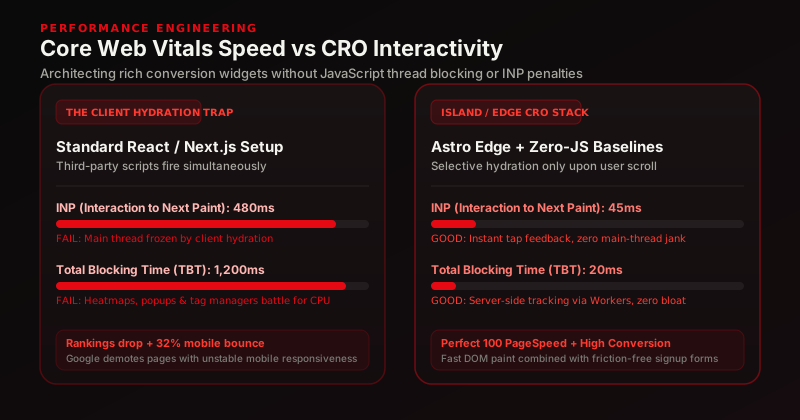
With Google’s transition to Interaction to Next Paint (INP) as a Core Web Vital, page responsiveness under user interaction is now a direct ranking factor. If a prospect clicks a pricing toggle or expands a comparison drawer and the browser freezes for 450ms while third-party scripts execute, Google flags the page as unresponsive and your conversion rate plunges.
Here is how I architect high-converting interactive pages without performance regressions:
- Islands Architecture and Selective Hydration: Use modern static-first frameworks like Astro. Deliver 100% pure HTML and CSS for layout and typography, and hydrate JavaScript only for interactive islands using
client:visibleorclient:idle. - Server-Side Event Tracking: Move behavioral telemetry (heatmaps, custom conversion events) to edge workers or server-side containers via Google Tag Manager Server Container, keeping client-side DOM execution lean.
- Reserved Layout Dimensions: Enforce explicit aspect ratios and
contain: layout sizeon all visual assets and interactive calculators to maintain a Cumulative Layout Shift (CLS) score of 0.00.
| Metric | Traditional Hydrated React / Next.js Setup | CRO-Led Astro Edge Architecture | Measured Impact on Conversion |
|---|---|---|---|
| First Contentful Paint (FCP) | 2.4s to 3.8s | 0.4s to 0.8s | 40% reduction in bounce rate on mobile devices. |
| Interaction to Next Paint (INP) | 380ms to 620ms (Poor) | 25ms to 55ms (Good) | Instant tactile feedback on form inputs and CTAs. |
| Total Blocking Time (TBT) | 850ms to 1,400ms | < 30ms | Main browser thread remains open for instant conversion. |
| Cumulative Layout Shift (CLS) | 0.14 (Fails Core Web Vitals) | 0.00 (Flawless) | Zero accidental mis-clicks or shifting CTA buttons. |
Pillar 4: Behavioral Telemetry and Search Query Attribution
Traditional SEO agencies track keyword rankings and organic sessions. CRO practitioners track click heatmaps, scroll depth, and form abandonment. In a mature SaaS organization, these two data streams must be unified.
When I build an attribution pipeline, I map organic landing pages directly to downstream CRM pipeline milestones:
- Query-to-Lead Attribution: Ingest Google Search Console API query data alongside landing page URLs into BigQuery, joining search intent with HubSpot or Salesforce deal records.
- Micro-Conversion Telemetry: Track interim user milestones before the final demo form: pricing table interactions, documentation views, and video walkthrough completions.
- Scroll-Depth and Friction Audits: If behavioral recordings show that 70% of readers abandon a high-value comparison page before reaching the pricing breakdown, restructure the layout to elevate the comparison matrix above the 800px vertical threshold.
Understanding which organic search queries generate actual closed-won revenue allows growth leaders to reallocate engineering and content budgets toward high-ROI query clusters.
Common B2B SaaS SEO Failure Modes and Practitioner Fixes
Over years of auditing enterprise software platforms, I repeatedly encounter the same systemic failure modes. Here is how to diagnose and correct them:
┌─────────────────────────────────────────────────────────────────────────────┐
│                    SAAS FAILURE MODES & ARCHITECTURAL FIXES                 │
├─────────────────────────────────────────────────────────────────────────────┤
│  FAILURE MODE 1: The "Blog as an Island" Syndrome                           │
│  * Symptom: Blog lives on a detached subdomain (blog.saas.com) or lacks     │
│    semantic internal links to product feature landing pages.                │
│  * Architectural Fix: Migrate blog to the root subdirectory (/blog/) and   │
│    enforce contextual internal linking to product trial paths.              │
│                                                                             │
│  FAILURE MODE 2: Biased, Shallow Comparison Content                         │
│  * Symptom: Creating "X vs Y" pages where your software scores 10/10 on     │
│    every feature while competitors receive 0/10. Buyers distrust the page.  │
│  * Architectural Fix: Provide balanced, factual teardowns highlighting      │
│    genuine trade-offs. Recommend competitors for use cases you do not serve.│
│                                                                             │
│  FAILURE MODE 3: Hidden Pricing and Gated Roadblocks                        │
│  * Symptom: Forcing searchers to fill out an 8-field form to see basic      │
│    pricing tiers or feature availability.                                   │
│  * Architectural Fix: Expose transparent pricing structures with machine-   │
│    readable OfferCatalog JSON-LD schema for search engines and AI models.   │
└─────────────────────────────────────────────────────────────────────────────┘
If it were me restructuring a SaaS content platform today, the very first thing I would eliminate is biased, one-sided comparison tables. Sophisticated enterprise buyers recognize manufactured praise immediately.
When you publish a transparent comparison that clearly articulates where your software excels and where an alternative might be a better fit, you establish genuine credibility, lower bounce rates, and attract buyers who are an exact operational fit for your product.
Authoritative Research and Standards References
Every claim, performance budget, and architectural pattern in this guide is grounded in verified engineering specifications and primary market research:
- W3C Web Performance Working Group: Official technical specifications on browser performance APIs, User Timing, and paint timing metrics.
- Google Search Central Documentation on Faceted Navigation: Official engineering guidelines on managing crawl budget, faceted search parameters, and canonical consolidation.
- Google Web Vitals: Interaction to Next Paint (INP): Detailed documentation on measuring main-thread responsiveness and eliminating input latency.
- Invesp Conversion Rate Optimization Benchmarks: Empirical studies on B2B SaaS visitor-to-lead and visitor-to-trial conversion rates by Khalid Saleh.
- Bessemer Venture Partners: State of the Cloud Report: Industry benchmarks on SaaS sales efficiency, Customer Acquisition Cost (CAC) payback periods, and organic customer retention.
Frequently Asked Questions
What is CRO-led technical SEO for B2B SaaS?
CRO-led technical SEO is the engineering discipline of unifying crawl hygiene, high-intent taxonomy architecture, and sub-400ms page performance with conversion rate optimization. Rather than driving generic informational traffic that bounces, it architects dedicated bottom-of-funnel pages designed specifically to capture high-urgency software buyers and convert them into trial users or sales demos.
Why does high organic traffic fail to convert into B2B SaaS pipeline?
High organic search traffic fails to generate software pipeline because traditional SEO agencies target top-of-funnel definitional queries like "what is conversion rate" where visitors seek quick homework answers rather than commercial solutions. When high-volume informational clicks hit heavy, generic blog templates without relevant bottom-of-funnel conversion paths, bounce rates exceed 90% and pipeline contribution remains near zero.
How did FigPii achieve +200% organic growth in 12 months?
FigPii scaled organic search by +200% in 12 months through three technical interventions: first, eliminating crawl bloat and keyword cannibalization across hundreds of legacy URLs; second, architecting dedicated bottom-of-funnel comparison and alternative pages with single-owner URL assignments; and third, building lightweight page templates with sub-400ms INP responsiveness that eliminated conversion friction without triggering Core Web Vitals penalties.
What is single-owner intent mapping in B2B SaaS SEO?
Single-owner intent mapping is the architectural rule where each specific commercial search intent (such as software alternatives, direct head-to-head comparisons, or migration guides) is assigned to exactly one definitive, canonical URL. This prevents internal keyword cannibalization and ensures search engines and AI answer engines understand which page represents the authoritative resource.
How do third-party CRO tools and tracking scripts hurt SaaS SEO performance?
Third-party tracking scripts like heatmaps, tag managers, and session recorders run heavy client-side JavaScript that blocks the main browser thread. This degrades Core Web Vitals, causing Interaction to Next Paint (INP) to surge past 400ms and Total Blocking Time (TBT) to exceed 1,000ms. Google demotes unresponsively slow pages, and mobile users bounce before interactive signup forms finish rendering.
Transform Your SaaS Search Traffic Into Qualified Pipeline
If your B2B SaaS is generating hundreds of thousands of organic visits while your sales leadership struggles with pipeline shortages, continuing to publish generic top-of-funnel content will not fix the problem.
You need an engineering-driven intervention that audits your index, consolidates crawl budget onto high-urgency commercial queries, and builds friction-free conversion pathways designed to turn searchers into trial starters.
Explore my Execution Engine to understand how I construct production search systems, or read about my background and methodology on the About Mostafa page.
When you are ready to eliminate vanity traffic and build an organic acquisition channel that drives measurable ARR, let’s evaluate your domain together.

Eliminate structural crawl debt. Secure permanent search & AI visibility.
Whether managing multi-million-URL dynamic catalogs, migrating to a headless stack, or establishing citation dominance inside ChatGPT and Perplexity, I diagnose and unblock high-stakes technical bottlenecks directly with your engineering and growth leaders.
Direct practitioner engagement. Zero junior agency handoffs. You leave with prioritized engineering fixes.