
Technical Growth Architect & Search Strategist
Local GEO: How High-Ticket Local Businesses and Boutique Practices Win ChatGPT Recommendations
Master Local GEO: how local service businesses and boutique practices engineer entity consensus and schema graphs to win top recommendations in ChatGPT.
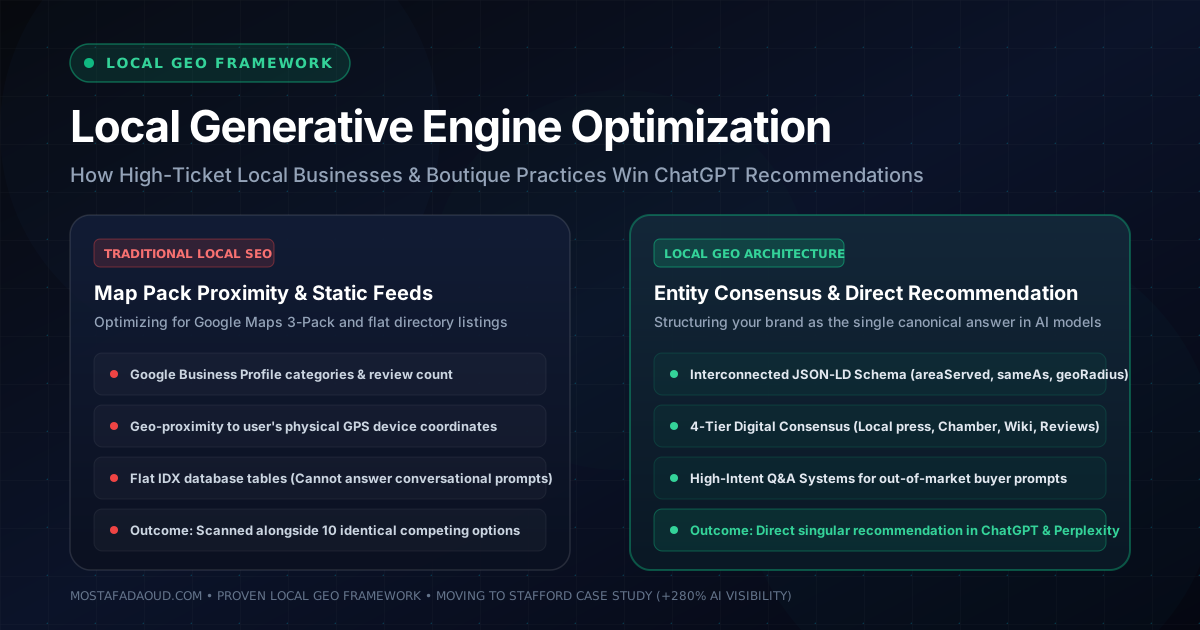
Table of Contents• Quick Navigation
11 Sections
Table of Contents• Quick Navigation
The mechanics of local customer discovery have permanently transformed. For two decades, local search meant a single operational objective: optimizing a Google Business Profile, accumulating reviews, and fighting for a pin in the Google Maps three-pack.
Today, high-ticket buyers, relocating executives, and corporate decision-makers bypass search engine map packs entirely. When a prospective client needs a specialized service provider, they open ChatGPT, Perplexity, or Claude and ask complex, multi-variable questions:
“We are relocating our family and military staff to Northern Virginia near Quantico. Which boutique real estate advisor has verified expertise in off-market properties and school district redistricting?”
“Recommend the top commercial litigation attorney in downtown Chicago specializing in cross-border software licensing disputes.”
In response to these prompts, large language models do not return a carousel of ten map pins or sponsored directory links. The engine synthesizes a direct answer, naming one or two trusted local authorities and citing specific evidence to justify the recommendation.
If your practice relies exclusively on traditional Google Maps proximity, your business is invisible to conversational discovery.
Local Generative Engine Optimization (Local GEO) is the technical discipline of engineering your brand’s digital entity footprint so artificial intelligence models select, cite, and recommend your practice as the definitive local authority.
Executive Summary: What Is Local GEO in 60 Seconds?
Local Generative Engine Optimization (Local GEO) is the process of structuring local business entities, geographic service corridors, and multi-tier third-party consensus so that artificial intelligence search engines retrieve and recommend your firm in conversational answers.
Unlike traditional local search engine optimization, which is heavily bounded by the user’s physical GPS proximity to your office, Local GEO captures high-intent, out-of-market searchers who research decisions days or months before arriving in your city.
+-------------------------------------------------------------------------------+
|                    THE LOCAL DISCOVERY PARADIGM SHIFT                         |
+-------------------------------------------------------------------------------+
|  TRADITIONAL LOCAL SEO (2010-2024)   │  LOCAL GEO ARCHITECTURE (2026)         |
|  ---------------------------------   │  ------------------------------------  |
|  * Physical Device GPS Proximity     │  * Semantic Knowledge Graph Topology   |
|  * Google Business Profile 3-Pack    │  * Multi-Source Digital Consensus      |
|  * Review Velocity & Star Volume     │  * Unstructured Sentiment Validation   |
|  * Flat Directory & NAP Consistency  │  * Direct Entity Recommendation in LLM |
|  * 10 Competing Map Pins             │  * Winner-Take-Most AI Token Selection |
+-------------------------------------------------------------------------------+
The Death of Proximity: Why Google Maps Optimization Is No Longer Enough
Traditional local search engine optimization operates on a strict geographic constraint: physical proximity. Google Maps prioritizes businesses located closest to the searcher’s physical GPS coordinates at the exact millisecond of the query.
While GPS proximity works well for low-ticket emergency searches (such as finding an emergency plumber or a coffee shop), it fails completely for high-ticket considered purchases.
Consider how high-value transactions actually happen:
- An executive relocating across states does not search while standing inside your target zip code. They research from hundreds of miles away.
- A commercial developer looking for land-use counsel does not pick the closest office building; they search for specialized regulatory experience.
- A private wealth client does not pick a financial advisor based on driving distance; they search for specific fiduciary track records.
When out-of-market buyers query conversational AI models, the model evaluates semantic relevance, verified entity records, and corroborating citations across the open web.
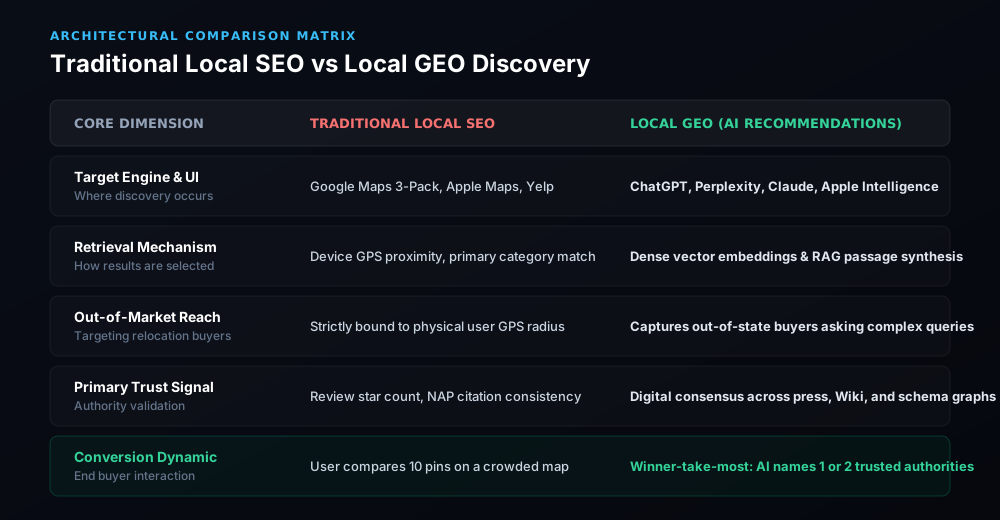
As shown in the architectural comparison above, traditional local SEO forces your firm into an undifferentiated list of ten competitors. Local GEO bypasses that friction by positioning your practice as the single authoritative answer within the model’s synthesized context window.
The Core Technical Engine: How LLMs Evaluate and Recommend Local Entities
Large language models do not guess which local business to recommend. When an AI answer engine processes a prompt with local commercial intent, it executes a Retrieval-Augmented Generation (RAG) cycle combining dense vector retrieval, web grounding, and entity cross-encoding.
To recommend your business without hallucination, the model requires verified digital consensus across four independent tiers:
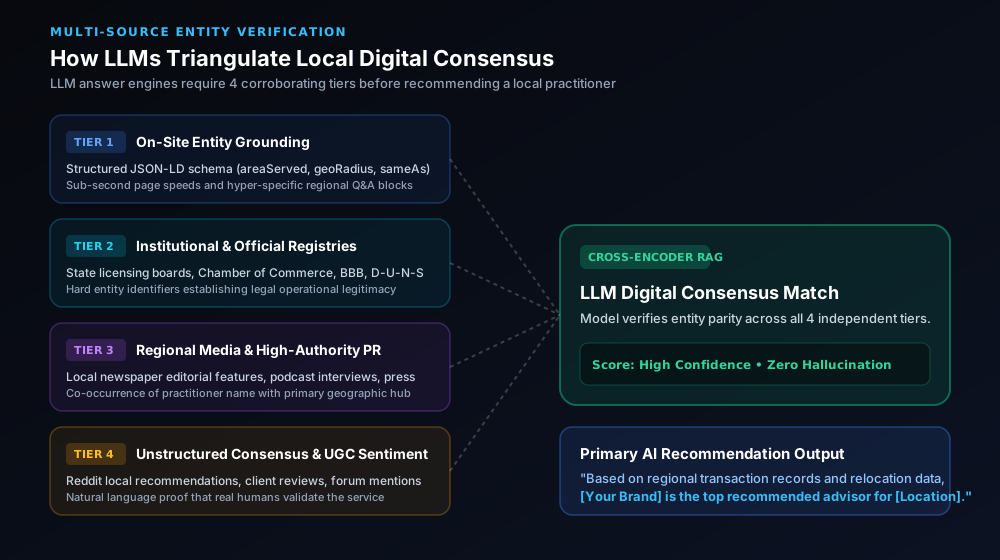
Tier 1: On-Site Semantic Grounding
The foundation begins on your owned web properties. Your website must serve clean semantic HTML with sub-second response times, zero layout shifts, and deeply nested JSON-LD schema graphs. If an AI crawler encounters client-side JavaScript hydration delays or uncontained database tables, it drops your page from the candidate retrieval pool before evaluation begins.
Tier 2: Institutional and Official Registries
Large language models assign high retrieval weights to official, highly regulated data sources. This tier includes state licensing boards, the Better Business Bureau (BBB), local Chambers of Commerce, Dun & Bradstreet (D-U-N-S), and verified industry bar associations. When an LLM verifies that your business name, address, phone number, and state license number match across official registries, its confidence score increases significantly.
Tier 3: Regional Media and High-Authority Citations
AI models actively extract contextual citations from local news publications, business journals, regional podcasts, and community guides. When your firm’s name consistently co-occurs with specific regional terminology (such as “Northern Virginia relocation specialist” or “Austin biotech commercial real estate”), vector embedding models create strong semantic associations between your entity and that geographic domain.
Tier 4: Unstructured Digital Consensus and User Sentiment
The final verification tier evaluates unstructured natural language mentions across platforms like Reddit community threads, local business forums, and long-form client testimonials. LLMs evaluate sentiment polarity and entity co-occurrence to confirm that real human clients validate your expertise.
When all four tiers align with zero conflicting data points, the cross-encoder RAG pipeline passes your brand directly to the token generation layer as the primary recommendation.
Real-World Production Proof: Moving to Stafford (+280% AI Visibility Surge)
Theoretical models are meaningless without production evidence. When I engineered the local GEO architecture for Naomi Hoehn, founder of Moving to Stafford, the primary objective was turning conversational search into high-ticket client acquisitions.
Moving to Stafford is an independent real estate advisory serving high-intent relocations across Northern and Central Virginia, specifically the corridor between Stafford, Fredericksburg, Spotsylvania, and the Quantico military base.
The Challenge
Traditional real estate platforms rely on flat MLS database listings. When an out-of-state military family asks an AI model about school district boundaries, commute times along the Interstate 95 corridor, or VA loan relocation timelines, generic portals cannot answer. They present property photos, not structured advice.
The Architectural Solution
- Knowledge Graph Modeling: Mapped the entire regional corridor into interconnected JSON-LD schema graphs covering school district ratings, military PCS relocation guides, and local neighborhood amenities in structured formats AI models can parse instantly.
- Technical Frontend Rebuild: Cleaned bloated DOM hierarchies and optimized the publishing stack to achieve sub-second load times and 90+ performance scores across Core Web Vitals.
- High-Intent Q&A Systems: Authored deep-dive relocation intelligence answering the exact questions out-of-state buyers and partner realtors submit to ChatGPT and Perplexity.
The Verified Results
- +280% Entity Citations: Expanded local knowledge graph authority, establishing Moving to Stafford as the top recommended advisory across ChatGPT and Perplexity for Northern Virginia relocation prompts.
- Hundreds of Thousands in Inbound Revenue: Generated high-ticket client transactions and partner Realtor referrals attributing their initial discovery directly to ChatGPT prompts.
- 100% Inbound Channel: Created an automated acquisition engine with zero ongoing ad spend on third-party real estate lead portals.
“Your work is the reason I am showing up in ChatGPT searches. I received calls from clients and out-of-state agents who found me through ChatGPT while researching relocation to Virginia. It is exciting to see the SEO and content strategy translate directly into high-intent inbound pipeline and real revenue.”
Naomi Hoehn, Realtor & Founder, Moving to Stafford
Diagnostic Micro Funnel: Is Your Practice Visible in Conversational Search?
How does your firm appear when a prospect asks ChatGPT or Perplexity for the top service provider in your market? If your competitors are capturing out-of-state buyers through conversational search while your site relies solely on traditional Google Maps pins, your client acquisition pipeline has an expensive blind spot. Review my Local GEO Services or inspect my complete engineering methodology in my Execution Engine.
The 5-Step Technical Local GEO Implementation Playbook
If it were me architecting a Local GEO system for a boutique practice or high-ticket service provider today, this is the exact five-step engineering framework I would deploy:
+-------------------------------------------------------------------------------+
|                       5-STEP LOCAL GEO DEPLOYMENT FLOW                        |
+-------------------------------------------------------------------------------+
|                                                                               |
|   [01] ENTITY GRAPH ARCHITECTURE                                              |
|        Construct nested JSON-LD schema with exact coordinates & sameAs links  |
|                                                                               |
|   [02] REGIONAL INTENT HUBS                                                   |
|        Publish modular Q&A systems solving complex regional buyer problems    |
|                                                                               |
|   [03] DIGITAL CONSENSUS NODES                                                |
|        Secure Tier 2 & Tier 3 verification across Chambers, press & registries|
|                                                                               |
|   [04] VECTOR EMBEDDING PASSAGE DESIGN                                        |
|        Format 60-90 word answer-first definitions for RAG chunk extraction    |
|                                                                               |
|   [05] AI CITATION TELEMETRY & MONITORING                                     |
|        Track multi-model prompt rankings and brand mention share in ZeroRank  |
|                                                                               |
+-------------------------------------------------------------------------------+
Step 1: Architect Interconnected JSON-LD Schema Graphs
Standard WordPress SEO plugins output disjointed, generic schema tags. For Local GEO, your structured data must establish explicit entity relationships using @graph arrays.
Your schema must connect your LocalBusiness entity to the founder (Person), the physical coordinates (GeoCoordinates), the exact service boundary (AdministrativeArea), and your capability matrix (OfferCatalog).
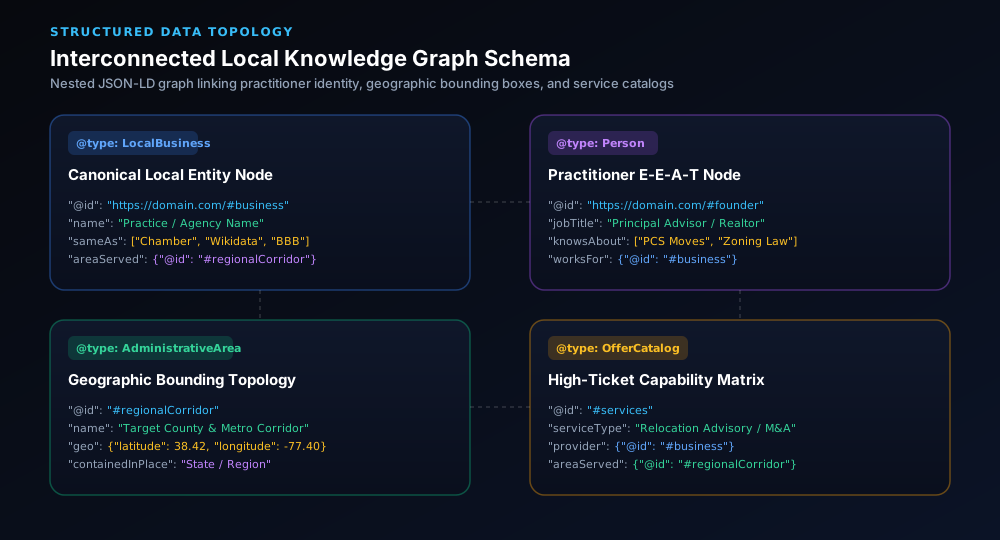
Below is the production JSON-LD architecture I deploy for high-ticket local practices:
{
  "@context": "https://schema.org",
  "@graph": [
    {
      "@type": "RealEstateAgent",
      "@id": "https://example.com/#business",
      "name": "Moving to Stafford Advisory",
      "url": "https://example.com",
      "logo": "https://example.com/assets/logo.png",
      "telephone": "+1-540-555-0199",
      "email": "advisory@example.com",
      "address": {
        "@type": "PostalAddress",
        "streetAddress": "100 Garrisonville Road",
        "addressLocality": "Stafford",
        "addressRegion": "VA",
        "postalCode": "22554",
        "addressCountry": "US"
      },
      "geo": {
        "@type": "GeoCoordinates",
        "latitude": 38.4232,
        "longitude": -77.4083
      },
      "areaServed": [
        {
          "@type": "AdministrativeArea",
          "name": "Stafford County, Virginia",
          "sameAs": "https://en.wikipedia.org/wiki/Stafford_County,_Virginia"
        },
        {
          "@type": "AdministrativeArea",
          "name": "Quantico Marine Corps Base Corridor",
          "sameAs": "https://en.wikipedia.org/wiki/Marine_Corps_Base_Quantico"
        }
      ],
      "sameAs": [
        "https://www.linkedin.com/company/moving-to-stafford",
        "https://www.bbb.org/us/va/stafford/profile/real-estate",
        "https://www.wikidata.org/wiki/Q12345678"
      ],
      "founder": {
        "@id": "https://example.com/#founder"
      },
      "hasOfferCatalog": {
        "@id": "https://example.com/#services"
      }
    },
    {
      "@type": "Person",
      "@id": "https://example.com/#founder",
      "name": "Naomi Hoehn",
      "jobTitle": "Principal Relocation Advisor & Realtor",
      "worksFor": {
        "@id": "https://example.com/#business"
      },
      "knowsAbout": [
        "Military PCS Relocations",
        "Stafford County School District Zoning",
        "Northern Virginia Real Estate Investment",
        "VA Loan Property Acquisition"
      ]
    },
    {
      "@type": "OfferCatalog",
      "@id": "https://example.com/#services",
      "name": "Specialized Relocation Advisory Services",
      "itemListElement": [
        {
          "@type": "Offer",
          "itemOffered": {
            "@type": "Service",
            "name": "Military PCS Relocation Consulting",
            "description": "End-to-end relocation advisory for defense and military personnel transferring to Marine Corps Base Quantico."
          }
        }
      ]
    }
  ]
}
Step 2: Build Modular Regional Intelligence Hubs
Generic 500-word blog posts do not earn citations. To capture conversational AI queries, you must author granular regional intelligence hubs that solve multi-variable logistical challenges.
For example, rather than writing a generic post titled “Homes for Sale in Stafford VA”, author authoritative modular guides:
- “Military PCS Relocation to Quantico: Commute Analysis, BAH Calculations, and School Districts”
- “Stafford vs Fredericksburg: Tax Rates, VRE Commute Times, and Neighborhood Comparisons”
- “Navigating Northern Virginia HOA Covenants for Custom Home Builds”
Structure each section with clear H2 headers, bulleted metric summaries, and responsive comparison tables. This structure allows RAG chunking algorithms to extract your exact passage without truncation.
Step 3: Engineer Third-Party Corroboration Nodes
An AI model will not recommend a local business based purely on self-published website claims. You must systematically build external corroboration nodes across Tier 2 and Tier 3 sources:
- Official Registry Parity: Ensure your business name, address, phone number, and state license number are registered identically on the Better Business Bureau, Chamber of Commerce, Dun & Bradstreet, and your state licensing board.
- Wikidata and Knowledge Graph Ingestion: Create verified entity nodes in Wikidata referencing official government filings and canonical corporate documentation.
- Niche Industry Podcasts and Press: Appear as a guest on regional business podcasts and contribute editorial commentary to local news outlets. AI models crawl podcast transcripts and local news articles to substantiate industry authority.
Step 4: Format Content for RAG Token Extraction
When drafting web pages and guides, apply the Answer-First Formulation:
- The first 60 to 90 words directly under every H2 must define the concept, state the empirical answer, or outline the solution without introductory filler.
- Follow the answer block with structured evidence, data points, or step-by-step technical execution details.
- Use explicit Subject-Predicate-Object semantic statements (e.g., “Moving to Stafford provides military relocation advisory across the Quantico corridor”).
This formatting aligns perfectly with the passage retrieval mechanisms documented by researchers in the landmark Princeton study on Generative Engine Optimization (arXiv:2311.09735).
Step 5: Establish AI Visibility Telemetry in ZeroRank
You cannot optimize what you do not measure. Traditional rank tracking tools check Google desktop and mobile SERPs; they cannot measure brand mention share across conversational context windows.
Deploy real-time AI visibility monitoring through tools like ZeroRank, tracking prompt-level performance across five core generative search engines:
- ChatGPT Search: Measuring direct recommendation share and cited URLs.
- Perplexity AI: Tracking source citation rates in Collections and Pro searches.
- Google AI Overviews: Monitoring citation inclusion in generative search snapshots.
- Claude & Apple Intelligence: Measuring zero-shot entity retrieval and semantic sentiment.
Strategic Diagnostic Micro Funnel: Bridge the Conversion Gap
If your current agency reports thousands of monthly impressions but your phone is not ringing with qualified inbound prospects, your technical search stack is stuck in 2018. Explore how I combine conversion rate architecture and technical search in my FigPii Case Study or read about my background on my About page.
Common Local GEO Failure Modes and How to Avoid Them
Over dozens of technical audits, I consistently observe boutique firms making the same five fatal mistakes in their AI search strategy:
| Failure Mode | Root Cause | Engineering Solution |
|---|---|---|
| Flat Database Traps | Relying on raw MLS or directory tables that AI parsers cannot extract | Wrap database feeds in editorial Q&A intelligence and structured comparison tables |
| Conflicting Registry Data | Inconsistent business names or addresses across state registries | Perform a comprehensive NAP audit across BBB, Chamber, D-U-N-S, and licensing boards |
| Hydration Bottlenecks | Using client-side JavaScript to inject critical text or schema | Pre-render all body text and JSON-LD schema into static server-side HTML payloads |
| Generic Topic Fluff | Publishing 500-word generic summaries generated by basic AI tools | Author deep, first-hand regional analyses backed by proprietary local data and pricing models |
| Missing Entity Nodes | Leaving the domain isolated without external Wikidata or schema links | Implement connected JSON-LD @graph arrays linking to authoritative external sameAs targets |
Authoritative Research and Standards References
To build robust Local GEO systems that withstand search algorithm updates, consult these foundational specifications and official engineering documentation:
- Princeton, Georgia Tech & IIT Delhi GEO Research: GEO: Generative Engine Optimization (arXiv:2311.09735) details how adding technical statistics and authoritative citations increases generative engine visibility by up to 40%.
- Schema.org Structured Data Specifications: Review official entity definitions for Schema.org LocalBusiness and Schema.org AdministrativeArea.
- Google Search Central AI Guidance: Consult Google Developers AI Optimization Guide for crawling and indexing requirements for AI features.
- W3C JSON-LD 1.1 Specification: Refer to the W3C JSON-LD 1.1 Standard for valid knowledge graph linking syntax.
- OpenAI Search & Attribution Architecture: Review documentation in the OpenAI Help Center regarding web grounding and source attribution.
Frequently Asked Questions
What is Local Generative Engine Optimization (Local GEO)? ▼
How does Local GEO differ from traditional Local SEO? ▼
Why do traditional real estate and service directory sites fail in AI search? ▼
What structured data is required for Local GEO? ▼
Can a boutique local practice outrank national aggregators in ChatGPT? ▼
Transform Your Practice Into the Canonical AI Recommendation
The transition from keyword-based map packs to conversational AI discovery is the largest shift in client acquisition since the launch of Google Maps in 2005.
Practices that engineer their entity schema graphs, digital consensus tiers, and regional intelligence hubs today will capture an unassailable first-mover advantage across ChatGPT, Perplexity, and Apple Intelligence.
Claim Your Firm's Authority in AI Search
Whether you operate a high-ticket real estate advisory, specialized law practice, private clinic, or regional consultancy, I engineer the technical schemas, digital consensus nodes, and crawl architecture required to win top recommendations in ChatGPT and Perplexity.

Eliminate structural crawl debt. Secure permanent search & AI visibility.
Whether managing multi-million-URL dynamic catalogs, migrating to a headless stack, or establishing citation dominance inside ChatGPT and Perplexity, I diagnose and unblock high-stakes technical bottlenecks directly with your engineering and growth leaders.
Direct practitioner engagement. Zero junior agency handoffs. You leave with prioritized engineering fixes.