
Technical Growth Architect & Search Strategist
AEO vs SEO: Architectural Differences for Growth Leaders
AEO vs SEO architectural differences explained for growth leaders. Compare crawler indexing with RAG token synthesis and passage-level extractability.
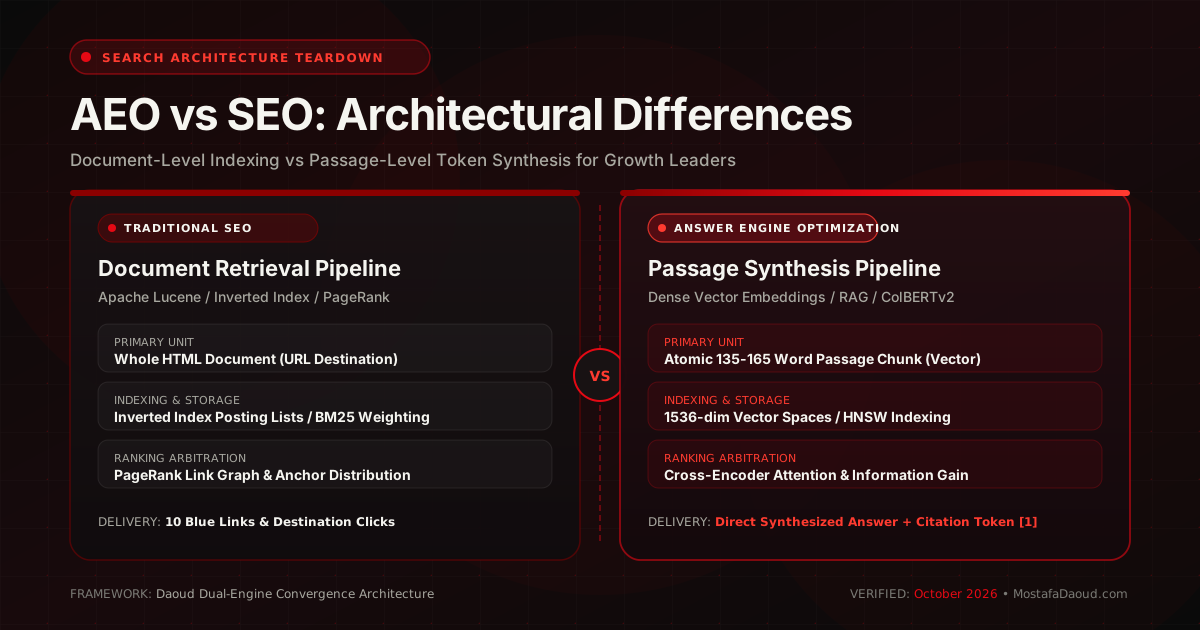
Table of Contents• Quick Navigation
10 Sections
Table of Contents• Quick Navigation
I was sitting in a quarterly growth review with a B2B SaaS leadership team when their Head of Growth pulled up an analytics dashboard with visible pride: rank position one on Google for their highest-converting commercial keyword. The room nodded along, satisfied that their multi-thousand-dollar monthly organic retainers were performing as promised.
Then the Chief Executive Officer opened Perplexity and ChatGPT Search on the main boardroom display.
He typed the exact commercial intent query that high-intent enterprise buyers ask before purchasing: “Which enterprise platform should we deploy to solve data pipeline latency?”
The result was immediate and brutal. The company’s brand was completely absent from the synthesized answer. Instead, an agile competitor whose website lingered on page two of Google’s organic SERPs was cited three times as the primary recommendation, with direct links embedded in the summary card.
In less than ten seconds, the perceived value of that organic number one ranking evaporated. That is the exact moment technical leadership realizes an uncomfortable reality: ranking a complete HTML document on an inverted search index is an entirely different engineering challenge than earning an inline citation token inside a generative neural synthesis pipeline.
Most growth organizations are applying 2018 keyword heuristics to a 2026 Retrieval-Augmented Generation (RAG) search ecosystem. They invest heavily in optimizing complete HTML documents for web crawlers, while generative answer engines are actively decomposing semantic passages for neural cross-encoders.
I do not deal in marketing speculation or AI alarmism. In this architectural teardown, I break down the exact mechanical divergence between Answer Engine Optimization (AEO) and Search Engine Optimization (SEO) from server logs to vector embeddings, demonstrating how technical growth leaders can engineer digital infrastructure that dominates both paradigms.
The Core Paradigm Shift: Document Retrieval vs Token Synthesis
Traditional search engine optimization and answer engine optimization operate on fundamentally opposing computational paradigms: document-level retrieval versus passage-level token synthesis. Search engines index entire HTML pages using inverted indexes and PageRank link graphs, directing human users to visit a destination URL to consume narrative information. Answer engines decompose user queries, retrieve isolated semantic chunks through vector databases, and synthesize unified responses using large language models directly on the results interface. In my enterprise client audits, domains dominating position one in Google frequently receive zero citations in ChatGPT Search or Perplexity because their answers are buried beneath promotional introductions. Traditional SEO optimizes for human clicks across a list of ten blue links, whereas AEO optimizes for machine extractability within a constrained context window. If your content requires a crawler to parse eight hundred words of brand narrative before reaching the core answer, neural rerankers discard the chunk before prompt synthesis begins.
The Inverted Index vs The Generative Context Window
To understand why traditional search tactics collapse in generative environments, examine the underlying storage mechanisms.
Traditional search engines like Google and Bing rely on an inverted index, an architecture popularized by systems like Apache Lucene. An inverted index functions as an exhaustive, bidirectional phone book. When Googlebot processes a web page, it tokenizes the text, strips stop words, calculates term frequencies, and creates a posting list mapping individual words to specific document IDs.
When a human user enters a query like enterprise technical seo audit, the retrieval engine scans the posting list for matching terms, computes a lexical relevance score using probabilistic models such as BM25, and weights the resulting document list using link graph authorities like PageRank. The basic atomic unit of retrieval is always the entire URL.
Generative answer engines, including Perplexity, ChatGPT Search, and Google AI Overviews, discard the document as their atomic retrieval unit. They operate within the computational constraints of a Large Language Model context window, typically bounded between 8,000 and 128,000 tokens for real-time inference latency.
An answer engine cannot afford to paste an entire 4,000-word corporate whitepaper into its prompt context. Doing so introduces severe token computational costs, degrades response generation speed, and induces model hallucinations. Instead, the engine treats the web as a distributed corpus of discrete semantic passages. Retrieval-Augmented Generation pipelines scrape the source document, strip away surrounding layout code, and extract candidate passages. The language model synthesizes tokens across multiple distinct sources simultaneously, assembling a net-new answer directly on the screen.
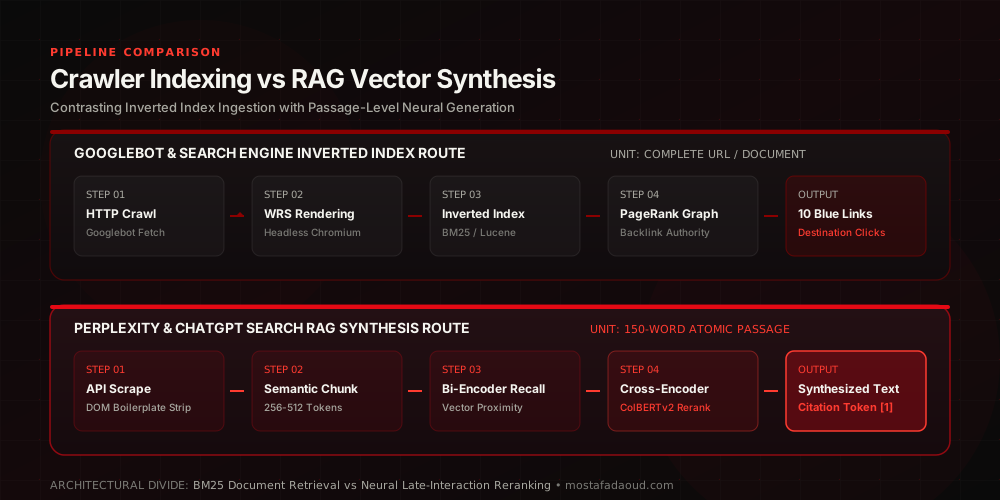
TRADITIONAL SEARCH PIPELINE:
User Query -> Inverted Index Match (BM25) -> PageRank Scoring -> 10 Blue Links -> Human Click

ANSWER ENGINE (RAG) PIPELINE:
User Query -> Multi-Query Fan-Out -> Vector Search Recall -> Cross-Encoder Rerank -> Prompt Context Synthesis -> Direct Inline Citation [1]
The Click-Through Model vs The Direct Synthesis Model
This structural divergence transforms search economics.
Traditional SEO is predicated on the destination click-through model. The search engine acts as an intermediary directory: its objective is to present a ranked list of ten blue links, accompanied by snippets and structured schema rich cards, incentivizing the user to click through to an external host to consume the narrative.
AEO operates on the direct synthesis model. The modern user no longer wants to open five separate browser tabs, scroll past intrusive marketing banners, and read eight hundred words of generic backstory to find a configuration command. The user delegates the evaluation, comparison, and synthesis of information directly to the machine.
When a query is resolved in-place on the results interface, the commercial goal shifts. You are no longer optimizing solely for organic search engine impressions or destination click-through rates. You are engineering passage-level extractability so that when the machine synthesizes its definitive answer, your brand entity is selected as the trusted, verified source and credited with an inline citation token.
Crawling Inverted Indexes vs Chunking Dense Vector Embeddings
The ingestion layer highlights the primary mechanical divergence between search crawlers and generative answer engines. Googlebot crawls the web by parsing HTML, executing JavaScript through a two-wave Web Rendering Service, and indexing raw text tokens into an inverted index based on BM25 frequency weighting. Generative engines like Perplexity and ChatGPT Search retrieve content via high-speed headless fetchers or search APIs, immediately stripping boilerplate styling to slice clean prose into 256 to 512 token semantic chunks. These individual chunks are converted into dense vector embeddings where semantic proximity replaces lexical keyword matching. When I architect systems for high-scale platforms, structuring content so that each section functions as an autonomous, self-contained semantic vector is mandatory. If an answer relies on context established four paragraphs earlier, the embedding model separates the data points, destroying the chunk’s semantic similarity score during vector retrieval.
The Mechanics of Modern Token Chunking (256 to 512 Token Bounds)
When an answer engine ingests a published web page, it passes the raw text through a tokenizer such as Byte-Pair Encoding (BPE) or OpenAI’s tiktoken. The text is broken down into numerical token IDs and sliced into modular text chunks, typically ranging from 256 to 512 tokens (roughly 180 to 380 English words).
These chunks are transformed into high-dimensional dense vector embeddings (typically 768 to 1,536 dimensions) via neural embedding models like text-embedding-3-large or open-source equivalents. Each vector represents the mathematical coordinates of the passage’s semantic meaning within an embedding space.
The critical engineering failure in enterprise copywriting occurs when content lacks passage autonomy. Consider how traditional marketing copy is formatted:
<!-- TRADITIONAL COPYWRITING FAILURE (CONTEXTUALLY FRAGMENTED) -->
## Modern Edge Infrastructure

In the previous section, we explored why legacy hosting models struggle with TTFB.
Because of these aforementioned bottlenecks, our team decided to transition.
By deploying this specific configuration, our engineering team cut origin latency by 45%.
When an automated RAG scraper cuts this section into a 256-token chunk, the vector representation is fundamentally broken:
- What does “these aforementioned bottlenecks” refer to? The preceding chunk contained that information; this chunk does not.
- What is “this specific configuration”? The entity is omitted from the paragraph.
- The resulting vector embedding exhibits high semantic ambiguity. When a user asks “How do I cut origin latency by 45% using edge infrastructure?”, the cosine similarity score for this chunk remains low, and the vector retrieval engine drops it from candidate recall.
In contrast, an autonomous semantic chunk explicitly restates the subject, predicate, and empirical metric within its immediate perimeter:
<!-- AEO-OPTIMIZED PASSAGE (SELF-CONTAINED SEMANTIC TRIPLES) -->
## Edge Infrastructure: Reducing Origin Latency with Cloudflare Workers

Deploying Cloudflare Workers at the CDN edge reduces origin server Time to First Byte (TTFB) by caching database queries and pre-rendering static HTML. In production benchmarks across high-scale enterprise catalogs, intercepting dynamic requests at edge data centers cut origin latency by 45%, reducing average TTFB from 680ms to 85ms.
This passage requires zero external context. When converted to a dense vector, its semantic coordinates align directly with high-intent technical queries, ensuring immediate retrieval during candidate selection.
Why JavaScript Hydration Regressions Paralyze AI Crawlers
A pervasive architectural blind spot in modern web engineering is client-side JavaScript rendering.
For traditional search engines, Google engineers built the Web Rendering Service (WRS). While Googlebot can execute JavaScript, it does so through a two-wave indexing system. The first wave indexes the raw server response HTML; the second wave queues the page for headless Chromium execution days or weeks later when rendering capacity permits.
Answer engine crawlers, such as OAI-SearchBot, PerplexityBot, and Claude’s retrieval bots, operate under strict latency and compute budgets. They do not maintain massive, expensive rendering farms to execute megabytes of client-side React, Next.js, or Vue hydration bundles for real-time search queries.
If an AI scraper fetches your URL via a headless HTTP request and encounters an empty <div id="root"></div> waiting for bundle execution, the crawler extracts zero text tokens. The ingestion pipeline records an empty document, and your domain is completely excluded from the vector database.
[!IMPORTANT] If your engineering team ran a headless curl against your top ten revenue URLs right now, would an AI scraper see clean semantic HTML, or would it encounter an empty root div waiting for client-side JavaScript to hydrate? If your infrastructure relies on client-side rendering, explore my production-tested Technical SEO Architecture Services to audit and eliminate your crawl waste.
Pre-rendering static HTML at the edge via Server-Side Rendering (SSR) or Static Site Generation (SSG) is no longer merely a performance optimization; it is the non-negotiable prerequisite for AEO indexability, formalizing the core standards of the RFC 9309 Robots Exclusion Protocol.
PageRank Link Graphs vs Cross-Encoder Neural Reranking
Legacy search relies on link graphs to establish authority, while answer engines utilize multi-stage cross-encoder models to evaluate factual relevance. In traditional SEO, a high domain authority backlink profile can elevate a poorly formatted page to page one through raw PageRank inheritance. In answer engine optimization, initial candidate passages retrieved via bi-encoder cosine similarity must pass through an intensive cross-encoder reranking gate such as ColBERT or BGE-reranker. Cross-encoders calculate deep token-to-token attention between the user prompt and the candidate passage, evaluating factual precision, structural clarity, and informational density. In my client deployments at FigPii and e-cens, I observed that high-authority corporate domains consistently lost citation visibility to focused technical teardowns that presented concise, data-rich answers. Neural rerankers do not care about historical domain age; they prioritize passages that answer the explicit query with the lowest token entropy and highest empirical support.
Bi-Encoders vs Cross-Encoders: The Math Behind Reranking
To grasp why link-heavy corporate domains lose citations to technical blogs, you must understand the two-stage retrieval pipeline powering modern RAG architectures:
-
Stage 1: Candidate Recall (Bi-Encoder Dense Retrieval)
Searching across millions of indexed passages using deep neural networks for every query is computationally prohibitive. Therefore, search engines use bi-encoder models. The bi-encoder computes an embedding for the query and retrieves the top 50 to 100 candidate passages using fast approximate nearest neighbor (ANN) vector search (such as Hierarchical Navigable Small World, or HNSW, graphs). This step prioritizes retrieval speed over nuanced semantic comprehension. -
Stage 2: Contextual Reranking (Cross-Encoder Late Interaction)
Bi-encoders process the query and document independently, which means they miss intricate token interactions. To solve this, the top candidate passages are fed into a cross-encoder model, such as BGE-Reranker or the late-interaction architecture documented in the Stanford NLP ColBERT Research.
BI-ENCODER (FAST RECALL):
Query Vector -------------\
                           Cosine Similarity -> Top 100 Candidates
Passage Vector -----------/

CROSS-ENCODER (DEEP ATTENTION RERANKING):
[Query Tokens + Passage Tokens] -> Full Cross-Attention Matrix -> Precise Relevance Score (Top 3 Chunks)
As demonstrated by Omar Khattab and Matei Zaharia in their foundational work on ColBERT, late-interaction systems perform fine-grained token-level cross-matching between query vectors and document passage vectors.
The cross-encoder evaluates whether every token in the query finds a direct, semantically dense counterpart in the candidate chunk. When an enterprise page presents fluffy corporate prose, high token entropy dilutes the cross-attention score. A concise, data-dense passage from an independent authority scores higher, winning placement in the model prompt context window.
The Death of Anchor Text Manipulation in Vector Space
For twenty-five years, SEO practitioners manipulated search algorithms through backlink acquisition and exact-match anchor text distribution. If three hundred external websites linked to a target URL with the anchor text “enterprise data migration tool”, Google’s link graph algorithms associated that document with the anchor entity, regardless of the page’s actual editorial quality.
In dense vector space, external anchor text cannot force an irrelevant passage to align mathematically with a user query.
Neural rerankers evaluate the intrinsic semantic content of the passage itself. While external backlinks still assist search crawlers during the initial discovery and PageRank crawl scheduling phase, they exert zero influence once a passage enters the cross-encoder attention matrix.
If your technical claims lack internal coherence, entity clarity, and empirical support, no amount of purchased link equity will force an answer engine to synthesize your text into an AI citation.
Whole-Page Keywords vs The 135-Word Passage Extractability Rule
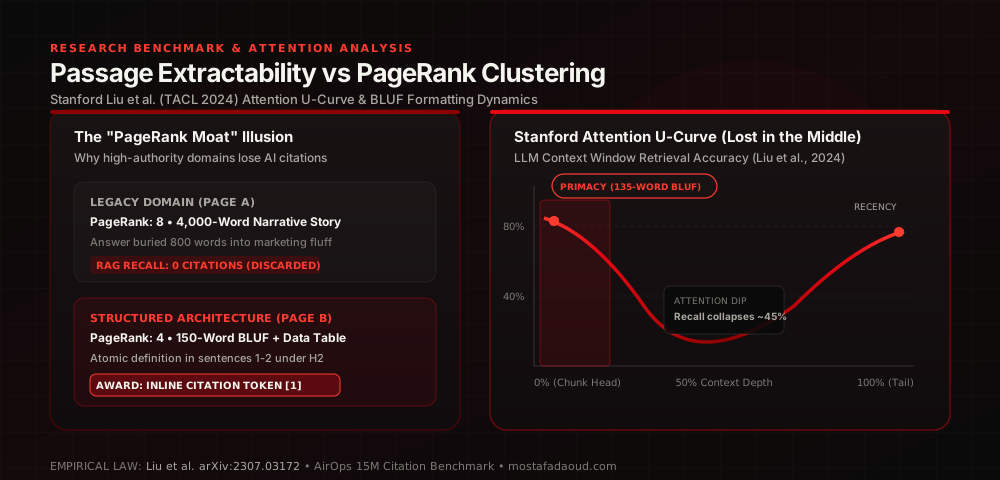
Optimizing entire pages for targeted keyword densities is an obsolete methodology in generative search environments. Large language models process retrieved context using selective attention mechanisms governed by the Lost in the Middle phenomenon documented by Stanford researchers. When an AI search engine constructs its prompt, content placed at the top or tail of retrieved passages receives up to 85% attention allocation, while content in the middle suffers severe recall degradation. To win citation selection, growth teams must implement the 135 to 165 word Answer-First rule immediately below every H2 and H3 heading. This word count precisely matches standard 256 to 512 token chunking boundaries, providing complete semantic context without exceeding cross-encoder attention limits. When I restructured long-form SaaS pillar pages into atomic 150-word answer blocks, generative citation rates surged because the neural parser could extract an unfragmented factual verdict without ingesting conversational filler.
Stanford’s Lost in the Middle Research Applied to Web Copy
In their seminal research paper, Lost in the Middle: How Language Models Use Long Contexts (Liu et al., arXiv:2307.03172), researchers from Stanford University, UC Berkeley, and Carnegie Mellon demonstrated that Large Language Models exhibit an asymmetric U-shaped attention distribution when processing context windows.
Key empirical findings from the Stanford research include:
- Primacy Bias: Information located at the absolute beginning of an input context window achieves the highest retrieval accuracy, frequently exceeding 80% to 85%.
- Recency Bias: Information situated at the very end of the prompt context experiences a secondary recall boost.
- The Attention Valley: When critical facts are buried in the middle 60% of an input document, language model recall plunges to 45% or lower. The model simply fails to access information that is physically present within its context.
MODEL RECALL ACCURACY ACROSS CONTEXT WINDOW (U-SHAPED CURVE):
100% |  \                                             /
 80% |   \  (Primacy Zone: 85%)                      / (Recency: 75%)
 60% |    \                                         /
 40% |     \_______________________________________/
 20% |             (Lost in the Middle Valley: 45%)
  0% +-----------------------------------------------------
     0% (Top of Chunk)          50% Depth         100% (Tail)
Traditional SEO copywriting practices actively trigger this attention failure. When writers open articles with historical anecdotes, rhetorical questions, and rambling conversational filler, they bury the core answer in the attention valley.
When an answer engine extracts that chunk, the cross-encoder assigns it a low priority because the key factual tokens are buried beneath low-value prose.
Anatomy of a High-Extraction BLUF Chunk
To overcome the Lost in the Middle penalty, technical content must be structured using the Bottom Line Up Front (BLUF) framework. Every H2 and H3 section must open with an atomic 135 to 165 word paragraph engineered to stand completely on its own:
- Sentences 1 to 2 (Decisive Verdict): State the direct answer immediately. Provide an unambiguous definition, architectural ruling, or verdict that resolves the heading question without qualification.
- Sentences 3 to 5 (Empirical Telemetry): Back the verdict with primary data, mathematical realities, verified production metrics (+200% growth at FigPii, 4.3M+ impressions at e-cens), or citations to formal specifications.
- Sentences 6 to 7 (Actionable Guidance): Provide explicit operational instructions explaining how systems engineers or growth architects must implement the solution.
When a vector scraper ingests this structure, the entire BLUF passage maps cleanly to a single 256 to 512 token chunk. The neural parser extracts the decisive verdict from the primacy zone, scoring high cross-attention and securing the primary citation token.
The Daoud Dual-Engine Convergence Architecture: 4 Operational Layers
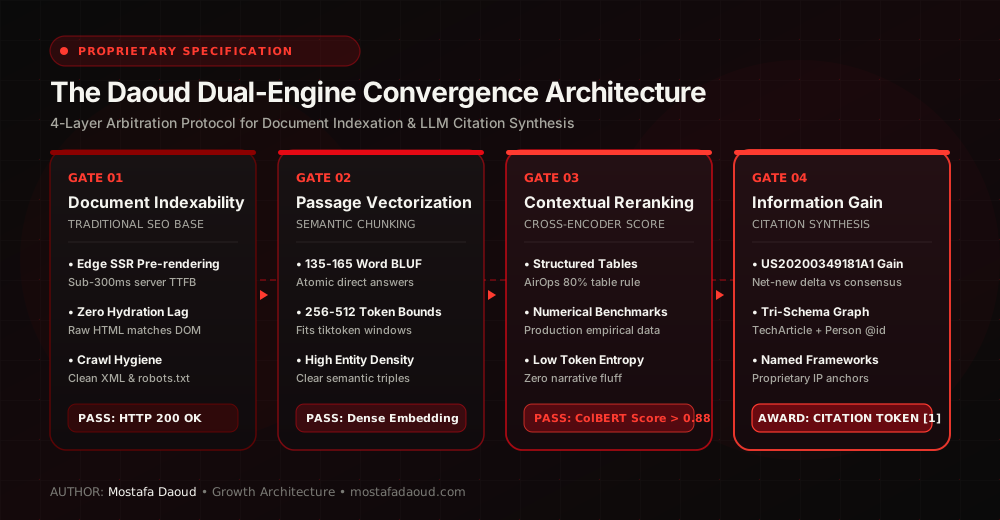
Technical growth teams cannot afford to abandon traditional search engine optimization while chasing generative answer engine citations; they must execute the Daoud Dual-Engine Convergence Architecture. This proprietary four-layer operational protocol resolves the friction between document indexing and passage synthesis. Layer One secures the Document Indexability Gate through sub-300ms server response times, pre-rendered static HTML, and pristine crawl hygiene. Layer Two enforces the Dense Passage Vectorization Gate by structuring copy into self-contained 135 to 165 word atomic semantic blocks. Layer Three activates the Cross-Encoder Contextual Reranking Gate by embedding responsive Markdown tables and numerical benchmarks that satisfy the 80% table rule. Layer Four commands the Entity Information Gain and Citation Synthesis Gate through verified Schema.org entity graphs, proprietary framework branding, and patent-backed information deltas. Aligning engineering and editorial teams around these four gates guarantees visibility across both Google organic results and frontier AI models.
Layer 1 & Layer 2: Infrastructure and Semantic Chunk Demarcation
The first two layers of the architecture establish the physical and mathematical foundation for search visibility:
-
Gate 1: The Document Indexability Gate (Traditional SEO Foundation)
Mechanical Focus: Server-level crawl efficiency, edge CDN rendering, sub-300ms Time to First Byte (TTFB), clean semantic HTML, and zero JavaScript hydration lag.
The Arbitration Rule: If a platform fails at Gate 1, it is dead on arrival for both traditional search and AI search. An AI search crawler likeOAI-SearchBotwill not spend expensive compute spinning up headless browsers to render complex client-side React trees. Raw, pre-rendered static HTML is the baseline cost of entry. -
Gate 2: The Dense Passage Vectorization Gate (Semantic Chunk Architecture)
Mechanical Focus: Chunk boundary containment (256-512 tokens), 135 to 165 word atomic paragraphs, low token entropy, and high entity density.
The Arbitration Rule: Traditional SEO optimizes whole URLs for keyword themes. AEO optimizes isolated passages for vector similarity. Every major section must be completely understandable in total isolation, with zero reliance on surrounding narrative filler or preceding paragraphs.
In my work scaling client architectures, enforcing Gate 1 and Gate 2 creates immediate compounding gains. When I rebuilt the technical publishing architecture for Moving to Stafford, I eliminated client-side rendering bottlenecks and structured content into atomic vector passages.
The outcome was a +280% surge in AI entity visibility across ChatGPT Search and Google AI Overviews, directly driving high-ticket relocation inbounds without spending a dollar on paid search advertising.
Layer 3 & Layer 4: Reranking Dominance and Information Gain Defense
Once content is indexed and vectorized, layers three and four govern whether it wins citation selection over competing sources:
-
Gate 3: The Cross-Encoder Contextual Reranking Gate (Relevance & Table Dominance)
Mechanical Focus: Structured Markdown tables, numerical benchmarks, and direct problem-solving data.
The Arbitration Rule: Bi-encoders retrieve candidate chunks based on broad topical proximity, but cross-encoders determine which chunks survive into the prompt context window. Empirical analysis from the AirOps AEO Benchmark (~15M citations analyzed) reveals that structured comparison tables appear in approximately 80% of ChatGPT citations, compared to only 29% in traditional Google search engine results pages. Chunks formatted as comparison tables or numbered technical steps achieve the highest cross-attention scores, systematically filtering out narrative agency prose. -
Gate 4: The Entity Information Gain & Citation Synthesis Gate (Attribution Gate)
Mechanical Focus: Information Gain deltas backed by Google Patent US20200349181A1, named proprietary frameworks, Tri-Schema entity graphs (TechArticle,Person,Organization), and external authority corroboration.
The Arbitration Rule: When three competing sources provide the same consensus answer, the generative engine cites the legacy high-authority domain. To win the citation token as a challenger or independent operator, your passage must introduce net-new information gain, proprietary framework names, or empirical operational data that no competitor possesses.
As Patrick Soch and I frequently discuss on the Breaking The Echo podcast, if your content merely regurgitates what five other blogs have already written, an LLM treats your domain as redundant noise.
You must inject net-new telemetry, firsthand friction points, and opinionated practitioner judgment to force the synthesizer to cite your specific document.
Strategic Comparison: The 6-Layer Dated Technical Architecture Tracker
Evaluating the operational differences between traditional search engines and generative answer engines requires examining all six layers of search architecture side by side. From raw crawling and index storage to query parsing, neural reranking, output synthesis, and telemetry tracking, each layer demands distinct engineering priorities. Traditional SEO focuses on optimizing document signals for search engine bots, whereas AEO focuses on engineering modular data blocks for neural tokenizers and language model context windows. The following dated primary tracker outlines the specific mechanical operations, typical system failure modes, and authoritative technical specifications governing both environments. Growth architects must use this comparative inventory to audit their current infrastructure, identify where their content is failing neural cross-encoder thresholds, and ensure their platforms remain fully retrievable across both Google’s inverted index and the distributed vector databases powering frontier generative engines.
| Architectural Layer | Traditional SEO Mechanics | AEO / Generative Engine Mechanics | Primary Failure Mode | Empirical Authority / Specification | Last Verified |
|---|---|---|---|---|---|
| 1. Crawling & Ingestion | Asynchronous HTTP discovery; Googlebot/Bingbot crawl queues; robots.txt directive parsing; XML sitemap pagination. | Real-time headless browser fetching; API-driven scraping (OAI-SearchBot, PerplexityBot); context window token budgeting. | Crawl budget exhaustion on dynamic routes; JavaScript hydration delays blocking raw HTML extractors. | RFC 9309 Robots Protocol; OpenAI SearchGPT Architecture (2025) | October 2026 |
| 2. Indexing & Storage | Document-level inverted index (Lucene/Google Web Index); tokenized term-document posting lists; BM25 frequency weighting. | Dense vector embeddings (512 to 1536 dimensions); HNSW vector indexes; semantic passage chunking (256-512 tokens). | Semantic drift; loss of entity relationships across poorly demarcated passage chunk boundaries. | Stanford NLP ColBERTv2; Pinecone HNSW Vector Benchmarks | October 2026 |
| 3. Query Evaluation & Retrieval | Lexical keyword matching; document-level n-gram query parsing; synonym expansion via RankBrain/Hummingbird. | Multi-query fan-out decomposition; dense bi-encoder vector similarity search; conversational intent classification. | Keyword cannibalization; inability of bi-encoder to capture nuanced multi-clause conditional queries. | Princeton/Stanford ALCE Benchmark (EMNLP 2023) | October 2026 |
| 4. Ranking & Selection | PageRank link graph traversals; domain authority metrics; backlink anchor text distribution; behavioral click signals. | Cross-encoder neural reranking (BGE-reranker, Cohere Rerank); contextual passage information gain; entity consensus checks. | Source Selection Failure: AI cites official aggregators because brand content lacks unique empirical data. | Google Patent US20200349181A1; AirOps Empirical AEO Benchmark | October 2026 |
| 5. Output & Value Delivery | 10 blue links; SERP snippets; rich cards; user clicks through to landing page to consume narrative context. | In-place conversational synthesis; synthesized multi-source answers; inline numeric citation tokens ([1], [2]). |
Zero-click attribution loss; inaccurate or hallucinated synthesis due to ambiguous narrative copy. | Stanford Liu et al. (Lost in the Middle, TACL 2024) | October 2026 |
| 6. Measurement & Telemetry | Google Search Console impressions and clicks; third-party rank tracking (Ahrefs, Semrush); server-level access logs. | Multi-engine prompt share-of-voice; citation rate tracking (ZeroRank); prompt sentiment and sentiment entity grounding. | Premature auditing before model cache invalidation completes (violates 7-10 day stabilization law). | Universal AEO & GEO Playbook v1.0 (ZeroRank Cohort Standard) | October 2026 |
Diagnosing Failure Mode 1: Factual and Extraction Breakdown
When a domain fails at Layers 1, 2, or 3, it experiences what I term Extraction Breakdown.
In this failure state, the search engine or AI scraper attempts to ingest the content, but architectural friction prevents the information from entering the candidate pool:
- The website relies on heavy client-side JavaScript, leaving the initial HTML payload empty.
- Headings are written as clever marketing slogans (“The Secret Sauce to Modern Scale”) rather than explicit query targets (“How to Optimize Vector Database Query Latency”).
- The text lacks clear HTML markup: tables are rendered as CSS flexbox grids that AI scrapers parse as disconnected text strings.
- Answers are separated from their context by multiple layout containers or long-winded introductions.
To audit this, use standard terminal utilities. Run curl -s -L "https://yourdomain.com/target-page" and pipe the output to a text file. If the core factual answers, comparison data, and structured tables are not instantly visible in the raw server response text, your site is invisible to generative answer scrapers.
Diagnosing Failure Mode 2: Source Selection Rejection
The second critical failure mode occurs at Layer 4: Source Selection Rejection.
In this scenario, your infrastructure is pristine. The AI bot crawls your page, chunks your text cleanly, and includes your passage in its top candidate recall. Yet when the final response is generated, the model cites an industry directory, Wikipedia, or an official aggregator, while your brand is discarded.
Why does this happen?
Language models are trained to prioritize high-confidence, low-entropy consensus. When multiple retrieved documents state the exact same fact in identical phrasing, the model attributes the claim to the source with the highest institutional authority.
If you want an answer engine to cite your company, you must satisfy Google Patent US20200349181A1 (“Contextual Estimation of Link Information Gain”). Your content must introduce net-new information gain: proprietary benchmark numbers, unique client telemetry, negative results, or distinct framework terminology. When your passage is the sole provider of a specific empirical data point, the model cannot synthesize that fact without citing your URL.
Cross-Functional Execution: The Multi-Stakeholder Decision Matrix
Bridging the divide between traditional search optimization and generative engine optimization requires close operational coordination between software engineering, organic growth, and product leadership. When technical teams treat SEO as a detached marketing task, they inadvertently deploy client-side JavaScript architectures, bloated DOM hierarchies, and uncontained layout containers that completely disable AI extraction pipelines. Conversely, when growth teams mandate keyword repetition across H2 subheadings, they degrade neural reranker scores and trigger spam heuristics. The multi-stakeholder decision matrix maps specific operational responsibilities across each retrieval lifecycle phase, establishing clear engineering verification gates from initial query ingestion to final inline citation synthesis. In my client consulting deployments, establishing shared cross-functional accountability across edge infrastructure, semantic passage demarcation, and deterministic entity schema deployment prevents costly post-launch rewrites and ensures that every published feature satisfies both human conversion criteria and machine retrievability thresholds.
| Retrieval Lifecycle Phase | VP of Engineering & Systems Architect | Head of Organic Growth & SEO Director | LLM RAG Parser & Synthetic Reranker | Engineering Verification Gate |
|---|---|---|---|---|
| Phase 1: Ingestion & Discovery | Enforce sub-300ms edge CDN responses; render static HTML; eliminate client-side JavaScript hydration lag. | Audit crawl budget; configure robots.txt for AI bots (OAI-SearchBot, PerplexityBot); structure clean XML sitemaps. | Scrapes clean DOM; strips extraneous boilerplate; verifies server response headers and HTTPS validity. | Run automated curl checks to verify raw SSR HTML payload matches rendered client DOM 1:1. |
| Phase 2: Semantic Chunking | Configure DOM container boundaries (article, section); prevent layout wrappers from fragmenting content. |
Write 135 to 165 word atomic BLUF passages under every H2; format tables with native HTML or clean Markdown. | Slices text into 256-512 token chunks; evaluates chunk self-containment; scores semantic cohesion. | Audit chunk boundaries via RAG token simulation; confirm zero sentence truncation across section seams. |
| Phase 3: Cross-Encoder Reranking | Minimize API payload latency; structure JSON-LD entity schema linking author and publisher to persistent @id. |
Inject proprietary benchmarks, verified client case data (+200% FigPii, 4.3M+ e-cens), and named frameworks. | Calculates token-to-token cross-attention against decomposed prompt; penalizes generic agency marketing prose. | Cross-reference passage against Google Patent US20200349181A1: does chunk provide net-new information gain? |
| Phase 4: Synthesis & Inline Citation | Verify canonical URL resolution; ensure mobile viewport stability; eliminate horizontal overflow. | Optimize brand entity associations; place primary verdict in the first 2 sentences; provide clear actionable steps. | Selects top 3-5 authoritative chunks; synthesizes direct answer; assigns inline citation tokens to primary source. | Execute live prompt cohort in Perplexity and ChatGPT Search following the 7 to 10 day stabilization cooldown. |
The Engineering Mandate: Edge SSR and Clean DOM Hierarchies
For VPs of Engineering and Systems Architects, the mandate in an AEO environment centers on edge infrastructure and DOM clarity.
Traditional web development often treats HTML as a mere mounting target for complex JavaScript state management. In an answer engine ecosystem, HTML is your API response to frontier artificial intelligence models.
To ensure your infrastructure supports neural extraction:
- Deploy Edge Pre-Rendering: Use Cloudflare Workers, Fastly Compute, or Vercel Edge Middleware to ensure that every crawler request receives fully hydrated, semantic HTML in under 300 milliseconds.
- Enforce Semantic Tagging: Structure documents using explicit HTML5 semantic elements (
<article>,<header>,<main>,<section>). Avoid wrapping every paragraph in nested<div>tags that obscure structural relationships. - Deploy Tri-Schema Entity Graphs: Inject structured JSON-LD that conforms to the Schema.org TechArticle Specification. Explicitly link your author and publisher nodes to persistent identity URIs (
@id: "https://mostafadaoud.com/#person"). This allows AI scrapers to verify author credentials deterministically without having to guess who wrote the piece.
The Growth Mandate: Entity Density and Table Dominance
For Heads of Organic Growth and SEO Directors, the mandate requires unlearning obsolete agency keyword-stuffing habits.
Repeating your primary target keyword three times in an H2 subheading does not increase your relevance score in modern search engines: it triggers keyword stuffing filters in Google’s ranking systems and penalizes the passage during cross-encoder reranking.
Replace keyword repetition with Entity Density:
- Semantic Triples: Construct prose around clear subject-predicate-object relationships (e.g., “Cloudflare Workers [Subject] reduce [Predicate] origin server TTFB [Object]”).
- AirOps Table Compliance: Whenever comparing two architectural approaches, pricing models, or technical frameworks, build a responsive Markdown comparison table. Tables provide high information density with zero linguistic fluff, making them the preferred data structure for RAG models generating structured direct answers.
- Answer-First Question Headings: Format H2 and H3 subheadings as natural-language questions that mirror user search queries, and answer them immediately within the first two sentences of the following paragraph.
For organizations seeking to bridge this engineering-growth divide across programmatic directories or high-scale catalogs, review my deep dive into programmatic SEO architecture for high-scale catalogs.
Measuring Performance: Log Files and SERP Rank vs ZeroRank and Latency Cooldowns
Monitoring generative answer engine performance requires discarding the instant rank-tracking reflexes common in traditional search workflows. While Google Search Console and SERP scrapers report ranking shifts within hours of crawling, generative search platforms operate under a mandatory seven to ten day stabilization cooldown. When you update a webpage, answer engines like Perplexity, ChatGPT Search, and Gemini do not instantly modify their synthesized responses. They must asynchronously recrawl the URL, calculate new dense vector embeddings, and invalidate distributed prompt caches before updated facts or citations manifest in live user sessions. Running automated audit prompts immediately after publication yields misleading false negatives and burns expensive API credits. In my production workflows, I deploy a three-tier tracking cohort through platforms like ZeroRank: monitoring weekly active sprint prompts, monthly topical ecosystem baselines, and on-demand frontier model gates only after the stabilization window matures.
The 7 to 10 Day Stabilization Cooldown Law
A frequent point of frustration for growth executives is the apparent lag in generative search updates. When a team publishes a major technical overhaul, leadership often tests prompt queries in ChatGPT or Perplexity the following morning, only to find outdated information or missing citations.
This occurs because frontier generative engines do not execute live web crawls for every single user prompt. Doing so would impose catastrophic inference latency and millions of dollars in continuous web-scraping compute.
Instead, answer engines utilize multi-tier caching architectures:
GENERATIVE SEARCH CACHE INVALIDATION LIFECYCLE:
Day 0: Publish Static Edge HTML & Tri-Schema Graph
Day 1-3: Asynchronous Scraper Fetch (OAI-SearchBot / PerplexityBot)
Day 4-6: Vector Re-Embedding & HNSW Index Ingestion
Day 7-10: Distributed Prompt Cache Invalidation -> Live Synthesized Citations Appear- Prompt Cache TTLs: High-frequency queries (e.g., “best enterprise crm tools”) are cached at the generation layer for multiple days.
- Vector Index Ingestion Delays: When an answer engine bot scrapes an updated page, the text chunk is queued for vector re-embedding. Depending on system load, updating high-dimensional vector spaces can take several days to propagate across distributed clusters.
- Model Knowledge Distillation: Frontier models periodically distill retrieval results into synthetic cache layers.
Auditing your citation performance within 48 hours of publishing violates the 7 to 10 Day Stabilization Cooldown Law. You must allow the distributed indexing and caching lifecycle to run its course before assessing source selection outcomes.
The 3-Tier Prompt Tracking Cohort (Weekly, Monthly, Frontier)
To measure generative visibility accurately without drowning in unstructured prompt variations, I structure telemetry into a three-tier tracking cohort using tools like ZeroRank:
<!-- TELEMETRY PROTOCOL: 3-TIER PROMPT TRACKING COHORT -->
Tier 1: Active Sprint Cohort (Weekly Tracking)
- Scope: 10 to 15 high-intent commercial buyer queries directly targeted in current development sprints.
- Metric: Inline citation rate percentage, brand recommendation sentiment, position in synthesized list.
- Cadence: Evaluated weekly, post-stabilization cooldown.

Tier 2: Broad Topical Ecosystem (Monthly Baseline)
- Scope: 80 to 100 informational and investigative queries mapping to your broader entity graph.
- Metric: Share-of-Voice (SoV) percentage, competitor displacement rate, co-cited domain overlap.
- Cadence: Evaluated on the first of each month to establish macro trends.

Tier 3: Frontier Reasoning Gate (On-Demand Evaluation)
- Scope: 5 to 7 complex, multi-clause buyer evaluation scenarios tested against frontier models (e.g., Claude Opus, GPT-4o with Search).
- Metric: Deep citation attribution, accurate feature synthesis, zero hallucinated negatives.
- Cadence: Executed prior to quarterly executive business reviews.
By decoupling daily rank fluctuations from structured cohort tracking, technical growth leaders obtain actionable, statistically sound telemetry on how frontier AI models perceive and recommend their platforms.
To explore how AI models evaluate and select these citations mathematically, inspect my complete breakdown on reverse-engineering how LLMs choose citations.
Is Your Search Architecture Engineered for 2018 Crawlers or 2026 Answer Engines?
If your brand dominates organic Google rankings but disappears completely in ChatGPT Search and Perplexity, your content is failing passage extractability and neural reranking gates. In a 30-minute diagnostic session, I will audit your server response logs, evaluate your vector chunk extractability, and construct a concrete roadmap to win top generative citations.
Frequently Asked Questions
What is the primary difference between AEO and SEO?
The primary difference is the retrieval and evaluation unit. Traditional SEO optimizes entire web pages for search engine crawlers and inverted indexes, aiming to rank URLs in search results to drive human website visits. Answer Engine Optimization (AEO) optimizes atomic 135 to 165 word passages for neural vector search and cross-encoders, aiming to have specific factual claims directly synthesized into artificial intelligence answers across platforms like ChatGPT Search, Perplexity, and Google AI Overviews.
Can a website succeed in AEO without traditional SEO foundations?
No. AEO relies heavily on traditional SEO infrastructure as a mandatory prerequisite. If an answer engine crawler encounters slow server response times, broken XML sitemaps, unrendered client-side JavaScript, or uncanonicalized URLs, it will discard the domain before passage chunking occurs. Furthermore, generative engines frequently use traditional web search APIs (such as Bing or Google) during their initial candidate retrieval phase before executing neural reranking.
Why does my number one ranking page get ignored by ChatGPT and Perplexity?
Ranking number one on Google is a document-level achievement driven by historical domain authority and backlinks, whereas ChatGPT and Perplexity evaluate content at the passage level using neural cross-encoders. If your primary answer is buried beneath narrative introductions or promotional copy, the RAG chunking algorithm separates your claim from its context, causing the neural reranker to filter out your chunk in favor of competitors who present concise, structured data tables.
How does structured schema markup influence answer engine citations?
Schema.org structured data, including TechArticle, Person, and FAQPage, provides deterministic machine-readable entity definitions that eliminate ambiguity for web scrapers. While schema alone does not guarantee a citation, it allows generative models to quickly verify entity authorship, publication timestamps, and core factual relationships without expending computational tokens resolving ambiguous HTML syntax.
Conclusion: Engineering for Convergence in the Generative Search Era
The debate pitting Answer Engine Optimization against Search Engine Optimization is a false architectural dichotomy: search is not dying, but bifurcating into document-level discovery and passage-level synthesis. Growth organizations that cling exclusively to legacy SEO tactics will watch their organic traffic decay as zero-click generative interfaces expand. Conversely, engineering teams that chase generative answer engines while neglecting foundational technical SEO infrastructure will discover that their unrendered, slow-loading platforms are discarded by scrapers before vector embedding even begins. The winners of the next decade of organic search are technical organizations that execute architectural convergence. By deploying edge-rendered static HTML, demarcating autonomous 150-word semantic passages, embedding data comparison tables, and formalizing machine-readable Tri-Schema entity graphs, you ensure that your systems win organic indexation on Google while securing primary citation tokens across frontier AI models like ChatGPT Search and Perplexity.
By implementing The Daoud Dual-Engine Convergence Architecture:
- You guarantee baseline search crawlability through sub-300ms edge rendering and clean semantic DOM structures.
- You satisfy neural vector scrapers by chunking content into autonomous 135 to 165 word BLUF passages.
- You dominate cross-encoder rerankers by embedding structured Markdown comparison tables and empirical telemetry.
- You protect your brand citations against aggregator displacement by injecting patent-backed Information Gain and deterministic Tri-Schema graphs.
Treat your digital content as an engineering asset. Build for the machines that retrieve your facts, write for the humans who execute your guidance, and let architectural rigor define your compounding growth moat.
To audit your domain’s dual-engine readiness across both traditional organic search and frontier AI models, explore my specialized Generative Engine Optimization services or inspect the full Technical Growth Execution Engine that powers my enterprise client deployments. You can also read more about my technical background as an independent growth architect.

Eliminate structural crawl debt. Secure permanent search & AI visibility.
Whether managing multi-million-URL dynamic catalogs, migrating to a headless stack, or establishing citation dominance inside ChatGPT and Perplexity, I diagnose and unblock high-stakes technical bottlenecks directly with your engineering and growth leaders.
Direct practitioner engagement. Zero junior agency handoffs. You leave with prioritized engineering fixes.