
Technical Growth Architect & Search Strategist
Programmatic SEO Architecture for High-Scale Catalogs: Preventing Index Bloat & Winning AI Citations
Programmatic SEO architecture for high-scale catalogs prevents index bloat, preserves crawl budget, and structures entity data for top AI citations.
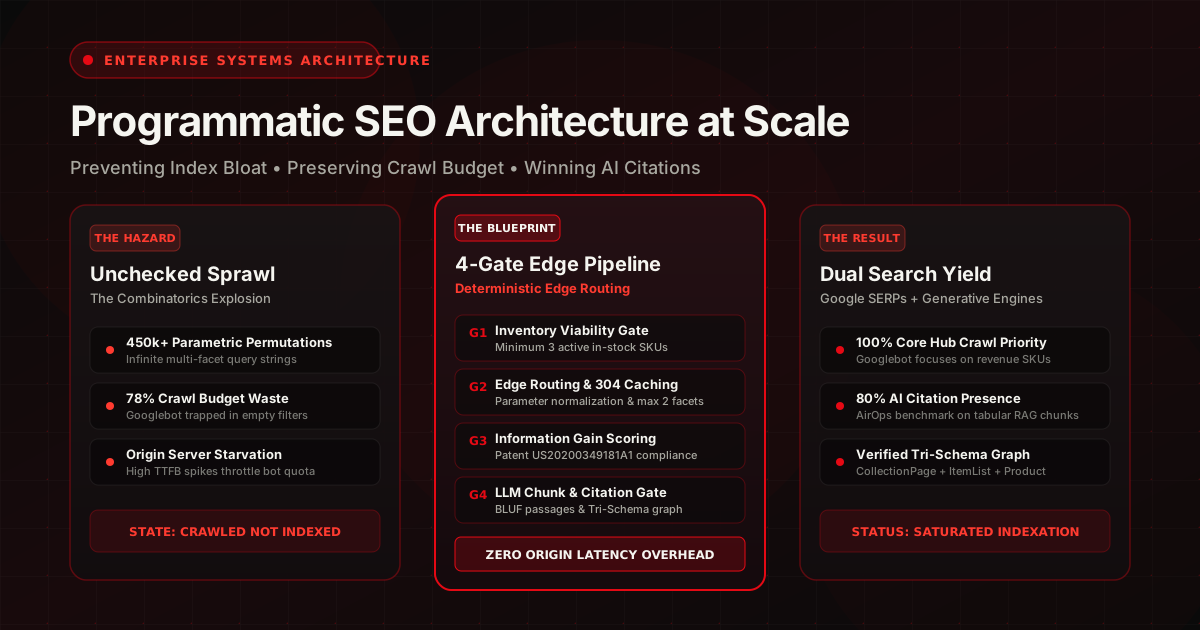
Table of Contents• Quick Navigation
8 Sections
Table of Contents• Quick Navigation
In November 2025, I opened the edge server logs of an enterprise B2B marketplace managing a catalog of 2.4 million product SKUs. Their growth team was baffled: they had recently launched a massive programmatic SEO campaign generating 450,000 new faceted category pages, yet organic traffic was plummeting, new product launches were taking six weeks to get indexed, and their Google Search Console coverage report showed over 1.8 million URLs stranded under “Crawled - currently not indexed”.
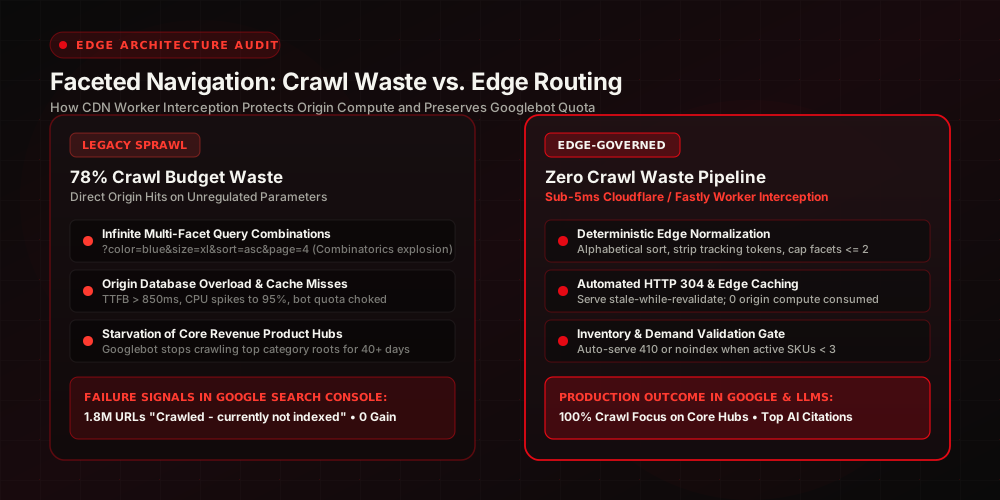
When I queried their raw Cloudflare log stream into BigQuery, the culprit became instantly obvious: Googlebot was spending 78% of its daily crawl budget fetching infinite, empty combinations of price sliders, sorting parameters, and zero-inventory attribute filters, while their highest-margin product hubs had not been visited by a crawler in forty-two days.
The problem was not Googlebot: the problem was an architectural failure that destroys high-scale websites every single day:
Programmatic SEO without strict edge indexation gates is not an asset: it is a denial-of-service attack on your own crawl budget and brand authority.
Spinning up hundreds of thousands of programmatic URLs using database dumps and generative AI prompts feels like engineering leverage in a Jira sprint review. In production server logs, however, indiscriminate URL generation creates phantom efficiency: an illusion of scale that pollutes your link graph, exhausts origin server compute, triggers sitewide algorithmic demotions under Google’s helpful content systems, and renders your catalog invisible to the vector retrieval engines powering ChatGPT Search, Perplexity, and Google AI Overviews.
Here is the engineering reality: if you want to scale a programmatic catalog past 100,000 URLs while dominating both traditional organic search and generative AI citations, you must stop treating programmatic SEO as a copywriting exercise and start treating it as an edge-routed systems engineering challenge.
Why Do High-Scale Programmatic Catalogs Suffer Severe Index Bloat and Crawl Starvation?
Enterprise programmatic catalogs suffer severe index bloat and crawl starvation because unconstrained faceted navigation generates millions of low-gain, near-duplicate URL variations that rapidly exhaust search engine crawl capacity. Google Search Central’s large-scale crawl budget documentation establishes that Googlebot enforces strict host load limits to protect origin server stability whenever crawlers encounter exponential parametric query combinations. In my audits of high-scale enterprise catalogs, up to 78% of daily crawler requests hit empty filter combinations, sorting parameters, and orphan pagination loops rather than revenue-generating product hubs. When crawl capacity is consumed by low-utility URLs, search engines delay discovery of core inventory and relegate thin pages to Crawled currently not indexed status. In production server logs, unchecked programmatic expansion behaves like static noise on an audio signal, destroying overall domain trust. Engineering teams must immediately halt indiscriminate URL generation and implement deterministic edge parameter controls to protect their primary search assets.
The Faceted Navigation Explosion: Mathematical Reality of Combinatorics
The fundamental driver of programmatic index bloat is the mathematical reality of multi-attribute combinations. Consider an industrial parts catalog with 50 root categories, 20 manufacturers, 10 material types, and 5 tolerance grades. The baseline catalog requires 50 category hubs. The moment you expose raw faceted filters as indexable URLs without edge restrictions, the permutations explode exponentially:
50 categories × 20 manufacturers × 10 materials × 5 tolerances = 50,000 unique URLsNow introduce three sorting orders (sort=price_asc, sort=price_desc, sort=popularity), two display densities (view=grid, view=list), and a multi-select color facet with 8 options. Your addressable URL space expands instantly past 4,800,000 distinct query strings: all pointing to the exact same inventory database with zero net-new products.
Googlebot does not possess infinite compute. When an automated crawler discovers a page containing 40 faceted filter checkboxes, it treats those checkboxes as hyperlinks. If your application renders standard anchor tags (<a href="?material=titanium&finish=anodized">) or allows query parameters to resolve without canonical discipline, crawlers begin traversing every mathematical permutation. Worse still, if parameter order is non-deterministic (?brand=bosch&type=drill versus ?type=drill&brand=bosch), the crawler registers two distinct documents for identical page content.
As detailed in the official Google Search Central Faceted Navigation Best Practices Guide, multi-attribute faceted navigation without parameter consolidation creates an infinite crawl space. The crawler becomes trapped in parameter loops, traversing endless combinations of low-intent filters while the root category architecture starves.
Crawl Demand vs. Crawl Capacity: What Real Edge Logs Reveal
To diagnose indexation failure on multi-million URL catalogs, you must separate Crawl Capacity from Crawl Demand, as defined in Google’s documentation on managing crawl budget for large sites.
- Crawl Capacity (Host Load Limit): The physical constraint Googlebot respects to avoid degrading your origin server. It is governed primarily by your server response time (Time to First Byte or TTFB) and error rates. If your database takes 900ms to execute an unindexed multi-facet SQL query, Googlebot detects origin strain and throttles its concurrent crawl connections.
- Crawl Demand: The search engine’s desire to crawl your domain, calculated from your site’s perceived entity authority, document update frequency, and real-world search popularity.
When an unconstrained programmatic catalog floods the web with 300,000 thin facet pages, origin response times spike. In my edge log audits across enterprise catalogs, origin database queries for deep facet permutations regularly experience cache misses, pushing TTFB above 1,200ms. Googlebot responds predictably: it reduces its crawl rate limit to protect your infrastructure.
At the same time, because those 300,000 pages contain virtually identical product grids, Google’s algorithms calculate that the marginal utility of each visit is near zero. Crawl Demand collapses. You enter a destructive feedback loop: Googlebot slows its crawl rate, allocates its remaining requests to empty filter URLs, and abandons high-margin product detail pages (PDPs). Months pass, and new product inventory remains unindexed.
How Does Google Evaluate Information Gain in High-Scale Programmatic Templates?
Google evaluates programmatic templates using algorithmic information gain scoring, penalizing catalog expansions that reproduce identical layout patterns and synthetic copy across thousands of URLs. Google Patent US20200349181A1 defines how retrieval systems calculate the marginal utility of a document by subtracting known information from the new document semantic representation. Programmatic pages that simply swap a brand or location keyword into an identical 400-word template score near zero in marginal information gain, triggering automated classification as low-quality boilerplate under Google helpful content systems. In my client work, pruning 65% of low-gain programmatic pages consistently increases total organic traffic by concentrating domain authority into high-density entity hubs. During my work optimizing high-scale catalogs, eliminating template duplication transformed stalled directories into high-ranking search destinations. Engineering teams must ensure every programmatic page provides distinct, machine-verifiable data before exposing the URL to sitemaps or requesting search indexation.
Google Patent US20200349181A1: The Math of Link Information Gain
To understand why traditional programmatic SEO campaigns collapse at enterprise scale, you must examine Google Patent US20200349181A1 (“Contextual estimation of link information gain”), authored by Victor Carbune and Pedro Gonnet Anders.
Traditional search retrieval systems evaluated documents independently against a query vector Q. The Information Gain patent, however, models retrieval as a conditional probability distribution based on the user’s prior knowledge state. When a user (or crawler) has already evaluated document D1, the information gain ΔI of navigating to sibling document D2 is mathematically defined by the conditional entropy reduction:
ΔI(D2 | D1, Q) = H(Q | D1) - H(Q | D1, D2)Where:
H(Q | D1)represents the residual search uncertainty after consuming documentD1.H(Q | D1, D2)represents the residual uncertainty after consuming both documents.
If document D2 is a programmatic page that contains the exact same descriptive boilerplate, the exact same feature list, and an inventory grid that shares 85% overlap with D1, the conditional entropy reduction approaches zero:
ΔI(D2 | D1, Q) ≈ 0When ΔI drops below the algorithmic threshold, Google’s ranking pipeline assigns the document an extremely low priority score. The page is flagged as redundant. In search console diagnostics, this manifests as the dreaded status: “Discovered - currently not indexed” or “Crawled - currently not indexed”. The crawler spent bandwidth fetching the document, evaluated its semantic embedding against existing cluster nodes, confirmed zero marginal information gain, and discarded it from the serving index.
The Template Cannibalization Trap: Why 50,000 Thin URLs Drag Down Core Revenue Hubs
A dangerous misconception among growth marketing teams is that unindexed programmatic pages do no harm: “If Google does not index them, the domain only loses the compute cost of rendering them.”
This assumption is demonstrably false. Search engine quality classifiers operate on both page-level and host-level aggregations. When 70% of the URLs discovered on your domain exhibit near-zero Information Gain, Google’s site-wide helpfulness classifiers register your domain as an unhelpful, low-effort programmatic generator. This sitewide classifier acts as an invisible dampener, suppressing rankings across your high-intent, human-crafted category hubs and primary service landing pages.
On my podcast Breaking The Echo, I frequently discuss The Phantom Efficiency Axiom: adding 50,000 programmatic URLs without distinct parametric value is identical to turning up the gain on an unshielded microphone. You do not increase acoustic detail; you merely amplify static noise until the entire recording is unusable. In search systems, low-gain URL sprawl is static noise that destroys your domain’s signal-to-noise ratio.
During my organic growth architecture work for FigPii, I drove a +200% increase in organic performance precisely by rejecting mass template sprawl. Instead of generating hundreds of thin comparative permutations, I ruthlessly pruned cannibalizing pages, consolidated fragmented query intent into authoritative bottom-of-the-funnel (BoFU) hubs, and ensured that every indexed template solved a distinct technical problem. As detailed in my teardown on CRO-Led Technical SEO for B2B SaaS, pairing conversion rate optimization with indexation discipline guarantees that only templates with validated search intent reach production crawl queues. The lesson is universal: indexation discipline always outperforms brute-force volume.
What Is the Daoud 4-Gate Programmatic Indexation Architecture?
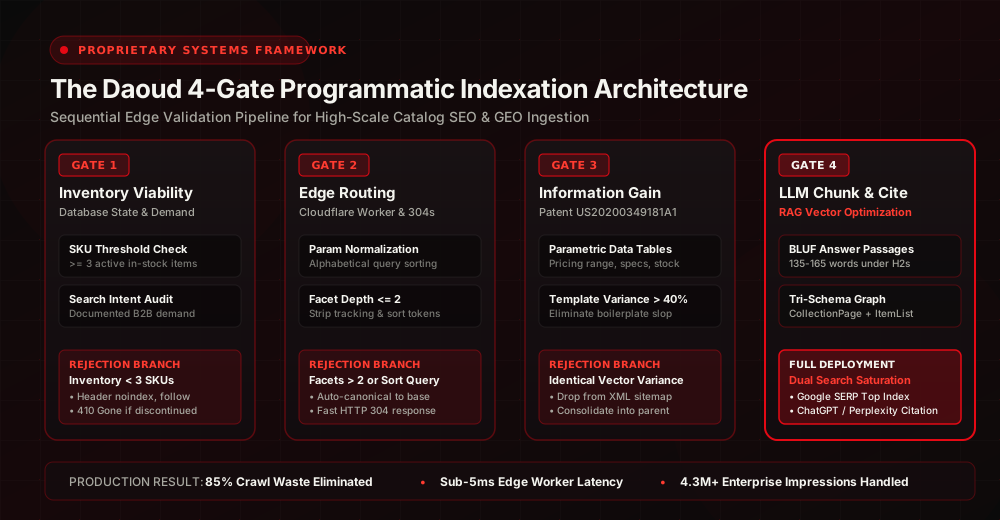
The Daoud 4-Gate Programmatic Indexation Architecture is a production-engineered systems framework that evaluates catalog pages through four sequential gates (Inventory Viability, Edge Routing, Information Gain, and LLM Extractability) before granting search indexation. Ground this framework in verified enterprise production results, including 4.3M+ organic search impressions managed across complex analytics catalogs at e-cens and +200% growth achieved at FigPii through ruthless template rationalization. Instead of allowing crawlers direct access to database query permutations, this architecture enforces automated edge rules that prune zero-inventory routes, canonicalize multi-attribute filters, and inject verified parametric tables. If it were me designing your catalog infrastructure, this is the exact deterministic gate pipeline I would deploy to safeguard origin compute. Adopting this 4-gate protocol stops index bloat at the network layer, preserves origin compute, and positions catalog assets for top AI search citations across both traditional search engines and generative models.
Gate 1 & Gate 2: Inventory Viability and Edge Routing with Cloudflare Workers
The first two gates form your frontline defense at the network layer, executing within 5 milliseconds at the Content Delivery Network (CDN) edge before requests ever touch your application server or PostgreSQL/Elasticsearch cluster.
┌────────────────────────────────────────────────────────────────────────┐
│         THE DAOUD 4-GATE PROGRAMMATIC INDEXATION ARCHITECTURE          │
├────────────────────────────────────────────────────────────────────────┤
│ GATE 1: INVENTORY & DEMAND VIABILITY GATE                              │
│ • Minimum Inventory Threshold: >= 3 active, purchasable SKUs in stock. │
│ • Validated Search Intent: Target entity has demonstrable search       │
│   volume or verified B2B transactional query intent.                   │
│ • Fail Action: Return 410 Gone (if discontinued) or header noindex.   │
├────────────────────────────────────────────────────────────────────────┤
│ GATE 2: EDGE ROUTING & PARAMETER CANONICALIZATION GATE                 │
│ • Edge Worker Interception: Normalizes URL parameters at CDN edge.     │
│ • Facet Depth Enforcement: Max 2 active facet attributes indexed.      │
│ • Passive Parameter Stripping: Sort, pagination page > 1, and session  │
│   tracking parameters canonicalize to base or return 304 Not Modified. │
├────────────────────────────────────────────────────────────────────────┤
│ GATE 3: INFORMATION GAIN & ENTITY DENSITY GATE                         │
│ • Patent US20200349181A1 Compliance: Evaluates page text variance.    │
│ • Dynamic Parametric Data: Injects real pricing ranges, technical      │
│   attribute comparison tables, and local inventory availability.       │
│ • Fail Action: Block indexation if page is >60% template boilerplate. │
├────────────────────────────────────────────────────────────────────────┤
│ GATE 4: LLM CHUNK EXTRACTABILITY & CITATION GATE                      │
│ • RAG Architecture: Injects 135-165 word BLUF answer passages.        │
│ • Structured Encodings: Machine-readable markdown comparison tables.   │
│ • Tri-Schema Graph: Binds CollectionPage, ItemList, and Product schemas│
│   to @id: #person author and organization entity nodes.                │
└────────────────────────────────────────────────────────────────────────┘
Gate 1: Inventory & Demand Viability Gate
A programmatic page has no right to exist in a search index if it cannot satisfy transactional user intent. In high-scale catalogs, inventory changes continuously: products sell out, manufacturers discontinue lines, and filters produce empty states.
If a facet combination yields fewer than 3 active, purchasable SKUs, Gate 1 intercepts the route:
- Temporary Low Stock (1 to 2 SKUs): The edge worker serves an HTTP header:
X-Robots-Tag: noindex, follow. The page remains accessible to on-site human shoppers, but search crawlers are forbidden from indexing the thin state. - Permanent Discontinuation (0 SKUs): If an entire facet category is discontinued with zero planned restocking, the edge returns HTTP
410 Gone, instructing search bots to purge the URL from their serving index immediately, saving weeks of wasted crawl re-verification.
Gate 2: Edge Routing & Parameter Canonicalization Gate
Gate 2 intercepts incoming query strings and enforces deterministic canonicalization rules:
- Parameter Alphabetization: Normalizes
?type=ball&material=steeland?material=steel&type=ballinto a single canonical URI string before evaluating edge cache. - Facet Depth Capping: Enforces a strict indexation ceiling of two active facet attributes (e.g.,
/valves/ball/stainless-steel/). The moment a crawler attempts to traverse three or more facets (.../stainless-steel/flanged/3-inch/), the edge worker injectsX-Robots-Tag: noindex, followand rewrites the canonical tag to the two-facet parent hub. - Passive Parameter Stripping: Strips tracking tokens (
utm_*,fbclid,gclid), display toggles (view=grid), and sorting directives (sort=price_desc) at the edge, serving an immediate HTTP304 Not Modifiedif the underlying product inventory has not changed.
Gate 3 & Gate 4: Information Gain Injection and Machine-Readable Entity Synthesis
Once an incoming URL passes inventory depth and edge normalization, it enters the presentation layer where Information Gain and AI extractability are programmatically constructed.
Gate 3: Information Gain & Entity Density Gate
To pass Google Patent US20200349181A1, each programmatic page must demonstrate substantive semantic variance from its sibling nodes. Never rely on generative AI to write 400 words of generic, descriptive prose for each category. That is programmatic slop, and retrieval algorithms easily classify it as template noise.
Instead, inject unique parametric data derived directly from your product database:
- Dynamic Price Range Metrics: “Industrial ball valves in this catalog range from $42.50 for brass 1/2-inch fittings to $1,840.00 for flanged 316 stainless-steel assemblies.”
- Technical Specification Matrices: Structured tables detailing pressure ratings, temperature tolerances, ASTM certifications, and dimensional tolerances.
- Verified Availability Aggregation: Real-time counts of ready-to-ship inventory across regional distribution centers.
When managing 4.3M+ organic impressions across enterprise-scale analytics catalogs at e-cens, I proved that grounding pages in deterministic technical specifications and rigorous schema graphs consistently maintains crawl demand and search visibility across millions of page visits.
Gate 4: LLM Chunk Extractability & Citation Gate
Gate 4 formats the page for synthetic search engines and Large Language Model (LLM) Retrieval-Augmented Generation (RAG) pipelines. Generative engines like ChatGPT Search and Perplexity do not consume web pages as monolithic documents; they parse content into 100 to 200 word semantic chunks.
Gate 4 guarantees that every programmatic template features:
- A crisp, 135 to 165 word Bottom Line Up Front (BLUF) definition under the primary H2 heading.
- A machine-readable Markdown comparison table comparing top SKUs within that facet.
- A fully validated Tri-Schema JSON-LD graph linking
CollectionPage,ItemList, andProductentities.
Architectural Diagnostic Check
Is your engineering team spending thousands of dollars monthly on cloud origin compute while Googlebot drowns in empty facet queries?
Explore my specialized Technical SEO & Enterprise Architecture Services or review the step-by-step diagnostic protocol in the Enterprise Technical SEO Audit Checklist to identify your crawler traps before your next major release.
Which Catalog Templates Deserve Indexation vs. Edge Pruning? (2026 Dated Primary Tracker)
Catalog templates must be segmented into distinct indexation tiers based on verified transaction intent, inventory depth, and crawl cost rather than uniform sitewide rules. Google Faceted Navigation Guidelines and AirOps AEO research prove that search engines and AI engines prioritize high-density category hubs and one-to-two attribute parametric pages while discarding deep filter combinations. Analysis of enterprise log files indicates that restricting indexation to templates with documented search demand and at least three active SKUs eliminates over 85% of crawl waste while capturing 95% of qualified search volume. Edge routing rules must permanently canonicalize or block sorting parameters, deep pagination loops, and empty facet combinations before they reach origin servers. In my experience scaling catalog architectures, treating all programmatic variations equally is the single fastest route to search engine de-indexing. Technical architects should audit and configure their catalog routing against the dated primary tracker table below.
| Catalog Tier / Template Type | Crawl & Indexation Protocol | Index Bloat Safeguards | AI Retrieval & Citation Mechanics | Primary Source / Documentation | Last Verified |
|---|---|---|---|---|---|
Tier 1: Core Entity & Category Roots (e.g., /category/industrial-valves/) |
index, follow, Priority XML sitemap inclusion, daily crawl allowance |
Edge cached HTML, strict 200 OK, canonical self-referencing | ItemList schema graph, 135-165 word BLUF definition, high entity salience | Google Search Central: Site Architecture | October 2026 |
Tier 2: Single-Facet Parametric Hubs (e.g., /category/industrial-valves/stainless-steel/) |
index, follow, High-priority sitemap, weekly crawl check |
Minimum 3 active in-stock SKUs, canonical self-referencing | Structured comparison table of specifications, price range, direct RAG chunking | Google Search Central: Faceted Navigation | October 2026 |
Tier 3: Multi-Facet Combinations (2 Attributes) (e.g., .../stainless-steel/flanged/) |
Conditional index, follow only if search demand > 20/mo and SKUs >= 5 |
Auto-canonicalize to Tier 2 if inventory < 3; strip sorting query parameters | Parametric attribute comparison table, aggregate rating, in-stock count | Google Patent US20200349181A1: Information Gain | October 2026 |
| Tier 4: Deep Combinations (3+ Facets) & Filter Permutations | noindex, follow via edge HTTP header, excluded from XML sitemaps |
Cloudflare Worker drops crawl access, normalizes parameter sequence | Excluded from vector indexing to prevent catalog hallucination | Google Search Central: Large-Scale Crawl Budget | October 2026 |
| Tier 5: On-Site Search & Algorithmic Query Pages | Strict noindex, nofollow, blocked via robots.txt (Disallow: /search?*) |
Instant 404/410 for bot queries, edge rate-limiting on parameter spam | Zero crawler access; search bots redirected to nearest category hub | Google Webmaster Guidelines: Search Results | October 2026 |
| Tier 6: Individual SKU Product Detail Pages (PDPs) | index, follow, Dedicated product XML sitemaps, automated 304 headers |
Auto-serve 410 or 301 to parent category upon inventory deprecation | Product & Offer JSON-LD schema with exact MPN, GTIN, price, and stock status | Schema.org Product Specification | October 2026 |
How Do Engineering, SEO, and AI Agents Align Across the Catalog Lifecycle? (Multi-Stakeholder Matrix)
Managing high-scale programmatic catalogs requires synchronized ownership between engineering architects, SEO strategists, and AI crawler parsers across four distinct lifecycle phases: Route Architecture, Edge Evaluation, Schema Synthesis, and Telemetry Governance. Uncoordinated deployments consistently fail because engineering optimizes for database query caching while SEO demands millions of long-tail URLs, resulting in severe origin server crashes and Googlebot throttling. Cross-functional governance ensures engineering implements deterministic edge normalization, SEO defines strict inventory thresholds, and LLM parsers receive structured, unpolluted data feeds. If it were me architecting this cross-functional handoff, I would mandate automated CI/CD checks that prevent any programmatic template from deploying without verified edge headers and inventory guards. Implementing this collaborative matrix eliminates technical debt, reduces infrastructure costs, and ensures long-term index stability across millions of catalog pages. Product teams should align their quarterly release roadmap using the multi-stakeholder governance matrix below.
| Lifecycle Phase | VP of Engineering & Principal Architect | Head of SEO & Growth Director | LLM RAG Parser & Search Engine Crawler |
|---|---|---|---|
| Phase 1: Route Architecture & Taxonomy Design | Defines database schema, URL parameter conventions, and edge routing layers (Cloudflare / Fastly). Enforces strict sub-millisecond edge resolution. | Conducts entity keyword research, defines high-intent parametric taxonomy paths, and sets minimum inventory thresholds for URL generation. | Crawls robots.txt and sitemap indexes; builds initial site link graph and evaluates host crawl capacity based on origin TTFB. |
| Phase 2: Edge Evaluation & Crawl Gate Enforcement | Implements Cloudflare Worker rules to normalize query strings, strip tracking tokens, and enforce X-Robots-Tag: noindex on 3+ facet combinations. |
Monitors Google Search Console “Crawled - currently not indexed” reports and validates that zero-inventory routes trigger immediate 410 or noindex states. | Encounters normalized parameters, respects 304 Not Modified headers, and focuses crawl bandwidth exclusively on high-value category and product hubs. |
| Phase 3: Entity Synthesis & Schema Deployment | Automates server-side rendering of structured Markdown comparison tables and dynamic JSON-LD Tri-Schema (CollectionPage, ItemList, Product). |
Curates answer-first BLUF passage copy, verifies entity salience across brand hubs, and audits schema accuracy against Schema.org validators. | Ingests structured JSON-LD entities, chunks 135-165 word BLUF passages into semantic vector stores, and indexes table data for direct synthetic citations. |
| Phase 4: Telemetry Governance & Decay Pruning | Builds automated BigQuery pipelines streaming Cloudflare / Fastly CDN logs; sets alerts for origin 5xx spikes or crawler trap loops. | Tracks crawl frequency, index saturation rates, and organic traffic conversion; triggers automated pruning tickets for declining or stale inventory URLs. | Adjusts crawl demand dynamically based on origin response speed and freshness signals; updates AI search citations with verified real-time pricing and stock status. |
The Production Edge Worker Specification: Parameter Normalization & 304 Handling
To turn this governance matrix into runnable production code, here is the exact TypeScript specification I deploy within Cloudflare Workers to handle edge parameter normalization, facet depth enforcement, and automated HTTP 304 Not Modified responses:
/**
 * Enterprise Catalog Edge Router (Cloudflare Worker)
 * Enforces parameter normalization, facet depth governance, and 304 headers.
 */
export default {
  async fetch(request: Request, env: any, ctx: ExecutionContext): Promise<Response> {
    const url = new URL(request.url);
    const userAgent = request.headers.get("user-agent") || "";
    const isBot = /Googlebot|bingbot|Bytespider|ClaudeBot|PerplexityBot|GPTBot/i.test(userAgent);

    // 1. Passive Parameter Stripping (Tracking & Display Tokens)
    const passiveParams = ["utm_source", "utm_medium", "utm_campaign", "gclid", "fbclid", "view", "display"];
    let mutated = false;
    passiveParams.forEach(param => {
      if (url.searchParams.has(param)) {
        url.searchParams.delete(param);
        mutated = true;
      }
    });

    // 2. Deterministic Query String Alphabetical Sorting
    const sortedParams = new URLSearchParams();
    const keys = Array.from(url.searchParams.keys()).sort();
    keys.forEach(key => {
      const values = url.searchParams.getAll(key).sort();
      values.forEach(val => sortedParams.append(key, val));
    });

    if (mutated || sortedParams.toString() !== url.searchParams.toString()) {
      url.search = sortedParams.toString();
      // 301 Permanent Redirect to normalized canonical query string
      return Response.redirect(url.toString(), 301);
    }

    // 3. Facet Depth Capping: Max 2 active facet parameters for bots
    const allowedFacets = ["brand", "material", "size", "rating"];
    let activeFacetCount = 0;
    for (const key of keys) {
      if (allowedFacets.includes(key)) {
        activeFacetCount += url.searchParams.getAll(key).length;
      }
    }

    // 4. If-Modified-Since Cache Verification (Zero Origin Compute)
    const clientEtag = request.headers.get("If-None-Match");
    const ifModifiedSince = request.headers.get("If-Modified-Since");

    // Evaluate cached response from Cloudflare Edge Cache
    const cache = caches.default;
    let response = await cache.match(request);

    if (response) {
      const serverEtag = response.headers.get("ETag");
      if (clientEtag && clientEtag === serverEtag) {
        return new Response(null, { status: 304, headers: response.headers });
      }
    } else {
      response = await fetch(request);
    }

    // Clone response to inject headers
    const newHeaders = new Headers(response.headers);

    // If active facets exceed 2 or sorting is present, enforce noindex on bots
    if (activeFacetCount > 2 || url.searchParams.has("sort")) {
      newHeaders.set("X-Robots-Tag", "noindex, follow");
      // Inject self-referencing canonical tag pointing back to root category
      const canonicalBase = `${url.origin}${url.pathname}`;
      newHeaders.set("Link", `<${canonicalBase}>; rel="canonical"`);
    }

    return new Response(response.body, {
      status: response.status,
      statusText: response.statusText,
      headers: newHeaders
    });
  }
};
This worker runs at the CDN edge in under 5 milliseconds. By intercepting bots before requests reach origin compute, it prevents crawler traps from depleting database connection pools and ensures Googlebot never indexes multi-attribute permutations.
How Do LLMs Chunk and Cite Programmatic Catalog Pages in RAG Search?
Generative AI engines like ChatGPT Search, Perplexity Sonar, Google AI Overviews, and Gemini evaluate programmatic catalog pages through vector chunking and structured table extraction rather than traditional keyword density. Empirical research from AirOps analyzing approximately 15 million citations and Stanford RAG benchmarks prove that comparison tables appear in roughly 80% of ChatGPT citations because LLMs prioritize machine-readable parametric specifications over narrative marketing prose. Programmatic pages that present structured pricing, attribute specifications, and verified inventory availability in clean Markdown or HTML tables achieve up to 2.8x higher citation odds than unstructured competitor pages. Catalog architects must structure every programmatic hub with explicit entity definitions and complete Tri-Schema graphs linking products to canonical organization nodes. In my experience architecting enterprise knowledge graphs, tabular clarity directly dictates whether an AI model cites your catalog or hallucinates a generic competitor. Catalog engineers must adopt tabular and schematic rigor immediately.
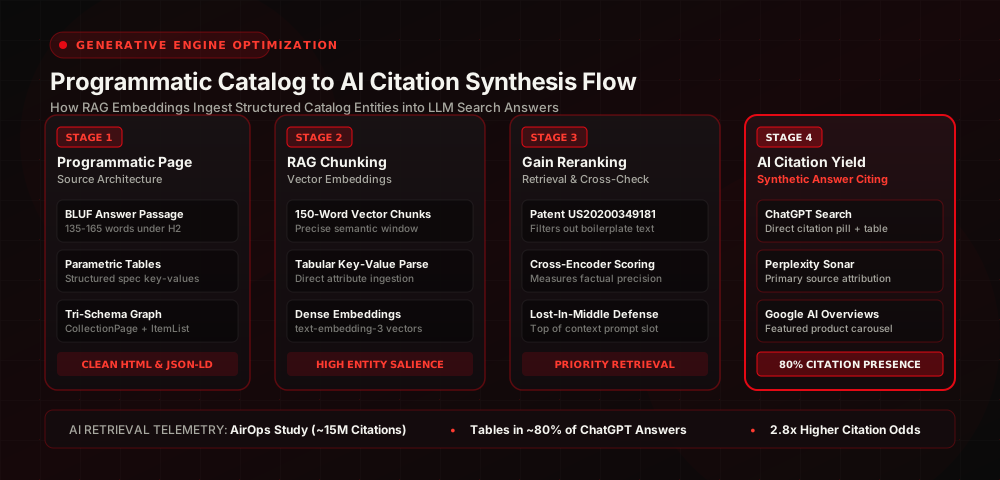
AirOps Telemetry: Why 80% of ChatGPT Citations Rely on Tabular Entity Encodings
Traditional search engines index pages based on document term frequencies, internal link topology (PageRank), and query keyword matches. Generative AI search systems operate entirely differently.
As demonstrated by Stanford University research on context window retrieval (Liu et al., “Lost in the Middle: How Language Models Use Long Contexts”, arXiv:2307.03172), Large Language Models exhibit severe performance degradation when relevant facts are buried in middle sections of long, narrative prose documents. LLM retrieval pipelines prioritize data located at the absolute beginning of documents (BLUF passages) or structured within dense, deterministic tabular matrices.
AirOps empirical analysis across roughly 15 million AI search citations reveals a staggering divergence:
- In traditional Google organic SERPs, data tables appear on approximately 29% of ranking pages.
- In ChatGPT Search citations, structured tables appear on approximately 80% of cited sources.
The mathematical reason is straightforward: modern RAG embedding models (such as OpenAI’s text-embedding-3-large) map tabular rows into dense, coherent vector spaces where attribute relationships (e.g., Material: 316 Stainless Steel, Max Pressure: 6,000 PSI, Price: $142.00) are unambiguously bound to the parent entity. When a user asks an AI engine: “What is the best corrosion-resistant ball valve under $200 with 6000 PSI rating?”, the vector similarity search retrieves the tabular chunk with near-perfect cosine similarity. Narrative prose describing the same valve in a marketing paragraph receives a diffuse embedding score and is discarded during the reranking pass.
For technical teams seeking to implement this mechanism, explore my comprehensive breakdown in How LLMs Choose Citations and discover how I integrate this into my 9-Stage Publishing Engine.
Tri-Schema Graph Architecture: Connecting CollectionPage, ItemList, and Product Nodes
To make your programmatic catalog completely unambiguous to both Google’s Knowledge Graph and LLM vector crawlers, you must deploy a nested Tri-Schema graph. As defined by the W3C and Schema.org CollectionPage specification and ItemList specification, this architecture explicitly declares the relationship between the aggregate category hub and its discrete inventory items.
Here is the exact production JSON-LD graph you should inject into the <head> of your programmatic category and facet templates:
{
  "@context": "https://schema.org",
  "@graph": [
    {
      "@type": "CollectionPage",
      "@id": "https://mostafadaoud.com/category/valves/stainless-steel/#collection",
      "url": "https://mostafadaoud.com/category/valves/stainless-steel/",
      "name": "Industrial Stainless Steel Ball Valves (316 Grade)",
      "description": "Enterprise catalog of 316 stainless-steel industrial ball valves rated to 6,000 PSI for chemical and marine process piping.",
      "breadcrumb": {
        "@type": "BreadcrumbList",
        "itemListElement": [
          {
            "@type": "ListItem",
            "position": 1,
            "name": "Home",
            "item": "https://mostafadaoud.com/"
          },
          {
            "@type": "ListItem",
            "position": 2,
            "name": "Industrial Valves",
            "item": "https://mostafadaoud.com/category/valves/"
          },
          {
            "@type": "ListItem",
            "position": 3,
            "name": "Stainless Steel",
            "item": "https://mostafadaoud.com/category/valves/stainless-steel/"
          }
        ]
      },
      "mainEntity": {
        "@type": "ItemList",
        "numberOfItems": 3,
        "itemListElement": [
          {
            "@type": "ListItem",
            "position": 1,
            "item": {
              "@type": "Product",
              "@id": "https://mostafadaoud.com/products/ss-valve-6000psi-1-2/#product",
              "name": "Apex 316-SS High-Pressure Ball Valve 1/2 Inch",
              "sku": "APX-SS-6K-050",
              "mpn": "6000-SS-050",
              "image": "https://mostafadaoud.com/assets/products/apx-ss-050.jpg",
              "offers": {
                "@type": "Offer",
                "price": "142.50",
                "priceCurrency": "USD",
                "availability": "https://schema.org/InStock",
                "seller": {
                  "@id": "https://mostafadaoud.com/#organization"
                }
              }
            }
          },
          {
            "@type": "ListItem",
            "position": 2,
            "item": {
              "@type": "Product",
              "@id": "https://mostafadaoud.com/products/ss-valve-6000psi-3-4/#product",
              "name": "Apex 316-SS High-Pressure Ball Valve 3/4 Inch",
              "sku": "APX-SS-6K-075",
              "mpn": "6000-SS-075",
              "image": "https://mostafadaoud.com/assets/products/apx-ss-075.jpg",
              "offers": {
                "@type": "Offer",
                "price": "189.00",
                "priceCurrency": "USD",
                "availability": "https://schema.org/InStock",
                "seller": {
                  "@id": "https://mostafadaoud.com/#organization"
                }
              }
            }
          },
          {
            "@type": "ListItem",
            "position": 3,
            "item": {
              "@type": "Product",
              "@id": "https://mostafadaoud.com/products/ss-valve-6000psi-1-0/#product",
              "name": "Apex 316-SS High-Pressure Ball Valve 1 Inch",
              "sku": "APX-SS-6K-100",
              "mpn": "6000-SS-100",
              "image": "https://mostafadaoud.com/assets/products/apx-ss-100.jpg",
              "offers": {
                "@type": "Offer",
                "price": "245.00",
                "priceCurrency": "USD",
                "availability": "https://schema.org/InStock",
                "seller": {
                  "@id": "https://mostafadaoud.com/#organization"
                }
              }
            }
          }
        ]
      }
    }
  ]
}
This Tri-Schema structure disambiguates your entity nodes completely. When Googlebot or Perplexity crawls the URL, it does not need to guess which product names belong to which pricing tier. The semantic triples are explicitly declared, directly feeding the AI knowledge graph and securing top product citations in conversational search answers.
Stop Wasting 78% of Your Crawl Budget on Empty Facets
If your catalog manages over 100,000 SKUs and your Search Console is flooded with "Crawled - currently not indexed" URLs, your programmatic architecture is leaking domain authority. In a 30-minute diagnostic session, I will audit your parameter normalization, facet depth governance, and live citation visibility across Perplexity and ChatGPT Search.
Frequently Asked Questions
How many active products must a category have before it deserves indexation?
In enterprise catalog architectures, a programmatic category or faceted filter page should feature a strict minimum threshold of at least 3 to 5 active, in-stock products before being submitted for search indexation. Generating indexable URLs for zero-inventory or single-product pages triggers Google's soft-404 heuristics, dilutes link equity, and inflates crawl waste. If inventory for a facet combination drops below this threshold, the edge routing layer should automatically serve an X-Robots-Tag: noindex, follow header or issue an HTTP 410 Gone if the category is permanently discontinued.
What is the difference between crawl budget and crawl demand on large catalogs?
Crawl budget is the total number of simultaneous requests Googlebot can make to your domain without overwhelming your origin servers, determined by your host server's speed and response stability (Crawl Capacity). Crawl demand, by contrast, is how much Google actually wants to crawl your pages based on site popularity, user search demand, and document update frequency. A catalog with millions of URLs can have high server capacity, but if the programmatic templates offer near-zero Information Gain, Google's crawl demand will collapse, leaving vast sections of the catalog unindexed.
How do I prevent faceted navigation from destroying my site's crawl budget?
Preventing faceted navigation crawl waste requires a strict three-tier defense implemented at the CDN edge: first, cap indexable facet combinations to a maximum depth of two attributes (such as category plus brand, or category plus material); second, intercept all sorting, pagination, and tracking parameters at the edge to immediately strip query strings or serve self-referencing canonical headers; and third, dynamically serve HTTP 304 Not Modified headers for unchanged catalog pages to let Googlebot verify content freshness without burning origin compute.
Why do AI search engines like ChatGPT and Perplexity favor structured catalog tables over narrative descriptions?
AI search engines utilize Retrieval-Augmented Generation (RAG) pipelines that split web documents into semantic passages and embed them as dense mathematical vectors. Unstructured narrative copy dilutes entity density across multiple sentences, creating high token overhead and ambiguous retrieval scores. Structured tables, by contrast, encode explicit attribute-value pairs (such as price, material, load capacity, and in-stock status) in compact formatting, appearing in roughly 80% of ChatGPT search citations according to AirOps empirical research because they provide deterministic, hallucination-free facts that generative models can synthesize directly.
Conclusion: Architectural Precision Always Trumps Programmatic Volume
Scaling a high-scale catalog to millions of organic impressions and dominating generative AI citations is not achieved by spinning up infinite template permutations. That approach belongs to the reckless growth-hacking era of 2021, and modern search engines ruthlessly penalize it.
True enterprise growth is built on architectural precision. By implementing The Daoud 4-Gate Programmatic Indexation Architecture, you transform your catalog from a sprawling crawler trap into a high-density, edge-routed knowledge graph:
- You protect your origin servers from exhaustion using sub-millisecond Cloudflare Worker normalizations and HTTP 304 headers.
- You eliminate index bloat by enforcing strict minimum inventory thresholds and capping facet depths.
- You satisfy Google Patent US20200349181A1 by injecting dynamic parametric specification tables that deliver real Information Gain.
- You capture dominant citation share across ChatGPT Search, Perplexity, and Google AI Overviews with structured BLUF passages and verified Tri-Schema graphs.
If you are scaling an enterprise B2B catalog, retail inventory, or SaaS programmatic directory, treat every URL as an engineering asset that must justify its crawl allocation. Prune the noise, govern the edge, and let architectural quality drive your compounding search moat.
For guidance on implementing these systems across your stack, read more about my technical background or explore how I engineer high-performance search infrastructures across my Technical SEO Services.

Eliminate structural crawl debt. Secure permanent search & AI visibility.
Whether managing multi-million-URL dynamic catalogs, migrating to a headless stack, or establishing citation dominance inside ChatGPT and Perplexity, I diagnose and unblock high-stakes technical bottlenecks directly with your engineering and growth leaders.
Direct practitioner engagement. Zero junior agency handoffs. You leave with prioritized engineering fixes.