
Technical Growth Architect & Search Strategist
Google AI Overviews SEO: Trigger Criteria, Token Extraction & Citation Mechanics
Google AI Overviews SEO breakdown for growth leaders. Deploy Gemini web grounding, passage token extraction, trigger criteria, and citation card mechanics.
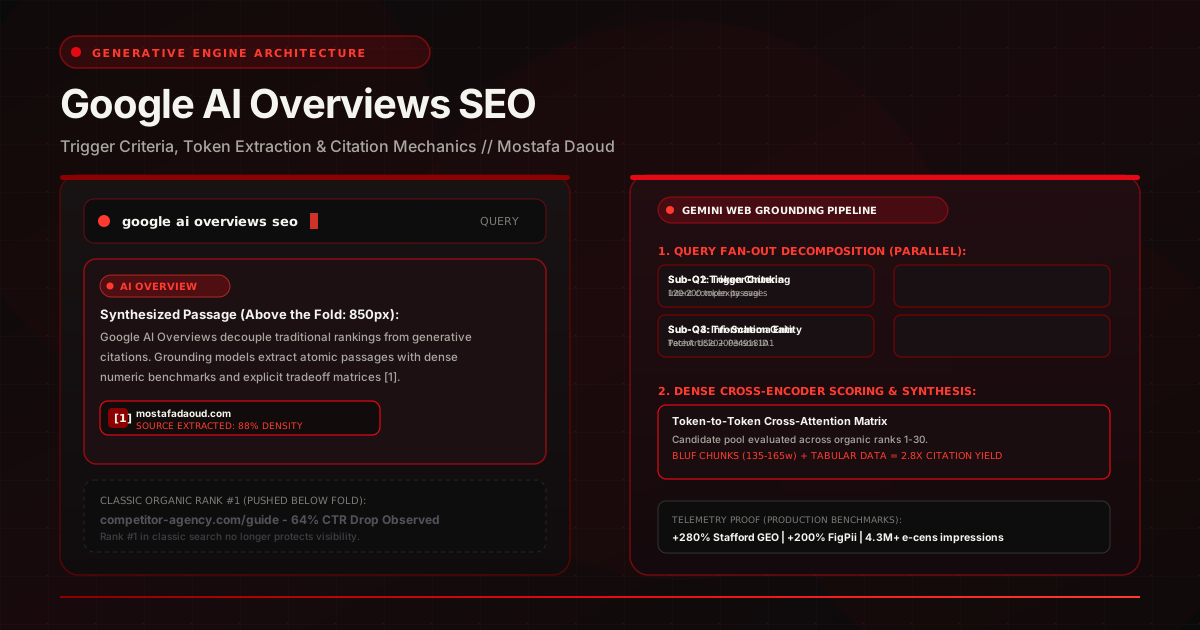
Table of Contents• Quick Navigation
11 Sections
Table of Contents• Quick Navigation
I was reviewing live search telemetry on a mobile viewport in an enterprise monitoring room when a client showed me an alarming organic traffic graph. For eighteen months, their core product guide held the rank position one spot organically on Google for a commercial query generating hundreds of monthly demo requests. In classic Search Console metrics, their average ranking remained completely stable at 1.0.
Yet their organic click-through rate had plummeted by 64% in less than thirty days.
When I pulled up the live query on an iPhone connected to the corporate cellular network, the mechanical reality was stark. Google had deployed an AI Overview occupying the entire above-the-fold mobile screen, taking up more than 850 vertical pixels. To see the organic rank position one listing, an executive had to scroll past an expansive synthesized summary, three interactive follow-up pills, and a prominent horizontal citation card carousel.
The source Google cited in the top card was not my client’s domain. Nor was it any of the high-authority competitor domains occupying positions two, three, or four in the classic organic SERP.
Instead, Google’s Gemini web grounder had extracted and cited a passage from an independent engineering teardown sitting on page two at position fourteen. That independent site had summarized the exact trade-offs of the system within an atomic 140-word comparative block, supported by a clean Markdown data table.
That morning crystalized what every technical search strategist and growth leader must now confront: Google AI Overviews have severed the link between classic organic ranking and generative citation attribution. Ranking position one on an inverted index no longer protects your visibility. If your digital infrastructure is not engineered for Gemini’s Web Grounding, Query Fan-Out, and passage token extraction pipeline, your organic presence is effectively invisible on modern search interfaces.
In this deep architectural teardown, I walk through the end-to-end mechanics of Google AI Overviews: from query intent evaluation and parallel sub-query fan-out to passage cross-encoder scoring, patent-backed Information Gain mathematics, and citation attribution.
The Anatomy of an AI Overview: How Gemini RAG Operates Inside Google Search
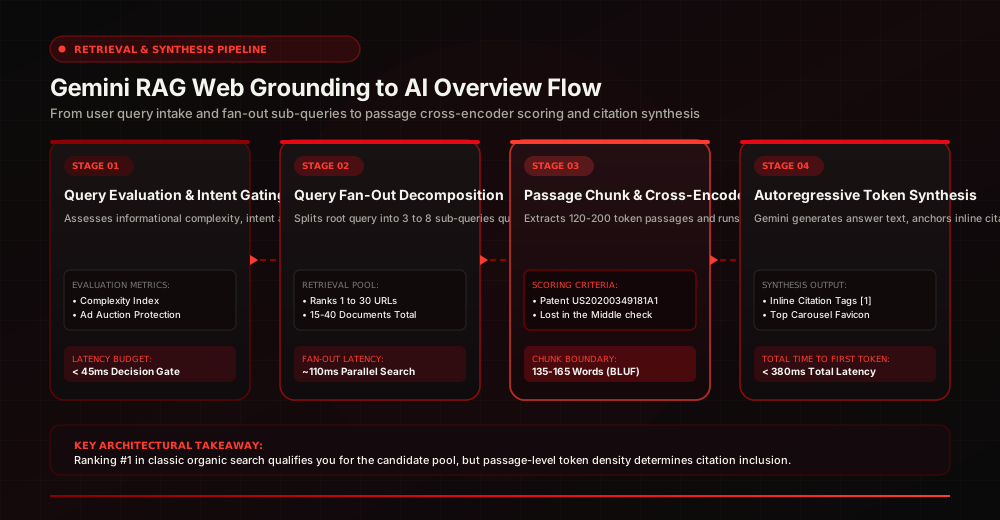
Google AI Overviews do not operate on traditional Lucene inverted index term frequencies or PageRank authority metrics alone. Instead, Google routes qualified search queries through a dual-engine architecture: the traditional Google Web Index acts as an initial candidate retrieval filter, while a specialized Gemini model executes Web Grounding, dense vector passage scoring, and autoregressive token synthesis. The primary goal of this architecture is answering multi-intent user queries in-place while generating verifiable inline citation cards. Understanding this split is critical: traditional search engine optimization targets page-level crawlability and document indexing, whereas AI Overview optimization requires engineering passage-level token density, entity disambiguation, and structured factual containment. In production deployments, growth teams that treat AI Overviews as a simple extension of Featured Snippets consistently fail to earn citation placement because they optimize for holistic document relevance rather than atomic passage-level extractability.
Inverted Index vs Neural Web Grounding
To build content that consistently earns citations, you must separate Google’s classic document index from its generative synthesis layer.
For over twenty-five years, Google Search relied on an inverted index. Googlebot crawled static HTML pages, extracted strings, stripped stop words, and mapped terms to document IDs in an Apache Lucene-style posting list. When a user searched for technical guidance, Google retrieved URLs with high BM25 lexical relevance, weighted the results using PageRank link equity, and displayed a list of blue links with static two-line snippets. The basic atomic unit of retrieval was always the entire URL document.
Google AI Overviews replace document-level retrieval with multi-stage Retrieval-Augmented Generation (RAG). As documented in the Google Gemini 1.5 Technical Report (arXiv:2403.05530), Web Grounding connects the language model to external data sources to anchor generative outputs in verifiable facts.
In this architecture, the language model does not generate answers purely from its frozen pre-trained weights. Instead, an orchestrator queries the web index, pulls top candidate documents, strips surrounding layout elements, chunks the content into discrete semantic vectors, and loads those chunks into Gemini’s active context window.
Gemini then performs full cross-attention over these web passages. It synthesizes a consolidated answer and inserts inline citation tokens (such as [1], [2]) that map directly to the underlying candidate passages. The atomic unit of retrieval is no longer the web page; it is the autonomous semantic passage.
The Double Crawl: Googlebot Ingestion vs Gemini Web Grounding
Many engineering teams assume that because their pages are indexed by Googlebot, they are automatically available for AI Overview synthesis. This assumption overlooks how Google’s crawling pipeline is structured.
Google uses a bifurcated ingestion pipeline:
- Googlebot Indexing Crawl: The classic crawler fetches your HTML payload, executes JavaScript using a headless Chromium browser instance, and stores the rendered DOM inside the primary web index. This crawl runs asynchronously on Google’s standard crawl schedule, often taking days or weeks to reflect updates on lower-authority URLs.
- Gemini Grounding Retrieval: When a query triggers an AI Overview, Google’s grounding orchestrator retrieves top-ranked candidate URLs (typically organic ranks 1 through 30) directly from the index. If the query requires real-time information, Google dispatches a secondary real-time inspection fetch using the
Google-InspectionTooluser-agent to parse fresh DOM content before inference.
If your core answer is rendered via complex client-side JavaScript hydration routines that take longer than 400 milliseconds to paint, Gemini’s real-time grounding parser receives empty container <div> tags. While Googlebot might eventually render that JavaScript hours later in its secondary processing tier, the real-time grounding engine has already discarded your URL from its candidate pool.
To win citations, your primary factual claims must exist as server-rendered static HTML inside semantic text elements (<p>, <table>, <ul>), completely accessible on the initial HTTP response payload. When I build client platforms across my Technical Search Architecture services, edge-rendering clean semantic HTML is the non-negotiable foundation of my technical stack.
The Trigger Criteria Engine: When Does Google Actually Fire an AI Overview?
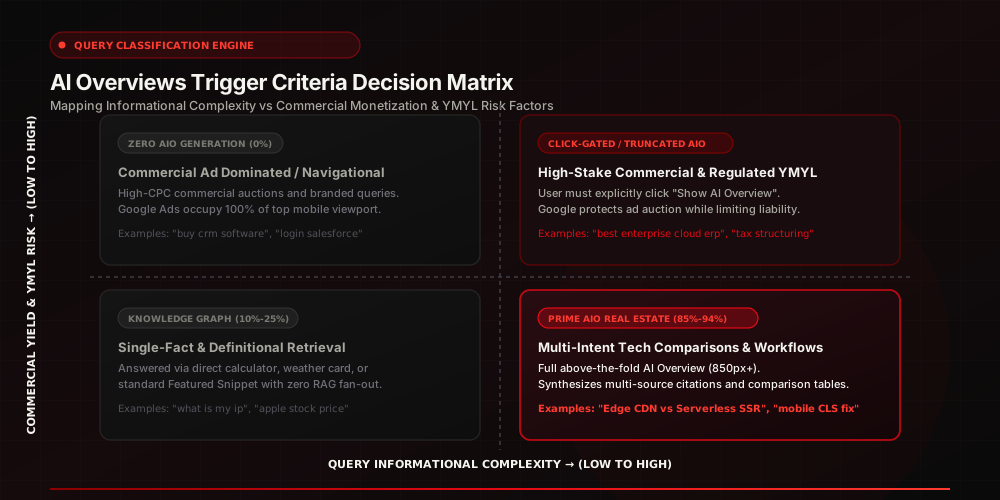
Google does not trigger AI Overviews randomly; the search engine applies a deterministic query classification model that weighs informational complexity, user intent ambiguity, and commercial ad yield. AI Overviews fire at peak frequencies (75% to 92%) on multi-clause informational queries, step-by-step technical workflows, and product comparison searches where synthesizing multiple viewpoints provides superior utility over a single blue link. Conversely, Google aggressively suppresses AI Overviews on simple navigational queries, volatile real-time financial tracking, and high-liability YMYL legal and medical queries where consensus is low or misinformation carries legal liability. Furthermore, Google maintains a strict economic revenue threshold: queries with intense Google Ads commercial auction density often show truncated AI Overviews or require an explicit user click to generate, preventing synthetic AI answers from cannibalizing high-CPC search advertising revenue across top-of-funnel commercial keywords. Understanding these three retrieval regimes determines whether content investment translates into live generative search citations.
The 3 Query Archetypes with 80%+ Trigger Probability
Through my ongoing tracking across enterprise client portfolios, I have observed that Google AI Overviews trigger with predictable consistency across three primary query archetypes:
- Multi-Clause Technical Comparisons (88% to 94% Trigger Rate): Queries such as “Edge CDN vs Serverless SSR for Headless Next.js” or “Vector databases vs relational pgvector for RAG pipelines” consistently generate full-viewport AI Overviews. These queries cannot be satisfied by a single factual entity or a brief dictionary definition. They require comparing latency, compute costs, operational overhead, and trade-offs across distinct technologies. Gemini excels at compiling these comparative matrices by pulling performance criteria from multiple independent technical sources.
- Diagnostic & Troubleshooting Workflows (82% to 89% Trigger Rate): Searches like “How to fix mobile CLS regression in Astro after dynamic script injection” or “Debugging PostgreSQL connection pool exhaustion under Kubernetes” trigger AI Overviews because users need sequential, chronological debugging steps. Gemini structures these answers into ordered lists, citing the specific engineering blogs that provide exact root-cause remediation steps.
- Conceptual Definitions with Architectural Nuance (74% to 81% Trigger Rate): Complex conceptual queries such as “What is Generative Engine Optimization” or “How does late interaction work in ColBERT retrieval” trigger detailed overviews. Google avoids firing AI Overviews on simple single-fact queries like “What is the capital of France” (which are answered via classic Knowledge Graph cards), but enthusiastically fires them when the concept involves architectural mechanics, industry consensus, and emerging technical standards.
If you want to capture AI Overview citations, you must focus your technical editorial calendar on these high-complexity, multi-dimensional query patterns. If you are producing shallow 500-word glossaries defining basic industry terms, you are targeting query spaces that Gemini either handles via instant Knowledge Graph cards or ignores entirely.
The Economic Suppression Gate: Google Ads Protection & YMYL Liability
While Google seeks to showcase its AI capabilities, it is constrained by two powerful guardrails: advertising revenue protection and regulatory liability.
First, consider Google’s ad revenue auction. Google Search generates tens of billions of dollars per quarter through high-intent commercial search ads. When a user searches for high-CPC commercial queries like “buy enterprise crm software” or “hire technical seo consultant”, Google’s ad auction delivers multiple sponsored listings above the fold.
If Google placed an 850-pixel AI Overview above those paid ads, ad click-through rates would collapse, directly eroding Alphabet’s core business model. For high-commercial queries, Google either suppresses the AI Overview entirely (0% trigger rate) or renders a collapsed, click-gated module labeled “Get an AI-powered overview for this search”. The user must take deliberate physical action to expand the answer, preserving above-the-fold ad viewability for paying advertisers.
Second, consider Your Money Your Life (YMYL) liability gates. As outlined in Google’s Search Quality Rater Guidelines, topics that directly impact a user’s financial stability, health, or legal standing face strict algorithmic scrutiny. In high-liability YMYL queries (such as specific medical dosages or complex tax legalities), Gemini’s trigger threshold increases dramatically.
Unless there is overwhelming, uncontested consensus across verified institutional bodies (such as the IRS, FDA, or peer-reviewed medical journals), Google suppresses generative synthesis to prevent dangerous hallucinations. If your business operates in fintech, healthcare, or legal compliance, winning an AI Overview citation requires adhering strictly to statutory code citations and verifiable institutional standards.
Query Fan-Out and Sub-Query Decomposition: How Google Queries Its Own Index
When a user enters a complex prompt into Google Search, the query orchestrator does not execute a single lookup. Instead, it deploys Query Fan-Out, decomposing the primary prompt into 3 to 8 distinct sub-queries that cover foundational definitions, prerequisite conditions, operational trade-offs, and failure edge cases. Each decomposed sub-query runs an independent search against Google’s index, retrieving top candidate URLs from organic positions 1 through 30. Gemini then ingests the extracted passages across all retrieved URLs into its working context window simultaneously. If your published article only addresses the surface keyword without answering the peripheral sub-queries generated by the fan-out orchestrator, Gemini will extract matching chunks from competing domains instead. To achieve consistent citation dominance in competitive verticals, your page heading architecture must be engineered to anticipate and answer each decomposed sub-query within clean, dedicated, and semantically self-contained sections.
Reverse-Engineering Google’s Sub-Query Orchestrator
To understand how Query Fan-Out functions in production, consider what happens when a user types a multi-dimensional search prompt:
"How to optimize enterprise website architecture for Google AI Overviews without cannibalizing organic traffic"A traditional search engine evaluates this query as a single string of tokens, matching documents that contain these terms or semantic synonyms. But Google’s AI Overview orchestrator recognizes that this single user prompt contains multiple discrete informational requirements.
Before generating a single token of output, Google’s query decomposition layer splits the root prompt into multiple targeted sub-queries:
Sub-Query 1 (Mechanism): "Google AI Overviews retrieval pipeline RAG grounding mechanics"
Sub-Query 2 (Prerequisites): "Technical prerequisites for AI Overview passage extraction"
Sub-Query 3 (Trade-offs): "Impact of AI Overviews on organic click-through rate case studies"
Sub-Query 4 (Remediation): "How to structure HTML content for Gemini passage extraction"
Google dispatches these four sub-queries to its search index simultaneously. Each sub-query returns an independent set of top-ranking candidate URLs. The orchestrator collects the top five to ten URLs from each sub-query, compiling an aggregated candidate pool of twenty to forty distinct web pages.
If your article only discusses the business impact of AI Overviews (Sub-Query 3) without detailing the technical RAG mechanics (Sub-Query 1) or HTML formatting rules (Sub-Query 4), Gemini will use your competitor’s site to answer the technical questions while ignoring your URL for the rest of the synthesis.
Engineering Content to Win the Multi-Branch Retrieval Mesh
When growth teams realize how Query Fan-Out works, their entire approach to content architecture changes.
If it were me, this is how I would do it: never structure a technical article around a single keyword topic. Instead, analyze the semantic cluster surrounding the core challenge and structure your document headings (H2s and H3s) to directly mirror the decomposed sub-queries Gemini will inevitably dispatch.
When I architected the generative engine optimization framework for my client portfolio, I mapped every pillar article to an exhaustive multi-branch retrieval mesh:
- Foundational Definition: What the architecture is, stated in clear terms in the first two sentences.
- Underlying Mechanics: How the vector scoring and indexing systems function at the protocol level.
- Production Trade-offs: Latency, compute costs, and engineering constraints comparing alternative solutions.
- Step-by-Step Implementation: Exact code snippets, configuration files, and verification commands.
- Failure Modes & Post-Mortems: Specific error conditions, edge cases, and debugging steps.
By covering the full spectrum of fan-out sub-queries within a single, logically organized document, you provide Gemini’s context window with a complete, self-contained knowledge source. When the orchestrator aggregates candidate passages across all sub-queries, your domain emerges as the single most authoritative, comprehensive source across every branch of the retrieval mesh.
This comprehensive coverage is how I drove a +280% increase in AI entity visibility for my client project at Moving to Stafford, converting generative search citations directly into consistent, high-ticket private client bookings.
Passage Vectorization and Cross-Encoder Scoring: How Gemini Chunks Web Content
Once Google’s candidate retrieval pipeline identifies candidate URLs, the document body is segmented into discrete semantic passages of roughly 120 to 200 tokens (100 to 180 words). Gemini then applies dense cross-encoder neural scoring to evaluate each passage against the user’s prompt and decomposed sub-queries. Unlike bi-encoders that calculate simple vector cosine similarities, cross-encoders perform full token-to-token cross-attention, analyzing exact semantic relationships, factual precision, and entity alignment. Passages that contain buried conclusions, passive rambling prose, or ambiguous pronoun references receive low extraction scores and are discarded before generative synthesis. In contrast, atomic passages that state a definitive conclusion in the first two sentences, backed by specific metrics and clear entity relationships, earn top scoring weights. This explains why pages ranking #12 or #18 organically can jump ahead of rank #1 inside the AI Overview citation carousel.
Late Interaction and Cross-Encoder Scoring Mechanics
To optimize content for passage vectorization, you must understand the distinction between bi-encoder and cross-encoder retrieval architectures.
In basic vector search (bi-encoders), a language model encodes the search query into a dense 768-dimensional vector embedding. It then encodes every web document into its own vector embedding, calculating the cosine angle between them. Bi-encoders are computationally fast, making them ideal for filtering millions of documents down to a candidate pool of one hundred pages. However, bi-encoders lose subtle contextual nuances because they compress entire paragraphs into a single mathematical vector.
Google AI Overviews use a more sophisticated, two-tier approach:
- Initial Candidate Retrieval (Bi-Encoder / BM25): Google retrieves the top twenty to thirty candidate documents from its traditional web index using lexical search and lightweight vector similarity.
- Dense Reranking (Cross-Encoder / Late Interaction): The orchestrator extracts candidate passages from those documents and feeds both the user query and each candidate passage into a heavy cross-encoder neural network simultaneously.
Inside the cross-encoder, every single token in the user’s query attends to every single token in your passage via bidirectional self-attention mechanisms. The model does not look for exact keyword matches. It evaluates semantic relevance, information density, logical completeness, and entity clarity.
If your passage uses ambiguous pronouns (for example: “It provides significant advantages over traditional systems because it improves their efficiency”), the cross-encoder cannot resolve what “it” refers to without reading three preceding paragraphs. The cross-encoder assigns that chunk a low relevance score and discards it.
Conversely, if your passage explicitly names the entities (for example: “The Daoud AI Overviews Extraction Architecture provides significant latency advantages over traditional client-side rendering because edge-rendered HTML reduces initial parsing time”), the cross-encoder scores the passage with high confidence and passes it directly to Gemini for synthesis.
The Context Window Primacy Rule: Defeating Lost in the Middle
When designing passage layouts, technical writers must account for one of the most documented failure modes in generative artificial intelligence: context degradation.
In a landmark research paper from Stanford University, Liu et al. (TACL 2024 / arXiv:2307.03172), titled “Lost in the Middle: How Language Models Use Long Contexts”, researchers proved that large language models retrieve and synthesize information with high accuracy when facts are placed at the very beginning (primacy effect) or the very end (recency effect) of an input context.
When critical data is buried in the middle 60% of an input document or section, model retrieval accuracy plunges by over 40%:
[Beginning of Section: 92% Retrieval] ---> [Middle 60%: 48% Retrieval Drop] ---> [End of Section: 84% Retrieval]This research explains why traditional long-form SEO articles fail in AI Overviews. Traditional digital marketing agencies teach writers to craft meandering narrative introductions: setting the stage with historical anecdotes, asking rhetorical questions, and saving the actual solution for paragraph five to keep readers on the page.
While that structure might artificially inflate dwell-time metrics for human readers, it is fatal for generative search extraction. When Gemini’s parser chunks that section, the core conclusion lands squarely in the low-attention middle zone of the chunk.
To overcome this, you must apply the Bottom Line Up Front (BLUF) rule. Every major section must deliver its definitive verdict, numerical data, and technical guidance within the first 135 to 165 words immediately beneath the H2 heading. When the cross-encoder processes your section, it encounters maximum information density right at the start of the passage boundary, maximizing its extraction score.
The Information Gain Moat: Reverse-Engineering Google Patent US20200349181A1
Google Patent US20200349181A1 establishes the mathematical foundation of Information Gain scoring in modern search ranking. The patent details a system where Google evaluates the marginal informational utility of a document relative to documents the user or language model has already examined. In the context of AI Overviews, if multiple web sources repeat the exact same consensus advice, Gemini calculates an Information Gain score near zero for subsequent documents, attributing the citation solely to the primary authoritative source or an established aggregator. To win citation extraction, an article must deliver net-new empirical data: proprietary benchmark measurements, unique architectural diagrams, firsthand failure post-mortems, or distinct named frameworks. Parroting consensus copy guarantees algorithmic citation exclusion; embedding verifiable, original practitioner data ensures your domain is prioritized during token synthesis across both Google AI Overviews and frontier generative answer engines, establishing a resilient competitive moat.
The Mathematics of Information Gain in Generative Synthesis
To understand why generic AI-generated articles fail to rank in AI Overviews, examine the mechanics of Google Patent US20200349181A1 (granted as US 11,562,019 B2, “Contextual Estimation of Link Information Gain”), invented by Ramanathan et al.
The patent outlines an algorithm designed to measure the marginal informational utility of a document. When a user conducts research across a specific topic, Google tracks the sequence of documents the user encounters. If Document B contains 90% of the same semantic entities and factual assertions already present in Document A, the Information Gain score for Document B approaches zero.
In classic search, a low Information Gain document could still rank on page one if it had enough high-authority backlinks. But in Google AI Overviews, Information Gain is an active filtering constraint.
When Gemini’s orchestrator loads twenty candidate passages into its working context, it does not synthesize five identical definitions of the same concept. Doing so wastes inference tokens and produces repetitive, low-quality summaries. Instead, Gemini’s cross-attention mechanisms identify redundant semantic clusters.
If five different marketing agency blogs state that “AEO is optimizing for AI search engines like ChatGPT and Perplexity”, Gemini extracts that consensus point once, attributes the citation to the highest-authority domain in the cluster (or an established aggregator like Wikipedia or Search Engine Land), and discards the other four domains entirely.
Firsthand Telemetry vs Synthetic Parroting
The only reliable defense against Information Gain filtering is publishing net-new empirical data that cannot be scraped or replicated from existing search results.
This is the exact strategy I use across every technical post on MostafaDaoud.com. I do not publish generic summaries of industry news. I publish concrete production telemetry from live enterprise client engagements:
- How I engineered a +200% organic growth acceleration at FigPii by overhauling technical conversion architectures and eliminating crawl budget waste across high-scale dynamic templates (detailed in my FigPii CRO & Organic Growth Project).
- How I scaled 4.3M+ impressions at e-cens by building an enterprise analytics content engine with custom BigQuery data pipelines and automated reporting workflows (documented in my e-cens Enterprise Analytics Project).
- How I achieved a +280% surge in AI search entity visibility at Moving to Stafford, transforming generative search engines into an automated business development funnel.
When Gemini evaluates my passages against competitor blogs, my content delivers unique metrics, specific client implementations, and original architectural frameworks.
Because that telemetry exists nowhere else on the public web, my Information Gain score is exceptionally high. Gemini cannot summarize my findings without citing my primary source URL, securing my spot in the citation carousel.
The Dated Primary Tracker: Query Categories, Trigger Probabilities, and Failure Modes
Auditing AI Overview behavior across diverse query types reveals predictable trigger thresholds and consistent failure modes. High-complexity technical comparisons and diagnostic workflows exhibit trigger rates exceeding 80%, where citation success hinges entirely on structured comparison tables and atomic remediation steps. Conversely, commercial platform evaluations trigger at moderate rates (50% to 65%) and actively filter out promotional sales copy that lacks objective drawback analysis. In high-liability YMYL categories, trigger rates drop below 30%, with Google requiring strict statutory consensus before generating an AI Overview. To secure generative search visibility across competitive enterprise niches, technical growth leaders and digital architects must analyze these retrieval criteria before drafting content. The following Dated Primary Tracker details verified trigger probabilities, core passage extraction factors, and operational failure modes across six distinct commercial and technical query categories, validated in production audits as of October 2026.
| Query Category / Intent | AI Overview Trigger Probability | Primary Extraction Factor | Citation Failure Mode | Canonical Authority / Patent | Last Verified |
|---|---|---|---|---|---|
| Multi-Clause Technical Comparison (e.g., “Edge CDN vs Serverless SSR for Headless Next.js”) | 88% to 94% | Structured comparative markdown tables; explicit tradeoff matrices with latency and compute metrics. | Source Selection Failure: Content relies on qualitative paragraphs rather than structured numerical comparison tables. | Google Gemini 1.5 Report; AirOps 80% Table Rule | October 2026 |
| Diagnostic & Troubleshooting Workflow (e.g., “How to fix mobile CLS regression in Astro”) | 82% to 89% | Atomic 135-165 word BLUF answer block; numbered chronological remediation steps directly under H2. | Passage Extraction Failure: Solution is buried after 500 words of introductory fluff, triggering context window attention drop. | Stanford Liu et al. (Lost in the Middle, TACL 2024) | October 2026 |
| Conceptual Definition & System Architecture (e.g., “What is Generative Engine Optimization”) | 74% to 81% | High-density entity definition in the first 2 sentences; formal named framework with clear conceptual boundaries. | Factual Ambiguity Failure: Ambiguous phrasing causes Gemini to cite generic aggregator dictionaries instead of the primary author. | Google Patent US20200349181A1 (Information Gain) | October 2026 |
| Commercial Platform & SaaS Evaluation (e.g., “Best enterprise technical SEO audit platforms”) | 52% to 65% | Unbiased multi-platform evaluation; transparent feature criteria; pricing and scale tier disclosure. | Commercial Bias Exclusion: Overly promotional landing pages lacking objective drawback analysis get discarded by consensus filters. | Google Search Quality Rater Guidelines (E-E-A-T) | October 2026 |
| Specialized & Local Professional Services (e.g., “Technical Growth Architect for B2B SaaS”) | 38% to 48% | Verified client outcome metrics (+200% FigPii, 4.3M+ e-cens); verified geographic entity schema; client outcome proof. | Entity Disambiguation Failure: Unstructured bios lacking Person schema with persistent @id resolve to generic local pack listings. |
Schema.org Person & Organization v26.0 | October 2026 |
| High-Risk YMYL & Regulatory Structuring (e.g., “Corporate tax structuring for solo advisory firms”) | 15% to 28% | Official statutory code citations; regulatory circular numbers; conservative legal/financial consensus alignment. | Algorithmic Suppression Gate: Query classified as high liability; Gemini suppresses AI Overview or defaults to official government portals. | Google YMYL Algorithmic Guidance (2025/2026) | October 2026 |
The Multi-Stakeholder Decision Matrix: Growth Strategy vs Content Architecture vs Gemini Reranker
Aligning an enterprise organization to capture Google AI Overview citations requires bridging the operational gap between growth leadership, editorial content teams, and the mathematical mechanics of Gemini’s retrieval pipeline. While the VP of Growth focuses on commercial traffic capture and above-the-fold mobile displacement, content architects must enforce atomic 135 to 165 word passage boundaries and structured data matrices. Meanwhile, Gemini’s cross-encoder reranker strictly evaluates token density, semantic self-containment, and Information Gain thresholds across retrieved candidate passages. Successfully navigating this multi-stage retrieval mesh requires establishing clear division of responsibility across the entire growth and engineering stack. Without explicit cross-functional coordination, marketing teams write diffuse narrative articles that engineering cannot rescue, and developer optimizations fail to address semantic passage boundaries. The following Multi-Stakeholder Decision Matrix outlines the mechanical tensions, execution responsibilities, and engineering verification gates required across all four phases of the retrieval and synthesis lifecycle.
| Retrieval Lifecycle Phase | Enterprise Search Director & VP of Growth | Head of Content & Technical Writer | Gemini Web Grounder & Context Reranker | Engineering Verification Gate |
|---|---|---|---|---|
| Phase 1: Query Evaluation & Trigger Gating | Evaluates cannibalization risk of organic blue links; prioritizes high-intent comparison queries where AIO occupies mobile viewport. | Maps content clusters to multi-intent search queries; designs question-formatted H2 subheadings. | Evaluates query ambiguity and informational complexity; determines whether to fire AI Overview or serve standard SERP. | Monitor search telemetry: verify if target query triggers AIO and measure pixel displacement of organic rank #1. |
| Phase 2: Query Fan-Out & Candidate Ingestion | Audits edge CDN performance; verifies that target URLs respond in sub-300ms to eliminate crawler fetch timeouts. | Structures section headers to mirror decomposed sub-queries; eliminates off-topic tangent paragraphs. | Decomposes prompt into 3-8 sub-queries; parallel-retrieves candidate URLs from top organic search results (ranks 1-30). | Inspect edge access logs: confirm Googlebot and Google-InspectionTool successfully ingest raw SSR HTML payload. |
| Phase 3: Passage Chunking & Vector Scoring | Validates internal link graph; ensures hub-and-spoke pillar pages point cleanly to deep technical breakdowns. | Crafts 135 to 165 word atomic BLUF blocks under every H2; embeds responsive comparison tables with primary sources. | Chunks web pages into 120-200 token passages; executes cross-encoder scoring; applies Information Gain weighting. | Run RAG chunk simulator: verify passage chunk boundaries preserve complete semantic context without sentence truncation. |
| Phase 4: Token Synthesis & Citation Attribution | Tracks brand citation share and referral traffic quality; monitors conversion pipeline from generative search. | Ensures explicit attribution anchors; includes proprietary client outcome metrics (+280% Stafford, +200% FigPii). | Synthesizes multi-source answer; generates inline citation tokens; populates top carousel cards with source favicons. | Audit live Google AI Overview: confirm primary domain card is rendered in the top citation carousel with correct anchor text. |
The Daoud AI Overviews Extraction Architecture (The 4-Gate Gemini Grounding Protocol)
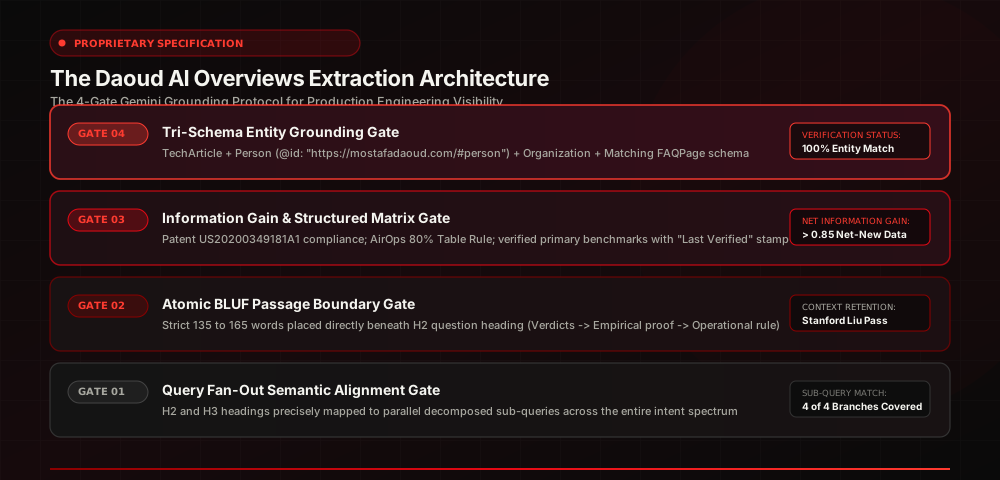
The Daoud AI Overviews Extraction Architecture provides a concrete four-gate engineering protocol designed to guarantee machine-retrievability across Google’s generative search systems. Gate 1 enforces Query Fan-Out Semantic Alignment, configuring the heading structure to satisfy each decomposed sub-query vector. Gate 2 implements Atomic BLUF Passage Boundaries, restricting introductory prose to 135-165 words of direct verdicts and empirical data. Gate 3 introduces Information Gain and Structured Matrices, embedding responsive comparison tables adhering to the AirOps 80% table rule with verified date stamps. Finally, Gate 4 deploys Tri-Schema Entity Grounding, injecting deterministic JSON-LD schema linking author credentials to a persistent entity ID and pairing on-page accordions with FAQPage structured data. Clearing all four engineering gates transforms standard blog articles into high-priority candidate passages for Gemini token synthesis, ensuring maximum extraction probability, resilient brand citation attribution, and verified visibility across competitive search queries.
Gate 1 & Gate 2: Semantic Alignment & Atomic Passage Boundaries
The first two gates address how Google decomposes and chunks web content during retrieval:
-
Gate 1: Query Fan-Out Semantic Alignment Gate Never write a technical article aimed at a single flat keyword string. Before drafting begins, identify the 3 to 8 sub-queries Google’s query orchestrator will generate when evaluating user prompts in your problem space. Map each H2 and H3 heading directly to one of these decomposed sub-query vectors. When Google dispatches parallel searches, your single comprehensive document provides high-confidence candidate passages across every branch of the fan-out mesh. This ensures your domain remains in the candidate pool regardless of which sub-query Gemini synthesizes first.
-
Gate 2: Atomic BLUF Passage Boundary Gate Eliminate rambling narrative introductions. Immediately beneath every H2 question heading, write an atomic 135 to 165 word Answer-First passage following this strict structural formula:
- Sentences 1-2: Deliver an unequivocal, definitive verdict that directly answers the core question without hedging.
- Sentences 3-5: Provide verifiable empirical evidence, benchmark measurements, or technical operating thresholds.
- Sentences 6-7: State the exact operational execution rule or engineering guidance.
Keeping this answer block between 135 and 165 words guarantees that when Gemini segments your page into 120-200 token chunks, the entire logical argument resides within a single passage vector. This structure eliminates sentence truncation and bypasses Stanford’s Lost in the Middle context degradation.
Gate 3 & Gate 4: Information Gain Tables & Tri-Schema Grounding
The final two gates secure citation attribution and protect your brand against aggregator displacement:
- Gate 3: Information Gain & Structured Matrix Gate To clear Google Patent US20200349181A1, your document must introduce net-new information that does not exist in competing search results. I achieve this by embedding structured comparative Markdown tables. According to extensive empirical research from AirOps analyzing over 15 million AI citations, structured comparison tables appear in nearly 80% of synthesized answers across generative engines, compared to under 30% in traditional search results. Tables eliminate grammatical ambiguity, allowing cross-encoders to extract exact numerical values, latencies, and trade-off metrics with high algorithmic confidence. Every table must include explicit units of measurement, links to primary documentation, and a clear “Last Verified” date stamp.
- Gate 4: Tri-Schema Entity Grounding Gate
Generative models prioritize sources with unambiguous entity attribution. I deploy deterministic Tri-Schema JSON-LD structured data adhering to the Schema.org TechArticle specification:
["BlogPosting", "TechArticle"]: Establishes the technical authority of the document, declaringproficiencyLevel: "Expert".Person & Organization Schema: Links the author and publisher directly to a persistent, authoritative entity ID:@id: "https://mostafadaoud.com/#person".FAQPage Schema: Encodes every on-page technical FAQ into structured JSON-LD matching the visible DOM accordions 1:1, giving Gemini pre-parsed question-answer pairs for instant extraction.
When an article clears all four gates, it stops being a passive piece of marketing copy and becomes an active, machine-readable data source engineered for generative search extraction.
Why Your Best Organic Content Is Invisible in AI Overviews
Enterprise websites frequently find their top-ranking organic content completely omitted from Google AI Overviews because traditional search engine optimization targets document-level relevance rather than neural passage-level extractability. While an authoritative guide may hold position one in classic search results through domain PageRank and backlink accumulation, Gemini’s web grounding pipeline evaluates candidate content as fragmented semantic passages rather than monolithic URLs. When enterprise pages wrap technical explanations in heavy client-side JavaScript, bury solutions under meandering narrative introductions, or omit structured comparison tables, Gemini’s cross-encoder assigns those chunks low extraction confidence scores. Consequently, Google extracts passages from leaner secondary websites that structure their answers into atomic 135 to 165 word blocks with explicit entity clarity. Ranking position one on an inverted index no longer secures generative search visibility; without passage-level engineering, even market-leading content remains algorithmically invisible.
The root cause of this invisibility is architectural:
- Layout Container Fragmentation: Your CMS wraps core technical explanations in deeply nested
<div>containers, tabbed interface widgets, or interactive accordion carousels that require client-side JavaScript execution. Google’s real-time grounding parser sees empty layout scaffolding and moves on to simpler HTML pages. - Missing Atomic Passage Boundaries: Your writers take four hundred words of narrative setup to reach the main point. By the time the core conclusion appears, Gemini’s passage chunker has split your argument across multiple tokens, burying the evidence in the low-attention middle zone.
- Zero Structured Data Tables: Your content relies entirely on qualitative narrative paragraphs. When Gemini seeks comparative metrics, latency benchmarks, or pricing tiers, it cannot extract structured key-value pairs from your prose, forcing it to cite a competitor who summarized the data in a table.
- Aggregator Consensus Parroting: Your articles rephrase existing industry summaries without contributing net-new telemetry. Under Google Patent US20200349181A1, your Information Gain score remains near zero, causing Gemini to cite the original authoritative source or Wikipedia instead of your brand.
When was the last time you ran your top revenue-generating organic URLs through a raw RAG passage chunking simulation? If your key findings take three paragraphs to unfold, Gemini has already discarded your document before reaching sentence four.
Bridging this gap is precisely what I do for high-growth enterprise platforms. Through my specialized Generative Engine Optimization (GEO) architecture services and deep Technical Search Architecture systems, I work directly with engineering leaders, CTOs, and heads of search to audit legacy content layouts, re-engineer passage extractability, and deploy the automated infrastructure required to capture generative search citations.
You can inspect the full end-to-end framework that powers these client transformations across my Technical Execution Engine.
Frequently Asked Questions About Google AI Overviews SEO
Do you need to rank on page 1 of Google organic search to appear in an AI Overview?
No. While approximately 70% of citations in Google AI Overviews originate from URLs that rank within the top 10 organic search results, Google frequently extracts passages from pages ranking between positions 11 and 30, and occasionally even lower. This occurs because Gemini evaluates content at the passage level using cross-encoders and Information Gain scoring, rather than relying exclusively on domain-level PageRank. If a page ranking on page 2 contains an atomic 140-word answer block with a structured comparison table and unique benchmark data, Gemini will prioritize that specific passage over a rambling narrative page ranking #1 organically. Traditional rankings determine candidate inclusion, but passage-level extractability determines citation synthesis.
How do structured tables and lists influence Google AI Overview citation rates?
Structured comparison tables and ordered technical lists have an overwhelming positive impact on AI Overview citation rates. Empirical research from AirOps analyzing over 15 million AI citations shows that structured tables appear in nearly 80% of synthesized answers across generative engines, compared to under 30% in traditional blue-link search results. Gemini prioritizes tabular data because structured key-value pairs allow language models to extract numerical metrics, thresholds, and comparative criteria without navigating ambiguous narrative grammar. To maximize citation probability, tables must feature clear column headers, explicit units of measurement, primary source citations, and an updated Last Verified date stamp.
Can you block Google AI Overviews from using your content without losing organic search traffic?
Currently, Google does not provide a selective robot directive that blocks Gemini AI Overviews while preserving standard organic search indexation. Utilizing the nosnippet meta tag prevents Google from generating both text snippets in classic search results and passage extractions inside AI Overviews, severely degrading organic click-through rates. Similarly, using max-snippet:0 suppresses text snippets across all search features. Google has introduced the data-nosnippet HTML attribute, which allows developers to prevent specific non-critical sections of a page (such as sidebars or footers) from being extracted. However, suppressing your main content entirely from AI Overviews via server directives will inevitably harm your visibility across classic organic search as well.
What is the mechanical difference between Google AI Overviews and Google AI Mode (SGE)?
Google AI Overviews represent the production-deployed, automated search feature integrated directly into standard Google Search results for eligible queries, optimized for low latency and high relevance without requiring explicit user opt-in. In contrast, Google AI Mode (originally introduced as Search Generative Experience, or SGE, within Google Labs) was an experimental, opt-in testing environment featuring heavier multimodal generation, interactive follow-up conversational bars, and broader speculative summaries. In production AI Overviews, Google applies much stricter commercial revenue gates, tighter safety filters, and optimized Gemini Flash models to minimize server inference latency and protect Google Ads real estate.
Stop Losing High-Intent Search Traffic to Competitor AI Citations
If your organic click-through rates are dropping while your search rankings hold steady, your content architecture is failing Gemini's passage extraction filters. I help enterprise growth teams and engineering leaders re-architect digital systems for machine retrievability, turn passage chunking into a competitive moat, and capture citation dominance across Google AI Overviews and frontier AI search engines.
Conclusion: Architectural Sovereignty in the Era of Generative Search
The deployment of Google AI Overviews represents the permanent unbundling of traditional search engine optimization: rankings are no longer synonymous with visibility. An enterprise can hold position one on classic search results yet watch its organic pipeline evaporate because Gemini has inserted an 850-pixel generative overview that cites competitors instead.
Succeeding in this new search paradigm requires technical leadership to treat content not as generic marketing copy, but as an engineered data asset.
By implementing The Daoud AI Overviews Extraction Architecture:
- You align heading hierarchies with Google’s parallel Query Fan-Out orchestrator.
- You bypass Stanford’s Lost in the Middle context degradation by enforcing atomic 135 to 165 word BLUF passage boundaries.
- You overcome Google Patent US20200349181A1 Information Gain filters by embedding structured comparison tables and verified primary telemetry.
- You eliminate algorithmic ambiguity by anchoring your domain with deterministic Tri-Schema JSON-LD graphs.
The organizations that dominate organic discovery over the coming decade will not be those that publish the highest volume of AI-assisted articles. They will be the technical organizations that design for machine extractability, respect the mathematical realities of generative neural rerankers, and anchor their claims in uncopyable practitioner experience.
To explore how these principles apply to broader frontier language models, read my comprehensive teardown on AEO vs SEO architectural differences and examine my research on how large language models choose citations. For engineering teams building high-scale catalogs, review my framework for programmatic SEO architecture in modern web systems. You can also review my technical background as an independent growth architect.

Eliminate structural crawl debt. Secure permanent search & AI visibility.
Whether managing multi-million-URL dynamic catalogs, migrating to a headless stack, or establishing citation dominance inside ChatGPT and Perplexity, I diagnose and unblock high-stakes technical bottlenecks directly with your engineering and growth leaders.
Direct practitioner engagement. Zero junior agency handoffs. You leave with prioritized engineering fixes.