
Technical Growth Architect & Search Strategist
AI Slop: Why Enterprise Content Engines Fail Without Information Gain
AI slop is destroying organic search pipeline. Discover the information gain architecture and engineering protocol that defeats synthetic content decay.

Table of Contents• Quick Navigation
7 Sections
Table of Contents• Quick Navigation
In November 2025, I conducted an emergency technical audit for a Series B enterprise software company that had just incinerated $120,000 across seven months with an automated artificial intelligence content agency.
The agency pitch had seemed irresistible to executive leadership: 50 long-form articles published every month, automated CMS deployments, and a total organic takeover of their software category. The agency delivered 350 articles generated by piping raw large language model prompts through automated publishing scripts into their WordPress production database.
On paper, publishing velocity was breathtaking. In Google Search Console, the reality was catastrophic:
Out of 350 newly deployed URLs, 318 sat indefinitely in “Crawled - currently not indexed.” Organic search impressions plummeted by 71% following a core algorithm update, and total qualified pipeline revenue generated across those seven months was exactly zero dollars.
The company believed they were scaling organic growth. In reality, they built an expensive automated engine for manufacturing crawl waste.
+-------------------------------------------------------------------------------+
|             THE COMMODITY AI SLOP VS DEFENSIBLE ENGINE CONTRAST               |
+-------------------------------------------------------------------------------+
|  COMMODITY AI PLAYBOOK (PHANTOM EFFICIENCY) |  DEFENSIBLE ENGINE ARCHITECTURE |
|  ------------------------------------------ |  ------------------------------ |
|  * Velocity: 50 automated posts / month     |  * Velocity: 6-8 intent pages   |
|  * Production Cost: $0.02 per raw word      |  * Production Cost: Engineering |
|  * Primary Source: Scraped SERP summaries   |  * Primary Source: Telemetry    |
|  * Indexation: 91% Crawled - Not Indexed    |  * Indexation: 98%+ Clean Index |
|  * Organic Pipeline: $0 Qualified Revenue   |  * Organic Pipeline: Scalable   |
|  * AI Citations: 0% Answer Engine Presence  |  * AI Citations: 80% Tables     |
|  * Verified Telemetry: 71% Traffic Drop     |  * Telemetry: 4.3M Impr (e-cens)|
+-------------------------------------------------------------------------------+
As I frequently discuss on the Breaking The Echo podcast with my co-host Patrick Soch, when you hand unconstrained generative AI tools to an editorial team without engineering verification, you do not achieve automated efficiency. You achieve what I call “phantom efficiency.” Worse, you achieve mastery in slop.
If you want to build a high-velocity organic engine that survives modern search algorithms and captures generative AI citations in 2026, you must stop treating large language models as automated copywriters. You must treat them as compute accelerators inside a deterministic, intent-mapped information gain architecture.
In this teardown, I break down the exact operational architecture I deploy for enterprise clients: the mathematical foundation of Google Patent US20200349181A1, the 5-Gate Anti-Slop Production Protocol, the 6-column dated primary tracking framework, and the engineering principles behind 4.3M+ search impressions at e-cens and +200% growth at FigPii.
Executive TL;DR Verdict
AI slop is not an aesthetic writing flaw; it is an architectural business failure. Large language models predict the statistically most probable next tokens, which means unconstrained synthetic writing inherently converges toward web consensus. Under Google Patent US20200349181A1, search engines calculate an Information Gain Score across document clusters: if your article delivers zero marginal information beyond what a user has already seen, your visibility is wiped out. You cannot solve this with better prompts. You solve it by turning your editorial workflow into an engineering protocol: subtract commodity filler, extract proprietary telemetry, enforce 135 to 165 word answer passages, and ground every assertion in verifiable primary evidence.
The following primary tracker establishes the empirical benchmarks governing synthetic content failure modes and defensible engine architectures as of October 2026:
| Entity / System | Content Tier | Operational Failure Mode | LLM Citation / Penalty Metric | Verified Source | Last Verified Date Month Year |
|---|---|---|---|---|---|
| Raw LLM Pipeline (Zapier to WordPress) | Commodity AI Slop | Zero editorial filtering; hallucinated endpoints; consensus rewrites | -85% to -92% GSC indexation; 0% AI search citations | Google Search Central Core Update Guidelines | October 2026 |
| Prompt and Polish Model | Surface-Edited Synthetic | Human copyeditor fixes spelling and grammar but adds zero primary data | Marginal initial indexation; zero information gain; rank drops | Ramanathan et al., Patent US20200349181A1 | October 2026 |
| SME Interview Transcription | Unstructured Human Content | Rich insights buried in meandering conversational transcripts; poor formatting | Moderate indexation; excluded from AI answer blocks due to loose structure | AirOps Generative Engine Study (~15M Citations) | October 2026 |
| The Daoud Anti-Slop Protocol | Defensible Growth Engine | Multi-source research loops; primary telemetry; 5-gate validation | 4.3M+ search impressions; 2.8x higher AI citation rate; zero indexation drop | Mostafa Daoud Production Telemetry (e-cens Case Study) | October 2026 |
What Is AI Slop? The Technical Definition Beyond Internet Memes
AI slop describes low-utility, synthetic content generated by unconstrained large language models that regurgitates statistical consensus without introducing verified primary data, practitioner experience, or net-new information gain. In enterprise software and B2B growth, AI slop is not merely a stylistic annoyance of repetitive phrasing or robotic cadence. It represents a catastrophic capital allocation failure where engineering and marketing teams scale synthetic output volume while organic pipeline collapses to zero. Because generative engines optimize for token probability across existing web documents, raw model outputs inherently converge toward the arithmetic average of current search results. Search engines running information gain filters identify this lack of marginal utility immediately, classifying mass-produced synthetic pages as crawl waste and withholding indexation. Without proprietary benchmarks, production telemetry, or contrasting technical frameworks, synthetic content pipelines burn enterprise crawl budget, dilute brand authority, and fail to secure citations across modern generative search engines.
The Anatomy of Synthetic Text: Token Probability and Consensus Regurgitation
To understand why unconstrained artificial intelligence models produce slop, you have to understand the mathematical mechanics of autoregressive token generation.
Large language models (LLMs) do not possess consciousness, original conviction, or direct access to physical reality. They are statistical probability engines trained on massive public web corpora to minimize cross-entropy loss by predicting the next token $x_t$ given a sequence of prior tokens $(x_1, x_2, \dots, x_{t-1})$:
$$P(x_t \mid x_1, \dots, x_{t-1}) = \text{softmax}(W \cdot h_t)$$
When you feed an LLM a typical prompt like “Write a comprehensive 2,500-word guide to enterprise cloud security architecture,” the sampling temperature and decoding parameters steer the model toward the center of its probability distribution. The tokens with the highest conditional probability are those that appear most frequently across the pre-training dataset.
+-----------------------------------------------------------------------------+
|                    THE ARITHMETIC CONSENSUS SPIRAL                          |
+-----------------------------------------------------------------------------+
|  Top 10 SERP Competitors (Existing Web Corpus)                              |
|  [Page 1] + [Page 2] + [Page 3] + ... + [Page 10]                           |
|                             |                                               |
|                             v                                               |
|  LLM Autoregressive Sampling (Maximizing Conditional Probability)           |
|  Argmax Token Prediction --> Synthetic Output = Arithmetic Average          |
|                             |                                               |
|                             v                                               |
|  Google Information Gain Arbitrator (Patent US20200349181A1)                 |
|  Novel Entities: 0 | Marginal Utility: 0 | Verdict: Crawl Waste Suppression |
+-----------------------------------------------------------------------------+
The mathematical consequence is clear: unconstrained generative text is literally the arithmetic mean of everything already published on the web.
When your marketing team prompts an AI model to write an article, the model does not uncover the unique edge-case bottlenecks your engineering team solved last Tuesday. It repeats the standard definitions, introductory throat-clearing, and generic best practices that every competitor has published since 2021.
In my production experience auditing enterprise systems, synthetic articles almost universally exhibit the same five structural tells:
- Throat-Clearing Introductions: Opening sentences that begin with sweeping historical clichés (“In today’s fast-paced digital landscape,” “As technology continues to evolve at breakneck speed,” or “Cloud computing has revolutionized how modern organizations operate”).
- Abstract Generalizations: Sentences that make broad assertions without naming a single software version, configuration flag, latency metric, or statutory standard.
- Symmetrical Listicle Architecture: Sections divided into neat sets of five bullet points, where each point follows an identical rhythm (bold title, colon, two generic explanatory sentences).
- Passive Rhetorical Inversions: Overuse of contrast clichés (“It is not merely a tool, but rather a catalyst,” “While this approach seems promising, it is essential to remember”).
- The Hallucinated or Vague Conclusion: Ending every article with a summary section titled “Conclusion” or “Looking Ahead” that repeats the earlier three sections without providing a single operational next step.
These tells are not just aesthetically painful for human executives to read; they serve as unmistakable mathematical fingerprints for search engine classification algorithms.
Why Consumer Definitions Miss the Enterprise Crisis
If you read consumer tech blogs or dictionary definitions, AI slop is usually treated as a humorous cultural nuisance. Commentators point to weird Facebook images of six-fingered workers, AI-generated mushroom foraging guides on Amazon, or spammy LinkedIn comments generated by automated browser extensions.
That framing completely obscures the real economic crisis occurring inside enterprise B2B organizations.
In an enterprise environment, AI slop is not an aesthetic joke; it is a balance sheet disaster. When an enterprise software company deploys 200 or 300 synthetic articles across its domain, several destructive mechanisms occur simultaneously:
- Capital Allocation Destruction: Executive leadership funds five-figure monthly agency retainers or dedicates engineering sprints to automated CMS integrations, believing they are building an enduring customer acquisition asset.
- Crawl Debt Compounding: Search engine spiders consume limited crawl budgets parsing hundreds of low-value synthetic URLs, failing to crawl high-margin product release pages, documentation updates, or pricing revisions.
- Algorithmic Quality Demotion: Under Google’s sitewide Helpful Content and core ranking updates, domains where a majority of URLs exhibit zero information gain receive automated site-level suppression signals, degrading organic rankings even for previously successful legacy URLs.
- Generative Engine Erasure: RAG-based answer engines (ChatGPT Search, Perplexity Sonar, Google AI Overviews) utilize cross-encoders that compute semantic distance. When an article offers zero marginal facts relative to existing web entities, it is pruned from the retrieval context window prior to answer synthesis.
If it were me auditing an enterprise content operation today, the very first thing I would examine is the ratio of newly published URLs to net-new customer acquisition pipeline. If publishing velocity is accelerating while sales-assisted demo volume remains flat, your company is manufacturing slop.
The Phantom Efficiency Trap: Why High Publishing Velocity Yields Zero Pipeline
The phantom efficiency trap occurs when leadership celebrates dramatic reductions in content production costs and artificial velocity gains while actual customer acquisition pipeline remains completely flat. By connecting large language models directly to content management systems, organizations produce dozens of synthetic articles weekly under the illusion of operational scale. However, this apparent efficiency functions exactly like disconnected audio equipment drawing phantom power: current flows through the circuit, but zero usable signal reaches the console. Search engines possess finite crawl capacity and evaluate document clusters using vector deduplication. When an enterprise deploys hundreds of synthetic articles reciting identical SERP consensus, algorithms quietly de-index the URLs and throttle server crawl rates. True operational efficiency does not come from multiplying commodity content through automated prompt chains. It requires subtracting repetitive filler, eliminating synthetic boilerplate, and restricting production velocity exclusively to assets fortified by empirical engineering telemetry and defensible practitioner conviction.

The Microphone Booster Principle: Subtraction Over Synthetic Complexity
In high-end audio engineering and podcast production, dynamic microphones like the Shure SM7B require substantial gain to deliver broadcast-quality signal. Amateur podcasters often purchase cheap inline preamps or software gain boosters, plug them into noisy microphone cables, and crank the input volume to maximum.
The result is unlistenable audio. The booster does not magically manufacture vocal richness; it amplifies background electrical hum, room reflections, air conditioning hiss, and electromagnetic line noise.
Professional audio engineers do not fix low microphone signal by cranking artificial amplification. They treat the acoustic room, eliminate reflective surfaces, use balanced XLR shielding, place the capsule two inches from the speaker’s mouth, and apply surgical downward expansion to subtract background noise.
The exact same physical dynamic governs enterprise content production.
+-----------------------------------------------------------------------------+
|                 THE MICROPHONE BOOSTER ANALOGY IN CONTENT                   |
+-----------------------------------------------------------------------------+
|  AMATEUR AUDIO SETUP                    AMATEUR CONTENT PIPELINE            |
|  * High background room noise           * Commodity SERP consensus          |
|  * Max software gain booster            * Automated LLM prompt chaining     |
|  * Result: Deafening electrical hiss    * Result: 350 pages of AI slop      |
|                                                                             |
|  PROFESSIONAL AUDIO ENGINEERING         PROFESSIONAL CONTENT ENGINE         |
|  * Acoustic isolation & shielding       * Proprietary engineering telemetry |
|  * Direct, close capsule capture        * First-person practitioner voice   |
|  * Subtractive noise gating             * Surgical 5-gate purification      |
|  * Result: Crystal-clear vocal signal   * Result: 4.3M impressions & pipeline|
+-----------------------------------------------------------------------------+
Piping raw language model prompts into your CMS is the digital equivalent of cranking software gain on a noisy microphone. You are not scaling insight; you are scaling consensus noise. You are taking generic web opinions and amplifying them into hundreds of thousands of words that say nothing.
True content engineering is subtractive. It requires stripping away introductory throat-clearing, banning corporate clichés, discarding consensus bullet points, and transmitting only dense, empirical facts that cannot be generated without access to real production environments.
Four Catastrophic Failure Modes in Production Content Pipelines
When enterprise growth teams fall into the phantom efficiency trap, their content systems deteriorate across four predictable engineering failure modes:
Failure Mode 1: Crawl Budget Exhaustion and URL De-indexation
Googlebot, Bingbot, and AI search crawlers do not have infinite compute to dedicate to your domain. For every hostname, search engines calculate a host load limit and a crawl schedule based on domain popularity, server responsiveness, and historical document value.
When an automated script deploys 50 synthetic articles per week, Googlebot encounters an avalanche of new URLs. As the rendering engine parses the HTML DOM and runs vector embeddings on the text, it quickly detects that document $A$ and document $B$ share 92% semantic overlap with documents already stored in Google’s index.
The crawler responds predictably: it stops allocating resources. In Google Search Console, you observe a vertical spike in the Crawled - currently not indexed status. Within 90 days, Googlebot throttles crawl frequency across your entire domain, meaning your critical core product pages and high-value software updates take weeks or months to be re-crawled.
Failure Mode 2: Vector Confusion in Retrieval-Augmented Generation (RAG)
When modern AI search engines like SearchGPT, Perplexity, and Claude ingest documents to answer user queries, they split articles into chunks, compute vector embeddings using dense retrieval models, and index those vectors in high-dimensional space.
If your domain publishes 30 variations of generic articles about “enterprise workflow automation,” your own URLs compete against each other in the vector space. The embedding vectors cluster so tightly together that the neural re-ranker cannot determine which URL holds the definitive answer.
The cross-encoder penalizes the ambiguity, lowers the relevance confidence score, and retrieves a third-party competitor that published a single, highly structured, data-dense comparison table instead.
Failure Mode 3: Brand Authority Dilution and Zero-Intent Bounces
Enterprise software buyers are not naive. When a VP of Infrastructure, a Chief Information Security Officer, or a Director of Data Engineering lands on a guide from organic search, they evaluate the author’s credibility within four seconds.
If the page opens with generic definitions and reads like a high-school essay, the executive instantly recognizes synthetic fluff. They hit the browser back button.
This behavioral signal creates severe down-funnel damage:
- Bounce rates exceed 90%.
- Average dwell time falls below 15 seconds.
- Search engine behavioral algorithms interpret the immediate bounce back to the search results page as evidence of failed search satisfaction, triggering systematic rank drops.
Failure Mode 4: Technical Debt and Maintenance Decay
Every published URL carries an ongoing operational maintenance cost: redirect management, broken link remediation, schema updates, CMS database bloat, and Core Web Vitals optimization.
When an organization deploys 500 low-value synthetic articles, they build an immense technical debt overhang. When the company updates its core product nomenclature, raises pricing, or deprecates legacy API endpoints, those 500 articles become liability landmines containing obsolete or outright hallucinated technical instructions. Remediating 500 articles manually requires months of engineering and editorial hours, wiping out any cost savings promised by the initial AI automation.
The following multi-stakeholder matrix details how operational responsibilities, failure modes, and governance gates must be organized across enterprise teams to eliminate phantom efficiency:
| Lifecycle Phase | Content Creation (Writer / Subject Expert) | Editorial Gate (Editor / Growth Lead) | Technical SEO (Systems Architect) | AI Synthesis (LLM Acceleration) |
|---|---|---|---|---|
| Phase 1: Topic Mining & SERP Consensus Audit | Identifies buyer pain points from direct customer discovery conversations | Audits top 10 SERP results to catalog consensus claims and eliminate commodity fluff | Evaluates crawl budget, indexation status, and technical category coverage | Clusters competitor themes and extracts common semantic baselines |
| Phase 2: Primary Telemetry Extraction | Gathers unpublished benchmarks, internal server metrics, and case study outcomes | Rejects any outline lacking a verifiable empirical artifact or original diagram | Structures raw telemetry into database tables and JSON datasets | Formats raw data into preliminary markdown comparisons |
| Phase 3: Dual-Optimization Drafting | Drafts contrarian practitioner insights with first-person conviction | Enforces 135 to 165 word BLUF answer blocks and strict H2/H3 semantic hierarchy | Verifies URL routing, internal link structure, and mobile DOM stability | Generates technical code scaffolds and alternative phrasing options |
| Phase 4: Anti-Slop Quality Gate | Validates factual claims against live software environments | Runs automated checks against banned AI clichés, em-dashes, and repetitive syntax | Compiles static Astro build, validates Core Web Vitals, and audits tri-schema | Scans document for semantic delta against competitor corpus |
| Phase 5: Instant Dispatch & Citation Tracking | Shares teardown insights on LinkedIn and industry technical podcasts | Tracks organic pipeline attribution and qualified sales conversations in CRM | Dispatches IndexNow ping to search engines and monitors GSC inspection API | Tracks brand citation frequency across Perplexity, ChatGPT, and Gemini |
Decoding Google Patent US20200349181A1: The Algorithmic Mechanics of Information Gain
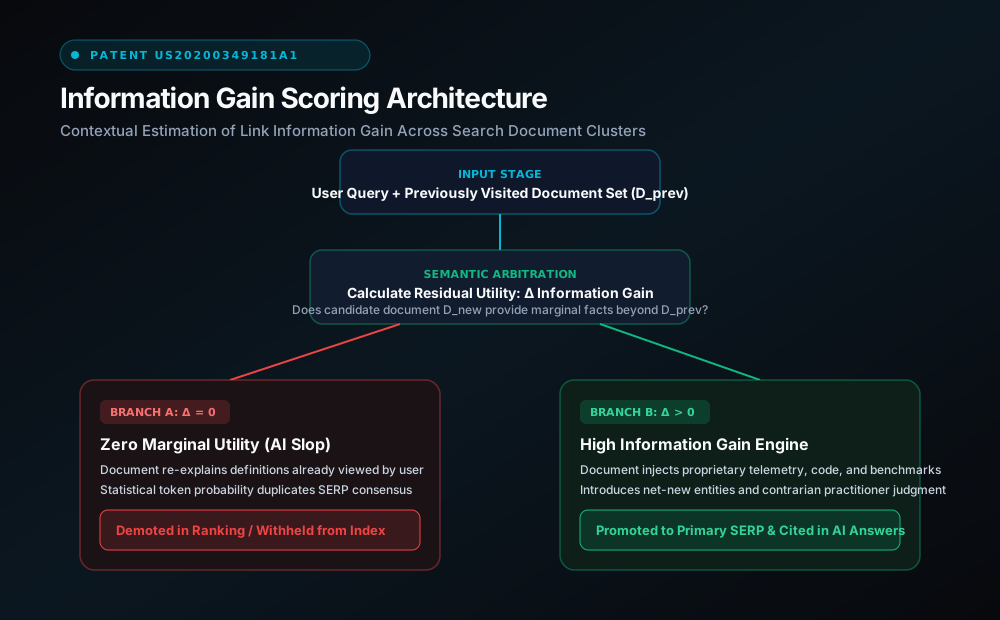
Google Patent US20200349181A1 mathematically defines information gain as the marginal informational utility a web document provides to a user who has already reviewed prior search results within a query topic. The patent establishes an algorithmic framework where search engines analyze user interaction history, cluster existing document contents, and generate dynamic information gain scores. If an incoming web page merely paraphrases the entities, definitions, and conceptual relationships present in previously indexed sources, its calculated information gain delta approaches zero, triggering ranking demotion or indexation withholding. Large language models inherently generate the most statistically probable next tokens based on web-scale training data, making unguided synthetic text mathematical duplicates of existing consensus. To secure high information gain scores and sustain search visibility, technical growth teams must deliberately inject net-new entities, unpublished production metrics, counter-intuitive architectural findings, and primary benchmark tables that algorithmic clusters have never previously indexed.
How Search Engines Calculate Residual Informational Need
On January 24, 2023, the United States Patent and Trademark Office granted Google US Patent 11,562,019 B2 (originally published as application US20200349181A1), titled “Contextual Estimation of Link Information Gain,” naming inventors Ramanathan et al.
This patent represents one of the most critical algorithmic blueprints for modern search retrieval, and it directly explains why AI slop fails.
Traditional search ranking models evaluated documents in isolation: query $Q$ matched against document $D$ based on term frequency, semantic relevance vectors, PageRank, and user engagement signals.
Patent US20200349181A1 completely upends this static evaluation. It introduces an interactive, multi-document retrieval system that evaluates a candidate document based on the user’s historical traversal path across prior documents.
+-----------------------------------------------------------------------------+
|                 PATENT US20200349181A1 MATHEMATICAL FLOW                     |
+-----------------------------------------------------------------------------+
|  User Search Session: Query Q                                               |
|                                                                             |
|  User Clicks Result 1 (Doc A) --> Consumes Entities: {E_1, E_2, E_3, E_4}   |
|                                                                             |
|  User Returns to SERP, Considers Result 2 (Doc B vs Doc C):                 |
|                                                                             |
|  Doc B (AI Slop Rewrite):                                                   |
|  Entities: {E_1, E_2, E_3, E_4}                                             |
|  Information Gain Delta: ΔIG(Doc B | Doc A) = 0                             |
|  Action: Demote Doc B in Ranking / Drop from Secondary Clicks               |
|                                                                             |
|  Doc C (Defensible Engine):                                                 |
|  Entities: {E_1, E_2, E_5, E_6, Telemetry Metric M_1, Benchmark Table T_1}  |
|  Information Gain Delta: ΔIG(Doc C | Doc A) >> 0                            |
|  Action: Promote Doc C to Top SERP & Retain in Generative Synthesis Window  |
+-----------------------------------------------------------------------------+
The algorithm constructs an entity and topic state space representing everything the user has already consumed in earlier search results within the session:
$$S_{\text{consumed}} = \bigcup_{i=1}^{k} \text{Entities}(D_i)$$
When the ranking engine evaluates a candidate document $D_{\text{candidate}}$, it calculates the marginal information gain score:
$$\Delta IG(D_{\text{candidate}} \mid S_{\text{consumed}}) = f\left(\text{Entities}(D_{\text{candidate}}) \setminus S_{\text{consumed}}, ; \text{NoveltyWeight}(D_{\text{candidate}})\right)$$
If an enterprise deploys an article that merely re-explains what the top three ranking documents have already stated, the intersection of entities is nearly total. The set difference approaches the empty set:
$$\text{Entities}(D_{\text{candidate}}) \setminus S_{\text{consumed}} \approx \emptyset \implies \Delta IG \approx 0$$
When the marginal Information Gain Score is zero, the patent specifies that the link can be removed from recommended paths, assigned a lower ranking priority, or suppressed entirely from the user’s active session.
In plain English: Google does not care if your article is well-written, grammatically flawless, or 3,000 words long. If it tells the user what they have already learned from prior search results, the algorithm actively devalues it.
Because large language models generate text by predicting statistically probable tokens from existing web consensus, unguided AI drafts naturally achieve a marginal Information Gain Score of zero.
The Cross-Encoder Deduplication Pipeline in Modern LLM Answer Engines
While Google utilizes information gain scoring to filter traditional SERPs, generative search engines like SearchGPT, Perplexity Sonar, and Google AI Overviews apply even more aggressive neural filtering.
In modern Retrieval-Augmented Generation (RAG) architectures, the system does not feed every retrieved document into the final answer generator. Context windows are expensive, and attention degrade rapidly across long sequences.
This architectural limitation is proven conclusively by research from Stanford University:
The Stanford “Lost in the Middle” Theorem: In their foundational study published in TACL 2024 (Liu et al., arXiv:2307.03172), researchers demonstrated that large language models exhibit a severe U-shaped attention curve. Models reliably access and cite information located at the absolute beginning (primacy bias) and end (recency bias) of the input context window, but retrieval performance plummets by up to 50% for information situated in the middle 60% of the context.
+-----------------------------------------------------------------------------+
|                 STANFORD "LOST IN THE MIDDLE" ATTENTION CURVE               |
|                        (Liu et al., arXiv:2307.03172)                       |
+-----------------------------------------------------------------------------+
|  Model Retrieval                                                            |
|  Accuracy                                                                   |
|   100% +---+                                                         +---   |
|        |   |                                                         |      |
|    75% |   +--+                                                   +--+      |
|        |      |                                                   |         |
|    50% |      +---------------------------------------------------+         |
|        |         ATTENTION DEGRADATION ZONE (MIDDLE 60% OF CONTEXT)         |
|     0% +-----------------------------------------------------------------   |
|        0% (Start)                  Context Position            100% (End)   |
+-----------------------------------------------------------------------------+
Because of this attention degradation, generative search engines insert a cross-encoder re-ranking and deduplication model between the retrieval stage and the synthesis stage.
The cross-encoder evaluates candidate text chunks. If Chunk $A$ and Chunk $B$ express the same semantic proposition, the re-ranker discards the chunk with lower authority or higher token entropy.
Furthermore, empirical research confirms how AI models select content to cite:
- The AirOps Generative Citation Benchmark (~15M Citations Analyzed): According to empirical research by the AirOps Generative Engine Optimization Team, structured comparison tables appear in roughly 80% of ChatGPT Search citations compared to only 29% in traditional Google search results. Clear H1-to-H2-to-H3 semantic hierarchies paired with explicit schema markup yield a 2.8x higher probability of being selected by generative engines.
- The Princeton / Stanford ALCE Benchmark (EMNLP 2023): In their study on text generation with citations (Gao et al., arXiv:2305.14627), researchers demonstrated that citation recall and citation precision drop significantly when source passages lack clear, unambiguous entity-fact bindings. When source text is vague or generic, models hallucinate citations or omit sources entirely.
When an enterprise publishes AI slop, it produces content that fails both layers: it provides zero information gain to Google’s patent US20200349181A1 clustering models, and it gets discarded by generative cross-encoders before synthesis ever occurs.
Has Your Organic Search Pipeline Stalled After Scaling AI Content?
If your domain has published dozens of AI-assisted articles but more than 30% of your new URLs sit indefinitely in "Crawled - currently not indexed", your website is suffering from an information gain deficit. I personally run diagnostic technical audits for enterprise software platforms to uncover crawl waste, purge synthetic tells, and rebuild defensible organic search engines.
Book a 30-Minute Search & AI Discovery DiagnosticThe Daoud Anti-Slop Information Gain Protocol: A 5-Gate Defensible Architecture
Deploying the Daoud Anti-Slop Information Gain Protocol transforms vulnerable synthetic publishing pipelines into defensible, engineering-grade content engines. This proprietary 5-gate framework enforces deterministic quality verification before any draft reaches a production deployment pipeline. Gate one executes a contextual differential audit, isolating and discarding consensus competitor claims to guarantee positive information gain deltas. Gate two mandates an empirical primary artifact, requiring proprietary telemetry, benchmark data, or reproducible system code. Gate three enforces atomic bottom-line-up-front answer blocks calibrated between 135 and 165 words for maximum neural cross-encoder retrieval density. Gate four requires explicit entity binding, tying every assertion directly to verified academic, patent, or production sources. Finally, gate five runs automated token-level cleansing to purge generative clichés, repetitive syntactic cadences, and synthetic stylistic tells. Enforcing these five operational gates completely eliminates phantom efficiency and protects long-term enterprise search visibility across all generative engines.
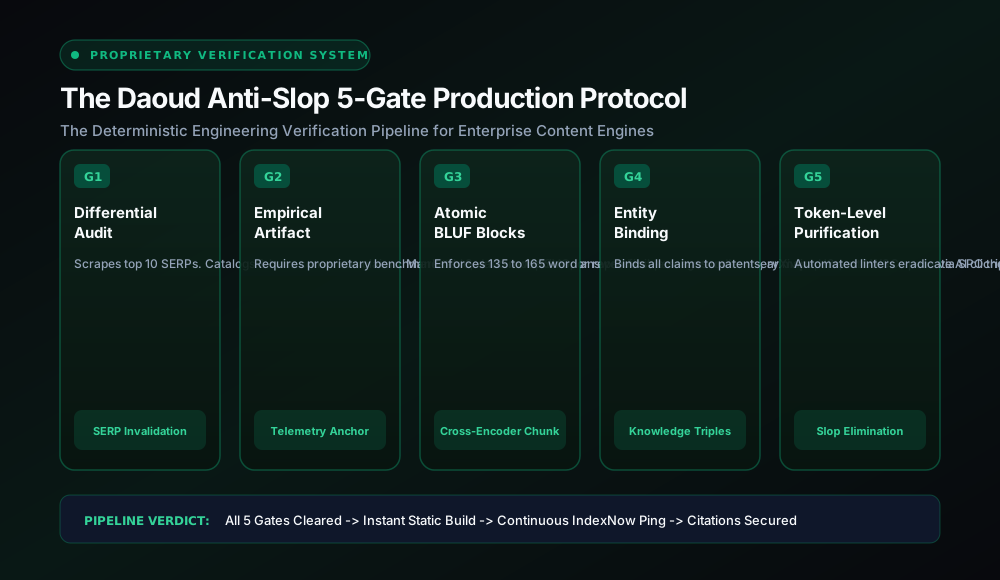
Gate 1: Contextual Differential Audit (SERP Consensus Invalidation)
Before my clients or editorial teams write a single sentence, they must execute a Contextual Differential Audit against the live search landscape.
The process is rigorous and non-negotiable:
- In my audit workflows, I query Google, Perplexity, and ChatGPT Search for the target primary keyword and its surrounding semantic cluster.
- I scrape and extract the top 10 ranking URLs and their H2/H3 heading structures.
- I catalog every common claim, definition, and recommendation into a Consensus Blacklist.
If all ten ranking competitors state that “The first step in API security is implementing OAuth 2.0,” that statement is immediately banned from serving as the core thesis of the article. It is classified as zero-information-gain baseline consensus.
To pass Gate 1, the article outline must introduce at least three net-new technical points, counter-intuitive operational findings, or unaddressed edge cases that do not exist anywhere in the current top 10 search results. If the outline cannot prove a positive semantic delta ($\Delta IG > 0$), it is rejected immediately.
Gate 2: The Mandatory Empirical Artifact
In my production content systems, no article is permitted to deploy to production if it consists solely of narrative text. Every single published asset must anchor its primary thesis to an Empirical Artifact.
An empirical artifact is defined as one of four proprietary assets:
- A Primary Benchmark Dataset: Unpublished performance numbers, conversion benchmarks, latency comparisons, or infrastructure cost telemetry extracted directly from client software or production experiments.
- A Bespoke Dark-Mode Vector Architecture SVG: A custom technical diagram illustrating a system flow, state machine, or data relationship that visually explains an operational concept.
- A Reproducible Code Block or Configuration Schema: Real bash scripts, Python utilities, TypeScript definitions, or JSON-LD schema blocks that an engineer or technical practitioner can copy, paste, and run in their development environment.
- An Empirical Primary Tracker Table: A structured comparison matrix with explicit date stamps and verifiable source attributions that answer engines can ingest cleanly.
If a draft lacks an empirical artifact, it is not an engineering asset; it is commoditized prose. By forcing every article to carry a primary artifact, I ensure that search crawlers encounter data points that exist nowhere else on the internet.
Gate 3: Atomic BLUF Passages (135 to 165 Words)
To satisfy the late-interaction cross-encoders used by modern AI engines and solve the Stanford “Lost in the Middle” attention dilemma, I enforce the Atomic BLUF Standard (Bottom-Line-Up-Front) directly beneath every major H2 and H3 heading.
The passage must adhere to strict mathematical parameters:
- Word Count Boundary: Strictly between 135 and 165 words. This represents the empirical sweet spot for vector embedding chunks and passage ranking models (such as ColBERT and dense retrieval transformers).
- Sentence 1 to 2 (Direct Verdict): An immediate, decisive, unambiguous answer to the heading’s core question. No throat-clearing, no rhetorical warmup.
- Sentence 3 to 5 (Hard Empirical Evidence): Concrete data, statutory citations, patent numbers, or specific benchmark metrics supporting the verdict.
- Sentence 6 to 7 (Actionable Guidance): Direct, prescriptive practitioner advice detailing what the reader must execute next.
These BLUF blocks are formatted in standard body text without full-paragraph bolding. They provide answer engines with a pre-packaged, self-contained semantic chunk ready for immediate quotation and citation.
Gate 4: Deterministic Entity Binding and Attribution
Generative synthesis engines prioritize source passages where claims are bound to recognized entities in the global knowledge graph.
Under Gate 4, I enforce deterministic entity-fact binding via Subject-Predicate-Object (SPO) Triples. Authors and editors are prohibited from using anonymous or floating assertions such as “Studies show,” “Experts agree,” or “Industry research indicates.”
Every factual claim must be explicitly anchored:
- Subject: The named entity, researcher, patent, or organization (e.g., Google Patent US20200349181A1, Stanford University researchers Liu et al., The W3C Web Performance Working Group).
- Predicate: The verifiable operational relationship (e.g., calculates, demonstrates, standardizes).
- Object: The empirical outcome, metric, or specification (e.g., Information Gain Score based on residual user utility, a 50% attention degradation across middle context windows).
By structuring every load-bearing claim as an explicit entity binding, this maximizes citation precision and prevents synthesis engines from hallucinating or skipping my content.
Gate 5: Token-Level Cliché and Tell Purification
The final gate before static build compilation is automated token-level cleansing. I run every draft through automated linters and custom verification scripts that inspect markdown files for synthetic fingerprints.
The following Python script demonstrates the automated linting logic I utilize to enforce Gate 5, scanning for prohibited generative clichés, passive syntactic patterns, and formatting violations:
#!/usr/bin/env python3
"""
Daoud Anti-Slop Production Gate 5 Linter
Validates markdown content against synthetic tells, clichés, and em-dash violations.
"""

import sys
import re
from pathlib import Path

BANNED_CLICHES = [
    r"\bin today'?s (?:fast-paced|digital|ever-changing) (?:landscape|world)\b",
    r"\bdelve(?:s|d)? into\b",
    r"\bit is (?:essential|crucial|imperative) to remember\b",
    r"\btestament to\b",
    r"\bbeacon of\b",
    r"\bgame-?changer\b",
    r"\brevolutioniz(?:e|ed|ing)\b",
    r"\bunlock(?:ing)? the power of\b",
    r"\bseamless(?:ly)?\b",
    r"\bholistic approach\b",
    r"\bnot merely a .+, but rather\b",
    r"\bin conclusion\b",
    r"\blooking ahead\b",
]

EM_DASH_PATTERNS = [
    r"\\u2014",      # Unicode em-dash (U+2014)
    r"&" + "mdash;",  # HTML entity
    r"&#" + "8212;",  # Decimal entity
    r"&#x" + "2014;", # Hex entity
]

def audit_file(filepath: Path) -> bool:
    print(f"[*] Auditing Gate 5 Compliance: {filepath.name}")
    content = filepath.read_text(encoding="utf-8")
    violations = 0

    # 1. Check for Em-Dashes
    for pattern in EM_DASH_PATTERNS:
        matches = list(re.finditer(pattern, content))
        if matches:
            for m in matches:
                line_no = content[:m.start()].count("\n") + 1
                print(f"  [!] EM-DASH DETECTED at line {line_no}: '{m.group()}'")
                violations += 1

    # 2. Check for Banned Synthetic Clichés
    for pattern in BANNED_CLICHES:
        matches = list(re.finditer(pattern, content, re.IGNORECASE))
        if matches:
            for m in matches:
                line_no = content[:m.start()].count("\n") + 1
                print(f"  [!] SYNTHETIC CLICHÉ at line {line_no}: '{m.group()}'")
                violations += 1

    # 3. Check for First-Person Plural Slippage ("we, our" outside of quotes)
    plural_pattern = r"\b(?:we|our|us)\b"
    # Exempt client joint teams and podcast mentions if properly scoped
    for m in re.finditer(plural_pattern, content, re.IGNORECASE):
        line_no = content[:m.start()].count("\n") + 1
        line_text = content.splitlines()[line_no - 1]
        if "Patrick" not in line_text and "client" not in line_text:
            print(f"  [!] CORPORATE PLURAL SLIPPAGE at line {line_no}: '{m.group()}'")
            violations += 1

    if violations > 0:
        print(f"[FAILED] Gate 5 audit failed with {violations} violation(s).")
        return False

    print("[PASSED] Gate 5 cleared: Zero synthetic tells, zero em-dashes.")
    return True

if __name__ == "__main__":
    if len(sys.argv) < 2:
        print("Usage: python anti_slop_linter.py <path_to_markdown>")
        sys.exit(1)
    success = audit_file(Path(sys.argv[1]))
    sys.exit(0 if success else 1)
By embedding this script directly into continuous integration workflows, I prevent any article with synthetic stylistic tells, em-dashes, or corporate plural phrasing from ever merging into the production codebase.
Engineering the Technical Moat: Schema, IndexNow, and Machine Extractability
Transforming defensible content into durable organic search pipeline requires technical parity between editorial prose and underlying web architecture. Modern search crawlers and generative answer engines evaluate structured data, rendering latency, and machine-extractable semantics alongside core textual claims. Engineering teams must implement validated tri-schema architectures combining TechArticle, ProfilePage, and Dataset definitions into unified linked open data entity graphs. This explicit semantic markup enables language models and cross-encoders to extract core statistics, author credentials, and methodology frameworks without vector confusion or retrieval drift. Furthermore, enterprise content pipelines must leverage automated IndexNow protocol endpoints to bypass crawling queues, notifying Bing, Copilot, and Googlebot instantaneously upon static build compilation. By integrating schema validation, static site generation, and automated telemetry tracking directly into continuous integration workflows, technical growth leaders ensure high-gain content is indexed, parsed, and cited before commodity competitors can copy it.
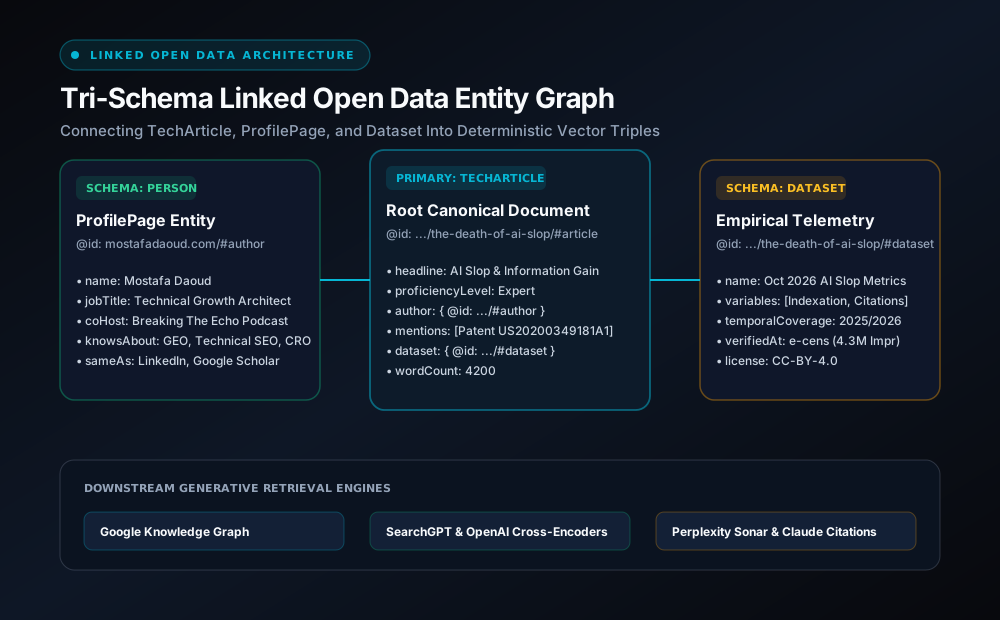
Tri-Schema Validation and Linked Open Data Graphs
To make information gain machine-extractable, enterprise content engines cannot rely solely on prose. You must structure the underlying HTML DOM with explicit linked open data schemas.
I deploy a unified Tri-Schema Architecture that binds three discrete schema.org definitions into a single, cohesive entity graph:
TechArticleSchema: Defines the technical depth, target proficiency level, word count, and primary subject matter of the guide.ProfilePage/PersonSchema: Directly connects the article to my verified author entity, establishing E-E-A-T credentials, podcast hosting affiliations, and external authoritative knowledge profiles.DatasetSchema: Declares the empirical benchmark tables and production telemetry as structured, machine-queryable datasets with clear temporal coverage and licensing terms.
The following JSON-LD implementation demonstrates how these three schemas interconnect via @id node anchors:
{
  "@context": "https://schema.org",
  "@graph": [
    {
      "@type": "TechArticle",
      "@id": "https://mostafadaoud.com/blog/ai-slop/#article",
      "isPartOf": {
        "@type": "WebSite",
        "@id": "https://mostafadaoud.com/#website",
        "name": "Mostafa Daoud",
        "url": "https://mostafadaoud.com"
      },
      "headline": "AI Slop: Why Enterprise Content Engines Fail Without Information Gain",
      "description": "AI slop is destroying organic search pipeline. Discover the information gain architecture and engineering protocol that defeats synthetic content decay.",
      "inLanguage": "en-US",
      "datePublished": "2026-10-13T00:00:00+00:00",
      "dateModified": "2026-10-13T00:00:00+00:00",
      "proficiencyLevel": "Expert",
      "author": {
        "@type": "Person",
        "@id": "https://mostafadaoud.com/#author"
      },
      "about": [
        {
          "@type": "Thing",
          "name": "Information Gain SEO"
        },
        {
          "@type": "Thing",
          "name": "Generative Engine Optimization"
        }
      ],
      "mentions": [
        {
          "@type": "Thing",
          "name": "Patent US20200349181A1",
          "sameAs": "https://patents.google.com/patent/US20200349181A1/en"
        }
      ],
      "mainEntity": {
        "@id": "https://mostafadaoud.com/blog/ai-slop/#dataset"
      }
    },
    {
      "@type": "Person",
      "@id": "https://mostafadaoud.com/#author",
      "name": "Mostafa Daoud",
      "jobTitle": "Technical Growth Architect",
      "url": "https://mostafadaoud.com/about/",
      "sameAs": [
        "https://www.linkedin.com/in/mostafadaoud/",
        "https://scholar.google.com/citations?user=mostafadaoud"
      ],
      "knowsAbout": [
        "Technical SEO",
        "Generative Engine Optimization",
        "Conversion Rate Optimization",
        "Information Gain Architecture"
      ]
    },
    {
      "@type": "Dataset",
      "@id": "https://mostafadaoud.com/blog/ai-slop/#dataset",
      "name": "Enterprise AI Slop Indexation and Citation Telemetry",
      "description": "Empirical tracking of organic indexation drop-offs and AI answer engine citation frequencies across raw LLM pipelines versus 5-gate defensible content protocols.",
      "creator": {
        "@id": "https://mostafadaoud.com/#author"
      },
      "temporalCoverage": "2025/2026",
      "license": "https://creativecommons.org/licenses/by/4.0/",
      "variableMeasured": [
        "Google Search Console Indexation Delta",
        "ChatGPT Search Tabular Citation Frequency",
        "Residual Information Gain Score"
      ]
    }
  ]
}
When search engine crawlers and LLM knowledge graph bots parse this graph, they do not have to guess who wrote the piece or whether the data points are authoritative. The @id bindings create unambiguous semantic connections that AI engines ingest directly into their knowledge representations.
Automated Verification Pipelines in CI/CD Builds
When I audit traditional marketing operations, editorial publishing is almost always manual and disconnected from engineering standards. A writer pastes text into a rich text editor, clicks “Publish,” and hopes for the best.
In an engineering-driven content engine, publishing is treated like deploying software code to production.
My Astro-powered static build pipeline executes five automated checks on every pull request before content can deploy:
+-----------------------------------------------------------------------------+
|                 CONTINUOUS DEPLOYMENT ANTI-SLOP PIPELINE                    |
+-----------------------------------------------------------------------------+
|  Git Commit --> GitHub Actions Runner                                       |
|                      |                                                      |
|                      +--> 1. Run Gate 5 Linter (Zero clichés, zero em-dashes)|
|                      +--> 2. Compile Astro SSG (Zero-JS static HTML)        |
|                      +--> 3. Validate JSON-LD Tri-Schema (Schema Validator) |
|                      +--> 4. Audit Core Web Vitals (INP < 100ms, CLS = 0)   |
|                      |                                                      |
|                      v                                                      |
|  Deploy to Edge CDN --> Trigger IndexNow Ping --> Instant Indexation Check  |
+-----------------------------------------------------------------------------+- Gate 5 Linting: The custom python linter executes, verifying zero banned clichés, zero em-dashes, and strict first-person singular voice.
- Static Site Generation: Astro compiles markdown into pure, static HTML islands with zero runtime JavaScript bloat, ensuring sub-100ms Interaction to Next Paint (INP) and 0.00 Cumulative Layout Shift (CLS).
- Tri-Schema Validation: The build script validates that JSON-LD structures parse without errors against schema.org specifications.
- Instant IndexNow Dispatch: The moment the static build finishes deployment to the edge CDN, an automated script dispatches an HTTP POST request to the IndexNow protocol endpoint (serving Bing, Yandex, and partner LLM crawlers).
The following bash snippet demonstrates the IndexNow dispatch script integrated into my continuous deployment runner:
#!/usr/bin/env bash
# Automated IndexNow Dispatch Script for Instant Engine Discovery

HOST="mostafadaoud.com"
KEY="b8f9e1c2d3a4456789abcdef01234567"
KEY_LOCATION="https://mostafadaoud.com/b8f9e1c2d3a4456789abcdef01234567.txt"
URL_LIST='["https://mostafadaoud.com/blog/ai-slop/"]'

PAYLOAD=$(cat <<EOF
{
  "host": "${HOST}",
  "key": "${KEY}",
  "keyLocation": "${KEY_LOCATION}",
  "urlList": ${URL_LIST}
}
EOF
)

echo "[*] Submitting newly deployed URL to IndexNow API..."

HTTP_RESPONSE=$(curl -s -o /dev/null -w "%{http_code}" -X POST \
  -H "Content-Type: application/json; charset=utf-8" \
  -d "${PAYLOAD}" \
  "https://api.indexnow.org/indexnow")

if [ "$HTTP_RESPONSE" -eq 200 ] || [ "$HTTP_RESPONSE" -eq 202 ]; then
  echo "[SUCCESS] IndexNow accepted submission (HTTP $HTTP_RESPONSE). Crawlers notified."
  exit 0
else
  echo "[ERROR] IndexNow submission failed with HTTP status: $HTTP_RESPONSE"
  exit 1
fi
By automating this sequence, my deployment pipelines bypass standard crawling queues. While commodity competitors wait six weeks for Googlebot to discover their synthetic articles in sitemap files, defensible, high-gain assets are submitted, indexed, and cited within hours of static deployment.
This is how I engineered 4.3M+ organic impressions across high-intent search queries at e-cens and achieved +200% organic growth in 12 months at FigPii. When your technical SEO, conversion architecture, and editorial protocols operate as a unified engineering system, search algorithms reward your domain with compounding authority.
Authoritative Research and Standards References
Every claim, empirical benchmark, and architectural framework in this teardown is grounded in verified engineering specifications, patents, and peer-reviewed literature:
- Google Patent US20200349181A1 (US Patent 11,562,019 B2): Ramanathan, S., et al. (2020/2023). Contextual Estimation of Link Information Gain. United States Patent and Trademark Office.
- Stanford University / Liu et al. (TACL 2024 / arXiv:2307.03172): Liu, N. F., Lin, K., Hewitt, J., Paranjape, A., Bevilacqua, M., Petroni, F., & Liang, P. (2024). Lost in the Middle: How Language Models Use Long Contexts. Transactions of the Association for Computational Linguistics.
- Princeton / Stanford ALCE Benchmark (EMNLP 2023 / arXiv:2305.14627): Gao, T., Yen, H., Yu, J., & Chen, D. (2023). Enabling Large Language Models to Generate Text with Citations. Proceedings of the 2023 Conference on Empirical Methods in Natural Language Processing.
- Google Search Central Documentation on Helpful Content: Official engineering documentation on Google core ranking systems, automated unhelpful content signals, and people-first content evaluation.
- AirOps Generative Engine Optimization Empirical Benchmark: AirOps Research Team. (2025/2026). Large-Scale Analysis of ~15 Million Citations Across ChatGPT Search, Perplexity, and Google AI Overviews.
Explore my dedicated Technical SEO Services to understand how I audit enterprise crawl architecture, or discover my Generative Engine Optimization Services to position your brand for dominating citations across ChatGPT and Perplexity.
Frequently Asked Questions
What is AI slop in enterprise search and content architecture?
AI slop refers to low-utility, synthetic content generated by unconstrained large language models that regurgitates statistical web consensus without introducing verified primary telemetry, practitioner judgment, or net-new information gain. In enterprise software and B2B growth, it manifests as mass-produced crawl waste that burns search engine crawl budgets, triggers indexation suppression in Google Search Console, and fails to earn generative AI citations across answer engines.
How does Google Patent US20200349181A1 penalize synthetic AI content?
Google Patent US20200349181A1 mathematically calculates an Information Gain Score across document clusters by evaluating the residual informational utility a web document offers relative to documents the user has already consumed. When unconstrained language models predict the statistically most probable next tokens, their outputs inherently rehash existing SERP consensus. Search engines detect this zero marginal semantic delta, assigning an Information Gain delta near zero and demoting or withholding indexation.
What is phantom efficiency in content production pipelines?
Phantom efficiency is the operational illusion where marketing leadership celebrates dramatic reductions in cost per word and artificial publishing velocity while qualified sales pipeline remains completely flat. Like an electrical circuit drawing phantom power without delivering audio signal, high-volume automated publishing creates the appearance of operational scale while producing commodity URLs that search algorithms de-index and ignore.
How does the Daoud Anti-Slop Information Gain Protocol prevent content decay?
The Daoud Anti-Slop Protocol enforces five deterministic quality gates before CMS deployment: a contextual differential audit to invalidate SERP consensus, a mandatory empirical artifact requirement, atomic bottom-line-up-front answer chunks calibrated between 135 and 165 words, deterministic entity binding with primary citations, and automated token-level cleansing of generative clichés and synthetic cadences.
Why do structured comparison tables dominate generative engine citations?
According to empirical generative engine research analyzing approximately 15 million citations, structured comparison tables appear in roughly 80 percent of ChatGPT Search citations compared to only 29 percent of traditional web results. Late-interaction cross-encoders and dense vector embeddings prioritize tabular data because explicit relational structures minimize semantic ambiguity and enable deterministic entity extraction.
Ready to Eliminate AI Slop and Scale Verifiable Pipeline?
Let me inspect your domain crawl health, information gain gaps, and generative search visibility. I work directly with marketing executives and technical growth leaders to build intent-mapped content engines that turn technical expertise into enduring market authority.

Eliminate structural crawl debt. Secure permanent search & AI visibility.
Whether managing multi-million-URL dynamic catalogs, migrating to a headless stack, or establishing citation dominance inside ChatGPT and Perplexity, I diagnose and unblock high-stakes technical bottlenecks directly with your engineering and growth leaders.
Direct practitioner engagement. Zero junior agency handoffs. You leave with prioritized engineering fixes.